
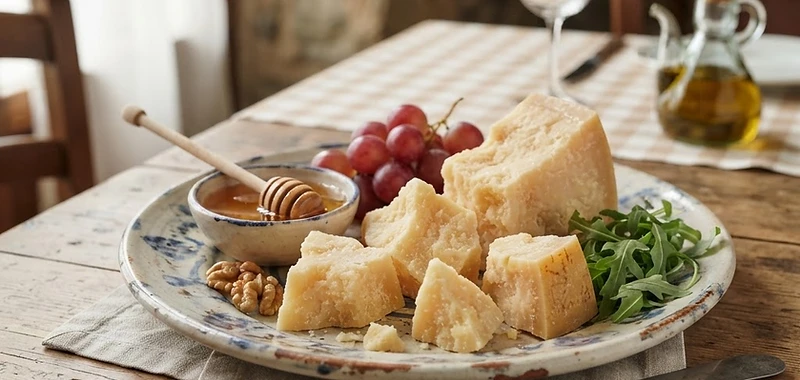
The Verdict
Parmigiano's less famous, less expensive, slightly less complex sibling. Made similarly (skimmed milk, aged) but across a wider zone (Lombardy, Veneto, Emilia, Piedmont, Trentino) and with fewer restrictions. The 16-month version is the workhorse of Italian cooking; the 24-month is a genuinely fine cheese. If you can't get Parmigiano, Grana is the answer — and it's cheaper because the zone is bigger, not because it's bad.
Why go
To understand the difference between Grana and Parmigiano — which most people can't explain.
The Field Guide take
Grana Padano is the primary hard cheese of the Po Valley. Often overshadowed by its more famous neighbor, Parmigiano-Reggiano, Grana Padano is a distinct product with a massive geographical footprint and a vital role in Italian domestic life. It is not a secondary substitute, but rather a functional, durable, and reliable cheese that serves as the backbone of Lombard cuisine.
What it is
Grana Padano is a semi-fat, hard, cooked, and slow-ripened cheese. The name grana refers to its granular texture, while Padano denotes its origin in the Po River valley. Unlike Parmigiano, which is restricted to a very specific set of provinces, the production zone for Grana Padano spans five regions: Lombardy, Veneto, Emilia-Romagna, Piedmont, and Trentino-Alto Adige. Because the production area is larger and the regulatory requirements regarding cattle feed are less restrictive, it is produced in higher volumes and is generally more affordable.
Origin and history
The history of Grana Padano dates back to the 12th century. It originated in the Chiaravalle Abbey near Milan, where Cistercian monks sought a way to preserve the surplus milk produced by their dairy cows. By heating the milk and removing the whey, they created a stable, long-lasting cheese that could be stored and traded. Over the centuries, the method spread throughout the Po Valley, becoming the staple protein and flavor profile for the region’s agrarian communities.
How it’s made
The production process relies on copper vats and partially skimmed cow’s milk. The milk is sourced from two daily milkings, allowed to rest, and then skimmed. A key technical differentiator in Grana Padano production is the use of lysozyme—a natural protein derived from egg whites. This additive is used to prevent the development of unwanted bacteria during the long aging process. The curds are cooked, molded, and then placed in brine for several weeks before entering the aging cellar. The minimum aging period is nine months, though most commercial Grana hits the market after 16 to 20 months.
Where to eat it
In Lombardy, you will find Grana Padano used as a structural ingredient in almost every household and trattoria. In Milan and the surrounding rural plains, it is shaved into salads, grated over risotto, and served as a standard table cheese alongside bread. Because of its vast production zone, you do not need to seek out a specific farm to find a high-quality wedge; the Consorzio for Grana Padano maintains consistent standards across the Po Valley. Look for the fire-branded marking on the rind to ensure it has passed the official quality inspections.
When and how
Grana Padano is a year-round cheese. When selecting a piece, consider the age. At 16 months, the cheese is buttery, light in color, and possesses a subtle, lactic sweetness; this is the ideal version for cooking or for everyday snacking. If you seek more complexity, look for the Riserva or versions aged 24 months or longer. At this stage, the texture becomes more crystalline and the flavor profile develops deeper notes of toasted nuts and savory richness. It is a workhorse—use it to provide salinity to a vegetable soup or to finish a plate of pasta, but do not hesitate to eat it on its own.
What to drink with it
Because Grana Padano is a versatile, salty, and savory cheese, it benefits from wines that have enough acidity to cleanse the palate. In Lombardy, the traditional pairing is Franciacorta. The sparkling, high-acid profile of these wines cuts through the fat of the cheese and balances the lactic notes found in younger wheels. If you prefer a still wine, a crisp, mineral-forward white or a light, acidic red—such as those from the Oltrepò Pavese—will complement the flavor without overpowering it. When served as an appetizer or at the end of a meal, a drizzle of local acacia or chestnut honey provides a necessary contrast to the cheese’s inherent saltiness.
The Story
Where Grana Padano comes from
Grana Padano is the daily cheese of the Po Valley, having been produced since the 12th century by monks looking to preserve surplus milk. While similar to Parmigiano, it covers a much wider production area and is slightly more approachable in its youth. It is a workhorse cheese, essential to Italian cooking as both a table staple and a structural ingredient.
What Defines It
Signature ingredients
Partially skimmed milk
Provides the characteristic flavor that is milder and less grassy than its more famous counterpart.
Lysozyme
An egg-derived protein used to prevent fermentation defects during the long aging process.
The Method
How it's made
The milk is heated in large copper cauldrons, separated, and then molded. It requires a shorter minimum aging period than Parmigiano, resulting in a slightly softer texture and more lactic, buttery profile.
Timing
When to eat it
Year-round.
Serve With
Classic pairings
Franciacorta
wineA classic sparkling wine that balances the saltiness of the cheese with refined bubbles.
Honey
foodAdds a necessary floral sweetness to elevate the milder notes of the cheese.
What makes it worth going
The other great hard Italian cheese — aged cow's milk, from a broader zone across the Po Valley.
Things to do
- producer
A Grana Padano cellar (e.g. Cremona, Piacenza, or Lodi)
The home of Grana Padano, in the Po valley. The wheels are aged for 9-24 months; the cellar is the show. Visit a producer; book ahead.
1.5 hrs
- latteria
A Milan latteria
In the city, for Grana Padano without the drive. The grating cheese and the table cheese; the age is the difference.
1 hr
- trattoria
A Lombard restaurant for risotto or pasta
The Grana Padano is the finish of the risotto and the pasta; the grating cheese is the table.
2 hrs
- experience
A cheese-tasting at different ages
The Grana Padano changes by age: 9-16 months (mezzano), 16-24 (oltre 16 mesi), 24+ (riserva). The tasting is the age.
Eat
- cheese
Grana Padano (giovane, 9-16 months)
The younger version; the paste is softer, the flavor is milder. The table cheese for everyday.
- cheese
Grana Padano (oltre 16 mesi or riserva)
The aged version; the paste is crumbly, the flavor is sharper. The grating cheese and the table cheese for the connoisseur.
- use
Grated over risotto or pasta
The classic use; the grating cheese of the north. The finish of the risotto alla milanese and the pasta.
Stay
- neighborhood
Milan center
The urban base, with good latterias and restaurants. Walkable.
- city
Cremona, Lodi, or Piacenza
At the source, in the Po valley. A car is required.
Experiences Worth Booking
Grana Padano cellar visit and tasting
2 hrsThe wheels, the aging cellar, the tasting at different ages. The cellar is the show.
The Grana Padano is aged in giant cellars; a visit shows you the wheels and the age.
Suits: Cheese lovers who want the grating cheese at its source.
Po valley cheese day
full dayA Grana Padano cellar, a gorgonzola producer, a culatello tasting. The full Po valley arc.
The Grana Padano, the gorgonzola, and the culatello are the Po valley's three gifts; a day covers all.
Suits: Cheese travelers with a day for the valley.
What's nearby & pairs with
More food from Lombardia
Dish
Risotto alla Milanese
Saffron risotto from Milan — the dish that made saffron the flavor of northern Italian rice.
Dish
Cotoletta alla Milanese
Breaded veal cutlet, fried in butter — Milan's answer to the Wiener Schnitzel, or its predecessor.
Dish
Ossobuco
Braised veal shanks with the marrow bone — slow-cooked until the meat falls, served with gremolata.
Cheese
Gorgonzola
Italy's great blue cheese — cow's milk, veined with Penicillium, in two styles: sweet (dolce) and sharp (piccante).
Cheese
Taleggio
Washed-rind cow's milk cheese from the Val Taleggio — soft, pungent, and one of Italy's best table cheeses.
Cured Meat
Bresaola della Valtellina
Air-dried, salt-cured beef from the Valtellina valley — lean, ruby-red, and Italy's answer to bresaola.
Ready to plan?
Ready to turn discovery into a trip?
Italy Field Guide helps you decide where to go. When you're ready to build the actual day-by-day itinerary, take your saved places to Travel Itinerary Co — your interests go with you.
Turn your saved Italy places into a trip