The Verdict
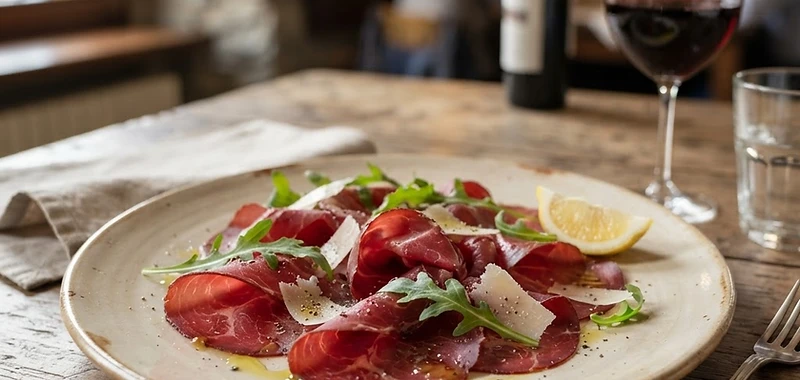
The lean cured meat, for when you can't face pork. Beef (usually from the underleg), salted and air-dried in the Valtellina valley for 2-3 months, with spices and wine. Sliced thin, ruby-red, lean, and tender. Eaten with olive oil, lemon, and black pepper, or with arugola and Parmigiano. The PGI zone is the Valtellina, in the Lombard Alps north of Lake Como.
Why go
To taste Italy's great cured beef — lean, elegant, and made for summer.
The Field Guide take
Bresaola della Valtellina stands apart in the Italian landscape of cured meats, which is overwhelmingly defined by pork. In the high, alpine reaches of Lombardia, the climate dictates a different approach to preservation. Here, the focus is on beef, resulting in a product that is lean, intensely savory, and firm in texture. It is a defining product of the Sondrio province, reflecting the environmental constraints and long-standing pastoral traditions of the Valtellina valley.
What it is
Bresaola della Valtellina is an air-dried, salt-cured beef. Unlike salami or prosciutto, which rely on the intermuscular fat of pigs, Bresaola is produced from the leanest cuts of cattle—typically the topside, or fesa. When properly prepared, it is deep ruby red in color, uniform in texture, and sliced to a translucent thinness. It lacks the buttery, melting quality of pork fat, offering instead a clean, muscular chew and a concentrated, savory flavor that speaks to its mountain origins.
Origin and history
The history of Bresaola is rooted in the specific geography of the Valtellina, a long, east-west valley in the Lombard Alps. Historically, this high-altitude environment was well-suited for raising cattle, but the isolation of the valley necessitated techniques for preserving protein through long, harsh winters. While most of Italy leaned into the curing of pork, the mountain communities of Sondrio refined the process of salting and air-drying beef. The valley’s unique microclimate—defined by dry, bracing air moving through the mountain passes—created the conditions necessary to cure the beef without it spoiling. It remained a localized staple for centuries before gaining broader recognition as a significant Italian export.
How it's made
The production of Bresaola follows a strict set of procedures mandated by its PGI (Protected Geographical Indication) status, which restricts production to the Valtellina valley. The process begins with the selection of high-quality beef cuts, which are trimmed of all external fat and connective tissue. The meat is dry-salted, often with a mix of sea salt, black pepper, and sometimes local herbs or a splash of wine, depending on the specific producer's tradition.
The meat is left to rest for a period of ten to fifteen days, during which time it is turned to ensure even curing. Following this, the meat is rinsed, stuffed into a natural or synthetic casing, and moved to drying chambers. This is the most critical stage: the temperature and humidity are carefully controlled to mimic the natural alpine air. The drying period typically lasts between two and three months. The reduction in water content is what gives the meat its characteristic density and deep color.
Where to eat it
If you are seeking Bresaola, the Valtellina valley is the only place to experience it at the source. Travelers should head to towns like Sondrio, Tirano, or Morbegno. The meat is found in butcher shops and small restaurants throughout the province, where it is often featured as an antipasto. While Bresaola is now available globally, purchasing it in the Valtellina ensures you are getting product cured in the valley’s specific climate, which remains the benchmark for the style.
When and how
Bresaola is available year-round, as the drying process creates a shelf-stable product. It is traditionally served sliced paper-thin. In a domestic or casual setting, it is frequently arranged on a plate with a drizzle of high-quality extra virgin olive oil, a squeeze of lemon, and a dusting of cracked black pepper. Another common preparation involves a bed of fresh arugula topped with shaved Parmigiano-Reggiano, which provides the necessary acidity and depth to balance the lean, salty beef. It is not a heavy meat; it is designed for lighter lunches or as an appetizer.
What to drink with it
Because Bresaola is a product of the Valtellina, it is best paired with the wines grown on the valley's steep, terraced slopes. The most iconic pairing is Sforzato di Valtellina (or Sfursat). This is a powerful, dry red wine made from Nebbiolo grapes that have been partially dried, similar to the process used for Amarone. The complexity and structure of Sforzato stand up well to the concentrated, savory profile of the beef. If you prefer something lighter, a standard Valtellina Superiore, also made from Nebbiolo, provides the necessary tannins and bright red-fruit notes to complement the leanness of the meat.
The Story
Where Bresaola della Valtellina comes from
Bresaola della Valtellina is an outlier in Italy, where pork dominates the cured meat landscape. This beef product originates from the cold, dry climate of the Valtellina valley, where it has been crafted for centuries. It is prized for being exceptionally lean and intense in flavor, making it a staple of healthy, lighter Italian meals.
What Defines It
Signature ingredients
Beef topside
The leanest, highest quality cut is chosen for its consistent texture and ability to cure evenly.
Mountain herbs
Traditional additions to the salt rub that imbue the beef with a subtle, mountain-grown complexity.
The Method
How it's made
The beef is rubbed with salt, pepper, and herbs, then left to cure and air-dry in the cold mountain climate. The result is a ruby-red, firm meat that is sliced paper-thin.
Timing
When to eat it
Year-round.
Serve With
Classic pairings
Sforzato di Valtellina
wineA powerful red made from dried grapes that stands up to the concentrated beef flavor.
Arugula and Parmigiano
foodA classic serving method; the pepperiness of the greens balances the beef perfectly.
What makes it worth going
Air-dried, salt-cured beef from the Valtellina valley — lean, ruby-red, and Italy's answer to bresaola.
Things to do
- producer
A bresaola producer in the Valtellina
The home of the bresaola, in the alpine valley north of Milan. The cure is the mountain air; the age is the taste. Visit a producer; book ahead.
1.5 hrs
- trattoria
A Valtellina restaurant for bresaola al pizzocchero
The bresaola is the starter; the pizzocchero (buckwheat pasta) is the main. The Valtellina table is the context.
2 hrs
- experience
A bresaola-tasting with arugula and grana
The classic plate: thin bresaola slices, arugula, lemon, oil, and grana. The plate is the dish.
1 hr
- experience
A Valtellina wine cellar
The Valtellina is the Nebbiolo valley (the 'Inferno', 'Sforzato', 'Grumello'). The bresaola and the Nebbiolo are the pairing.
Eat
- cured_meat
Bresaola della Valtellina IGP
The classic: air-cured, salted beef, from the Valtellina, in the Alps. The cure is the mountain air; the color is deep red. Sliced thin, with arugula, lemon, oil, and grana.
- dish
Bresaola al pizzocchero
The bresaola as a starter, followed by the pizzocchero (buckwheat pasta with potatoes, cabbage, and bitto cheese). The Valtellina pairing.
- wine
A glass of Sforzato or Grumello
The Valtellina Nebbiolo; the correct pairing for the cured beef.
Stay
- city
Sondrio or Tirano
The Valtellina bases, with good producers and restaurants. A car is useful.
- rural
A Valtellina alpine village
In the valley, where the bresaola is cured. A car is required.
Experiences Worth Booking
Bresaola producer visit and tasting
2 hrsThe cure, the mountain air, the age, the tasting. The alpine air is the context.
The bresaola is an air-cure; a producer visit shows you the salt, the air, and the age.
Suits: Cured-meat lovers who want the bresaola at its source.
Valtellina food and wine day
full dayA bresaola tasting, a pizzocchero lunch, a Nebbiolo cellar. The full Valtellina arc.
The bresaola, the pizzocchero, and the Nebbiolo are the Valtellina trinity; a day covers all.
Suits: Food and wine travelers with a day for the valley.
What's nearby & pairs with
More food from Lombardia
Dish
Risotto alla Milanese
Saffron risotto from Milan — the dish that made saffron the flavor of northern Italian rice.
Dish
Cotoletta alla Milanese
Breaded veal cutlet, fried in butter — Milan's answer to the Wiener Schnitzel, or its predecessor.
Dish
Ossobuco
Braised veal shanks with the marrow bone — slow-cooked until the meat falls, served with gremolata.
Cheese
Grana Padano
The other great hard Italian cheese — aged cow's milk, from a broader zone across the Po Valley.
Cheese
Gorgonzola
Italy's great blue cheese — cow's milk, veined with Penicillium, in two styles: sweet (dolce) and sharp (piccante).
Cheese
Taleggio
Washed-rind cow's milk cheese from the Val Taleggio — soft, pungent, and one of Italy's best table cheeses.
Ready to plan?
Ready to turn discovery into a trip?
Italy Field Guide helps you decide where to go. When you're ready to build the actual day-by-day itinerary, take your saved places to Travel Itinerary Co — your interests go with you.
Turn your saved Italy places into a trip