The Verdict
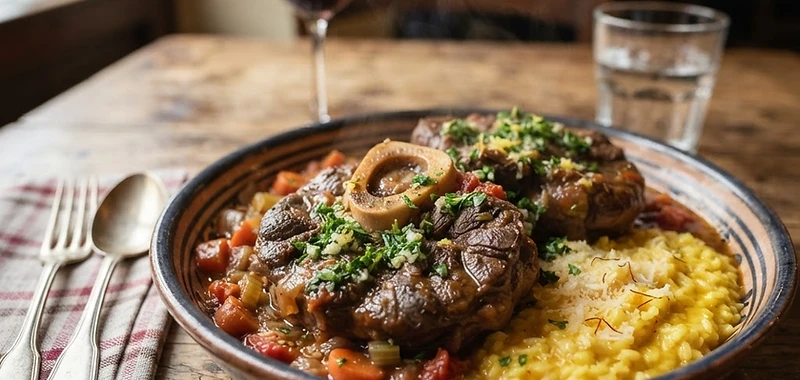
Cross-cut veal shanks braised with vegetables, white wine, and broth until the meat collapses and the marrow in the bone center turns to butter. Served with a gremolata of lemon zest, garlic, and parsley to cut the richness. The correct pairing is risotto alla Milanese. It's the cold-weather dish of Milan, and a reason to go in winter.
Why go
To eat the marrow from the bone — the luxury cut, braised until it melts.
The Field Guide take
Ossobuco is the definitive braised dish of Milan. It is a preparation of cross-cut veal shanks, braised slowly until the connective tissue breaks down and the meat yields to the fork. At its center, the marrow bone serves as the focal point of the dish, providing a rich, fatty intensity that defines the experience. It is a winter meal, suited for the fog and cold of the Lombard plain, and it remains a cornerstone of the city’s culinary identity.
Defining the dish
The name ossobuco translates literally to "bone with a hole," referring to the cross-section of the shank that exposes the marrow. Unlike other braises that rely on toughness or long-aging, ossobuco focuses on the veal shank—a cut valued for the balance of lean meat, connective tissue, and the central marrow bone. When prepared correctly, the meat should be succulent and the marrow should have reached a near-liquid, buttery consistency. It is almost always finished with gremolata, a finely minced mixture of lemon zest, garlic, and flat-leaf parsley, which provides the necessary acidity and aromatic lift to balance the weight of the braised veal.
Historical context
Ossobuco is deeply rooted in the domestic cooking traditions of Lombardy. Historically, the marrow bone was considered a luxury, and the preparation reflects a time when nothing from the animal was discarded. While its exact origins are debated by historians—some trace early versions to the 18th century—the dish stabilized into its current form in Milan over the course of the 19th and 20th centuries. It transitioned from a home-kitchen staple to a fixture of the classic Milanese trattoria, where it became inseparable from the city’s other great contribution to the table: risotto alla Milanese.
The preparation
The technique is one of patience. The shanks are first dredged in flour and seared to create a crust. They are then placed in a heavy pot with a soffritto—a base of sautéed onions, carrots, and celery—and deglazed with white wine. The braise continues with broth, often veal or beef, over low heat for several hours. The goal is not to cook the meat until it is dry, but to reach the point where the collagen has fully rendered into gelatin. The gremolata is strictly added in the final moments of cooking or just before serving; if cooked too long, the fresh, volatile oils of the parsley and lemon zest dissipate, losing their function as a sharp counterpoint to the deep, savory fats of the bone.
Where and how to find it
To eat ossobuco as it is intended, head to the traditional trattorie in Milan and the surrounding Lombard towns. You will find the best versions in establishments that maintain a consistent menu of regional classics rather than those attempting modern reinterpretations.
In Milan, the dish is almost exclusively served with risotto alla Milanese—saffron-infused risotto that acts as a bed for the shank. In the broader region, particularly as one moves toward the foothills or into more rustic territory, you may find it served alongside soft, buttery polenta. If you are ordering in a city restaurant, clarify if the kitchen prepares it in bianco (without tomatoes) or with a tomato-based sauce; the former is the older, more traditional preparation, though both are common.
When to order
Ossobuco is a seasonal dish. It is heavy, rich, and designed for cold weather. Seeking it out in July or August is not recommended, as it is inconsistent with the local rhythm of produce and climate. It is a dish for the winter months, best enjoyed after a day spent in the damp cold of a northern Italian city.
Pairing the meal
Because the dish is built on richness and the acidity of the gremolata, it requires a wine with enough structure to hold its own. While the classic pairing in many dining guides is a bold Barolo from neighboring Piemonte, a sturdy red from the Valtellina region of Lombardy, such as a Nebbiolo-based Sforzato, is an excellent alternative. The high tannins and bright acidity of these wines cut through the marrow’s intensity, cleansing the palate between bites. Avoid lighter wines, which will be completely overwhelmed by the texture of the veal and the density of the marrow.
The Story
Where Ossobuco comes from
Ossobuco, literally 'bone with a hole,' is the signature braised dish of Lombardy. It focuses on the marrow bone, which was long considered the most prized part of the veal. It is a slow, patient dish that exemplifies the classic Northern Italian love for tender, braised meats.
What Defines It
Signature ingredients
Veal shank
Contains the marrow-rich bone and tough connective tissue that melts.
Gremolata
A mix of lemon zest, garlic, and parsley that brightens the heavy stew.
White wine
Used to deglaze the pan and add a necessary acidic edge.
The Method
How it's made
The shanks are seared, then braised for hours in wine and broth. The gremolata is added only at the very end to provide a fresh, aromatic hit to the final dish.
Timing
When to eat it
Winter months
Serve With
Classic pairings
Barolo
wineA bold, tannic red that complements the rich, fatty marrow.
Polenta
foodThe creamy base that soaks up the braising liquid.
What makes it worth going
Braised veal shanks with the marrow bone — slow-cooked until the meat falls, served with gremolata.
Things to do
- trattoria
Trattoria Masuelli San Marco
The benchmark ossobuco, since 1921. The veal shank is braised with the marrow; the gremolada is the finish. Reserve.
2 hrs
- trattoria
Antica Trattoria della Pesa
The most traditional; the ossobuco is with polenta or risotto. The cotoletta is the rival.
2 hrs
- ristorante
Ratanà
The modern version; the ossobuco is refined, the polenta is from Valtellina. Reserve.
2 hrs
- latteria
A Milanese latteria (e.g. Latteria San Marco)
A small latteria with a few tables. The ossobuco is by the portion, slow-cooked. Book ahead.
Eat
- main
Ossobuco con gremolada
The benchmark: veal shank, braised with vegetables, white wine, and broth, finished with gremolada (lemon zest, garlic, parsley). The marrow is the luxury; eat it with a spoon.
- side
Polenta
The classic accompaniment; soft polenta, with the braising juices.
- risotto
Risotto alla milanese
The alternative accompaniment; the saffron risotto with the ossobuco is the full Milanese plate.
Stay
- neighborhood
Brera
Near Masuelli and the best Milanese trattorias. Walkable and central.
- neighborhood
Porta Garibaldi
Near Antica Trattoria della Pesa and Ratanà. The new Milan.
Experiences Worth Booking
Milanese braising class
4 hrsThe ossobuco, the braise, the gremolada, the polenta. The slow cook is the secret.
The ossobuco is a 3-hour braise; a class shows you the sear, the deglaze, the simmer.
Suits: Home cooks who want the braise; the time and the temperature are the technique.
Milanese classics day
full dayOssobuco for lunch, cotoletta for dinner, risotto in between. The full Milanese trio.
The three are Milan's meat gifts; a day covers them, with the city in between.
Suits: Meat lovers with one day for Milan's classics.
What's nearby & pairs with
More food from Lombardia
Dish
Risotto alla Milanese
Saffron risotto from Milan — the dish that made saffron the flavor of northern Italian rice.
Dish
Cotoletta alla Milanese
Breaded veal cutlet, fried in butter — Milan's answer to the Wiener Schnitzel, or its predecessor.
Cheese
Grana Padano
The other great hard Italian cheese — aged cow's milk, from a broader zone across the Po Valley.
Cheese
Gorgonzola
Italy's great blue cheese — cow's milk, veined with Penicillium, in two styles: sweet (dolce) and sharp (piccante).
Cheese
Taleggio
Washed-rind cow's milk cheese from the Val Taleggio — soft, pungent, and one of Italy's best table cheeses.
Cured Meat
Bresaola della Valtellina
Air-dried, salt-cured beef from the Valtellina valley — lean, ruby-red, and Italy's answer to bresaola.
Ready to plan?
Ready to turn discovery into a trip?
Italy Field Guide helps you decide where to go. When you're ready to build the actual day-by-day itinerary, take your saved places to Travel Itinerary Co — your interests go with you.
Turn your saved Italy places into a trip