The Verdict
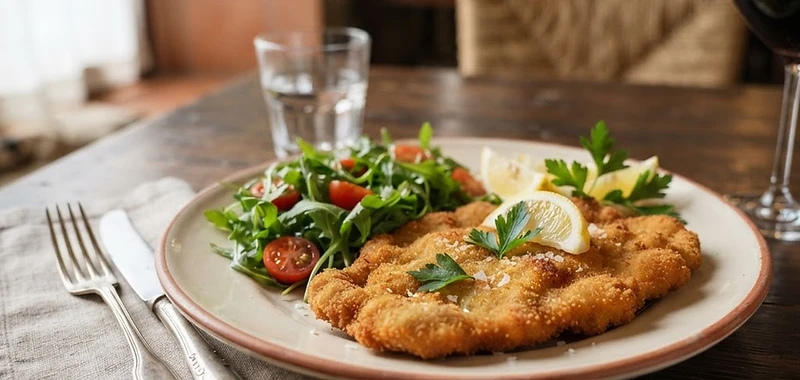
A bone-in veal cutlet, pounded thin, dipped in egg and breadcrumbs, and fried in butter — not oil. The Milanese version includes the bone (and is thicker) than the Viennese; the dispute over who invented it is endless. Crisp, buttery, and the dish that defines Milanese meat cookery. Eat it with risotto or rocket and tomato.
Why go
To settle the schnitzel question for yourself — in Milan, with butter.
The Field Guide take
In the culinary geography of Lombardy, the cotoletta alla Milanese occupies the center of the plate. It is a dish of straightforward engineering: a bone-in veal chop, breaded and fried in butter. While the debate regarding its ancestry—specifically its relationship to the Austrian Wiener Schnitzel—continues, the Milanese version maintains a distinct identity defined by the presence of the bone and a refusal to use any fat other than butter. It is a hearty, foundational dish that reflects the city’s preference for richness and technical precision.
Defining the dish
A proper cotoletta alla Milanese is a bone-in veal chop, typically cut from the loin (the costoletta). The meat is pounded to a uniform thickness, dipped in a beaten egg wash, coated in breadcrumbs, and fried in clarified butter. The bone is not merely for presentation; it provides structural integrity and keeps the meat moist during the quick, high-heat cooking process. Unlike the flattened, paper-thin escalopes found elsewhere in Europe, a traditional Milanese cutlet retains a noticeable bite and a soft, pink-hued center. The exterior should be golden and crisp, carrying the unmistakable scent of browned butter.
Origins and the schnitzel debate
The history of the cotoletta is a frequent source of friction between Italy and Austria. The Milanese claim local roots, pointing to a document from 1134 detailing a dish called lombolos cum panitio (meat with breadcrumbs) served to monks at the Basilica of Sant'Ambrogio. Conversely, historians often cite the 19th-century arrival of the Wiener Schnitzel in Milan via the occupying Austrian military.
The two dishes differ in critical ways. The Viennese version is typically made from boneless veal, pounded extremely thin, and traditionally fried in lard. The Milanese version insists on the bone and utilizes only butter. While food historians debate whether the Austrian dish evolved from the Italian or vice versa, the local stance in Milan remains firm: the cotoletta is an expression of Lombard ingredients—specifically the alpine butter that has long been a staple of the regional diet.
The mechanics of the kitchen
The preparation relies on the quality of three ingredients: the veal, the butter, and the crumbs. The veal must be high-grade, tender, and properly trimmed. The breadcrumbs should be coarse rather than fine, allowing for a crust that provides textural contrast rather than a sandy finish.
The cooking process is a matter of temperature control. The butter must be hot enough to crisp the breading immediately, but not so hot that it burns. Clarified butter (burro chiarificato) is preferred because it lacks the milk solids that would otherwise scorch during the frying process. When executed correctly, the fat does not penetrate the meat; instead, it creates a crisp shell that seals the juices inside. The result is a dish that is physically heavy but clean in flavor, lacking the greasy aftertaste associated with vegetable oils.
Where to find it
In Milan, the cotoletta is served in establishments ranging from traditional trattorias to formal dining rooms. When evaluating a menu, look for the term oia (the local Milanese dialect for the bone) to ensure you are receiving the authentic bone-in cut. It is a dish that requires a kitchen equipped for frying in butter; it is rarely found in casual street food settings. Because of the cost of high-quality veal and the labor-intensive nature of shallow-frying in butter, the cotoletta is consistently one of the more expensive items on a menu.
How to eat it
The cotoletta is a year-round staple, though its caloric density makes it particularly suitable for the cooler months. In the traditional Milanese logic, it is paired with two primary accompaniments. The first is risotto alla milanese, flavored with saffron. The second, preferred by those seeking to balance the richness of the fried veal, is a simple salad of rucola (arugula) and fresh tomatoes. The acidity of the tomatoes and the bitterness of the greens serve as a counterpoint to the salt and fat of the butter.
What to drink
Because of the high butter content, the dish requires a wine with enough structure and acidity to cut through the richness. A Chardonnay—specifically one produced in the nearby Franciacorta region or the cooler hills of Lombardy—works well. If you prefer red, look for a Nebbiolo-based wine from the Valtellina. Its naturally high acidity and tannins act as a cleanser for the palate between bites of butter-crusted meat. Avoid heavy, over-oaked wines, which will clash with the delicate flavor of the veal.
The Story
Where Cotoletta alla Milanese comes from
The Cotoletta alla Milanese is a long-standing point of contention with Vienna’s Schnitzel, but the Milanese claim it as their own centuries-old tradition. It was historically a dish for the wealthy, using premium veal fried in butter. Its defining characteristic is the bone-in cut, which keeps the meat succulent.
What Defines It
Signature ingredients
Veal chop
Bone-in provides flavor and structure during the frying process.
Clarified butter
Essential for high-heat frying without burning, adding a nutty richness.
Breadcrumbs
Used to create a golden, protective crust that seals in juices.
The Method
How it's made
The meat is pounded thin, breaded, and fried in a generous amount of butter. The result should be crisp on the outside and moist on the inside, with a distinct buttery aroma.
Timing
When to eat it
Year-round
Serve With
Classic pairings
Chardonnay
wineAn oaked white that stands up to the richness of the butter.
Arugula salad
foodLight and peppery, it cuts through the fried richness of the veal.
What makes it worth going
Breaded veal cutlet, fried in butter — Milan's answer to the Wiener Schnitzel, or its predecessor.
Things to do
- trattoria
Trattoria Masuelli San Marco
The benchmark cotoletta, since 1921. The veal is on the bone, the breading is crisp, the butter is generous. Reserve.
2 hrs
- trattoria
Antica Trattoria della Pesa
The most traditional; the cotoletta is on the bone, fried in butter, with the bone marrow visible. The oldest Milanese version.
2 hrs
- ristorante
Ratanà
The modern version; the cotoletta is refined, the veal is local, the butter is clarified. Reserve.
2 hrs
- ristorante
Cracco
The high-end version, by Carlo Cracco. The cotoletta is deconstructed, reimagined. For the curious and the funded.
Eat
- main
Cotoletta alla milanese (con osso)
The classic: a veal cutlet on the bone, breaded, fried in butter. The bone is the test; the marrow is the luxury. Larger than the plate.
- main
Cotoletta all'elettrica
The boneless version, pressed flat and fried. The modern, thinner cousin. The trattorias serve both; ask.
- risotto
Risotto alla milanese
The companion; the saffron risotto. Order both, share.
Stay
- neighborhood
Brera
Near Masuelli and the best Milanese trattorias. Walkable and central.
- neighborhood
Porta Garibaldi
Near Antica Trattoria della Pesa and Ratanà. The new Milan.
Experiences Worth Booking
Milanese classics cooking class
3 hrsCotoletta alla milanese and risotto alla milanese, in one class. The breading and the all'onda, together.
The cotoletta is a breading and a fry; the class shows you the butter and the bone.
Suits: Anyone who wants the Milanese classics correct at home.
Milan food walk (Brera + Navigli)
4 hrsAperitivo in Navigli, cotoletta in Brera, gelato in between. The full Milan circuit.
Milan's food is scattered; a walk covers the aperitivo, the cotoletta, and the gelato.
Suits: Eaters who want the city's food in a day.
What's nearby & pairs with
More food from Lombardia
Dish
Risotto alla Milanese
Saffron risotto from Milan — the dish that made saffron the flavor of northern Italian rice.
Dish
Ossobuco
Braised veal shanks with the marrow bone — slow-cooked until the meat falls, served with gremolata.
Cheese
Grana Padano
The other great hard Italian cheese — aged cow's milk, from a broader zone across the Po Valley.
Cheese
Gorgonzola
Italy's great blue cheese — cow's milk, veined with Penicillium, in two styles: sweet (dolce) and sharp (piccante).
Cheese
Taleggio
Washed-rind cow's milk cheese from the Val Taleggio — soft, pungent, and one of Italy's best table cheeses.
Cured Meat
Bresaola della Valtellina
Air-dried, salt-cured beef from the Valtellina valley — lean, ruby-red, and Italy's answer to bresaola.
Ready to plan?
Ready to turn discovery into a trip?
Italy Field Guide helps you decide where to go. When you're ready to build the actual day-by-day itinerary, take your saved places to Travel Itinerary Co — your interests go with you.
Turn your saved Italy places into a trip