
Cheese · Lombardia
Bitto
The Verdict
Bitto is the most serious mountain cheese in Lombardy and one of the few still made only in summer on high pasture. The aged forms are hard, savory, and expensive; the younger ones are the best picnic cheese in the Alps.
Why go
Alpine pasture dairies above the Valtellina, reached on foot or by mountain road, with cheese aged in the valley below.
The Field Guide take
Bitto is the most serious mountain cheese in Lombardy and one of the few still produced exclusively during the summer months on high-altitude pastures. It is defined by its strict adherence to traditional alpine methods, which require producers to remain in the Orobie Alps from June through September. The resulting product ranges from a supple, floral table cheese when young to a sharp, crystalline, and dense grating cheese when aged.
What it is
Bitto is a semi-hard or hard cow’s milk cheese, occasionally supplemented with a small percentage of goat’s milk. Its character is entirely dependent on the high-altitude flora of the Sondrio province. Because it is made only on mountain pastures—the alpeggi—the milk reflects the specific grasses, herbs, and wildflowers consumed by the herd during the brief alpine summer.
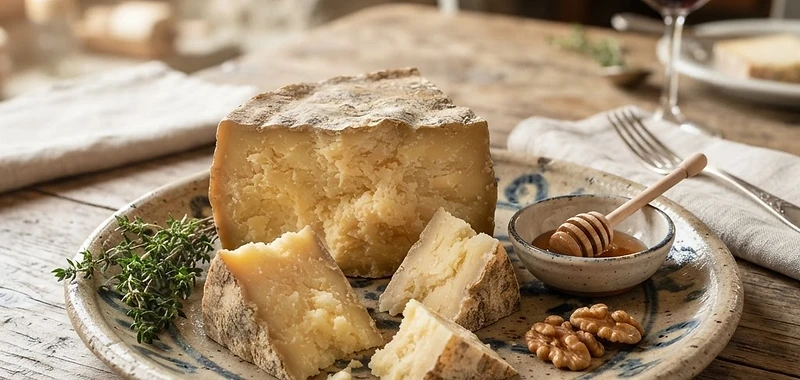
The cheese is formed into large wheels, typically weighing between 8 and 20 kilograms. When young, the paste is pale yellow, elastic, and sweet. As it ages, it darkens, the texture becomes brittle, and the flavor deepens into savory, toasted, and sometimes earthy notes. It is a cheese of terroir; you cannot replicate the environment of the Orobie Alps, and therefore, you cannot replicate the cheese.
Origin and history
Production in the Orobie Alps dates back to at least the sixteenth century. Etymologists suggest the name "Bitto" derives from the Celtic term bitu, meaning "everlasting" or "perennial," an allusion to the rugged mountain pastures themselves. Throughout the centuries, the production process has remained largely unchanged, resisting industrial shortcuts. The Valtellina valley has preserved these methods through strict local regulations that mandate the cheese be made at elevations generally exceeding 1,400 meters.
How it’s made
The process begins immediately after milking. The raw cow’s milk is heated in copper cauldrons over wood fires. If goat’s milk is used, it is added to provide a specific acidic structure and sharper profile to the finished wheel. Once the curd forms, it is broken, cooked, and pressed into wooden molds.
The aging process is where Bitto distinguishes itself. While some wheels are sold after a minimum of two months, the most prestigious examples are moved to stone cellars in the valley to mature for years. It is not uncommon to find Bitto aged for five, eight, or even ten years. At this stage, the cheese is strictly a grating ingredient, serving as a powerful seasoning for the region's buckwheat pasta dishes, like pizzoccheri.
Where to eat it
To experience Bitto properly, travel to the Valtellina valley in the province of Sondrio. The best way to encounter the cheese is to visit the alpine dairies—the casere—scattered across the mountain slopes above the valley floor. These are accessible primarily by mountain roads or footpaths during the summer season.
In the valley towns of Morbegno and Sondrio, cheese shops specialize in long-aged wheels. Morbegno hosts an annual festival dedicated to Bitto in October, which is the most reliable time to taste a wide variety of vintages from different producers. Outside of the province of Sondrio, the cheese becomes increasingly difficult to source, and prices rise significantly due to its limited production volume.
When and how
Bitto is a seasonal product. You will find the freshest wheels—those made in the current summer—in the autumn and winter months. These are best served in thick slices at room temperature, paired with local bread.
If you are served Bitto that is several years old, do not expect a table cheese. The long-aged form is hard and dry; it should be shaved or finely grated over hot grains or potato-based dishes. Confirm the age of the wheel before purchasing; a younger wheel provides a delicate, milky experience, while an older wheel provides a sharp, concentrated intensity that serves as a condiment rather than a snack.
What to drink with it
The pairing logic in the Valtellina is straightforward: drink what is grown in the shadow of the same mountains. The high-acid, refined red wines made from the Nebbiolo grape—locally known as Chiavennasca—are the standard accompaniment. Specifically, a Valtellina Superiore DOCG provides the necessary tannins to cut through the fat of a younger Bitto. For the intensely aged wheels, the high minerality of these mountain reds acts as a necessary counterweight. Avoid heavy, oak-forward wines, which will obscure the nuanced, floral characteristics of the mountain milk. Complement a plate of Bitto and local mountain honey with a few slices of Bresaola della Valtellina to complete the regional flavor profile.
The Story
Where Bitto comes from
The cheese has been made in the Orobie Alps since at least the sixteenth century, and the name may come from a Celtic word for mountain pasture. The rules restrict production to the summer months on defined pastures.
The Method
How it's made
Cow's milk, sometimes with a little goat's milk, is curdled and cooked, then pressed and salted. Aging runs from two months to ten years in cool cellars; the long-aged forms are used for grating.
Timing
When to eat it
June to September only, on the high pastures.
Serve With
Classic pairings
Valtellina Superiore DOCG
wineBresaola della Valtellina
cured meatWhat makes it worth going
A summer-pasture cheese from the Orobie Alps, aged for months in mountain cellars and sometimes for a decade.
What's nearby & pairs with
More food from Lombardia
Dish
Risotto alla Milanese
Saffron risotto from Milan — the dish that made saffron the flavor of northern Italian rice.
Dish
Cotoletta alla Milanese
Breaded veal cutlet, fried in butter — Milan's answer to the Wiener Schnitzel, or its predecessor.
Dish
Ossobuco
Braised veal shanks with the marrow bone — slow-cooked until the meat falls, served with gremolata.
Cheese
Grana Padano
The other great hard Italian cheese — aged cow's milk, from a broader zone across the Po Valley.
Cheese
Gorgonzola
Italy's great blue cheese — cow's milk, veined with Penicillium, in two styles: sweet (dolce) and sharp (piccante).
Cheese
Taleggio
Washed-rind cow's milk cheese from the Val Taleggio — soft, pungent, and one of Italy's best table cheeses.
Ready to plan?
Ready to turn discovery into a trip?
Italy Field Guide helps you decide where to go. When you're ready to build the actual day-by-day itinerary, take your saved places to Travel Itinerary Co — your interests go with you.
Turn your saved Italy places into a trip