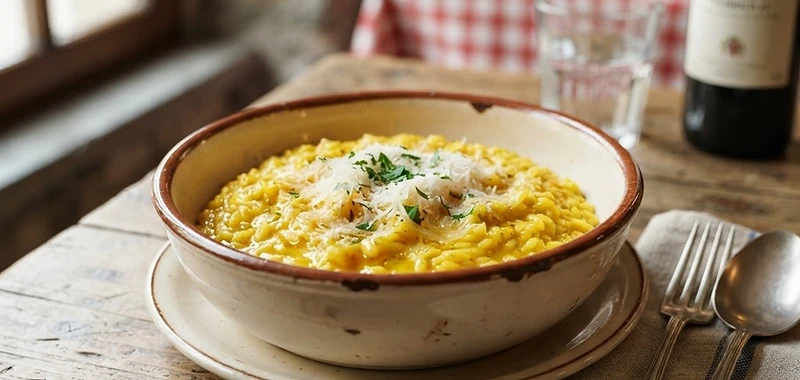
The Verdict
Milan's signature dish, and the most golden plate in Italy. Carnaroli rice, saffron threads, beef marrow, Parmigiano, and butter, stirred to a creamy 'all'onda' (wave-like) consistency. Born in the Duomo workshops, legend says, when a saffron-stained window was the inspiration. Rich, fragrant, and the only correct side for ossobuco.
Why go
To taste the dish that put saffron in Italian rice — golden, rich, and unmistakably Milanese.
The Field Guide take
Risotto alla Milanese is the definitive dish of Milan. While Italy is often associated with dried pasta and tomato-based sauces, the Po Valley—and specifically Lombardy—is centered on rice cultivation. In Milan, this grain is treated with a rigor that mirrors the city’s industrial precision. The resulting dish is a vibrant, golden-hued preparation defined by the distinct floral aroma of saffron and the savory, unctuous depth provided by beef marrow.
The character of the dish
This is a high-fat, high-impact risotto. It is not a light vegetable dish. The texture should be all’onda, a term describing the consistency of the rice as it moves in waves when the plate is tilted. If the risotto sits in a stiff, static mound, it has been overcooked or lacks sufficient butter and cheese. When prepared correctly, the individual grains of Carnaroli rice remain distinct and al dente, suspended in a creamy emulsion of broth, marrow, butter, and Parmigiano-Reggiano. The saffron does more than color the rice; it provides a metallic, hay-like fragrance that cuts through the intense richness of the animal fats.
Historical context
The presence of saffron in Milanese cooking is a relic of the city’s status as a medieval trade hub. Saffron was a luxury import, and its use in the kitchen signaled status and wealth. The most persistent legend attributes the dish’s origin to the glassmakers working on the Duomo di Milano in the 16th century. It is said that a master glazier, known for using saffron to achieve a brilliant yellow hue in stained glass, added the spice to a wedding risotto as a joke. Whether fact or folklore, the association between the golden color of the rice and the architectural gold of the Duomo remains a central part of the city’s identity.
Technique and ingredients
Success in making this dish relies on the quality of three specific ingredients: the rice, the marrow, and the saffron.
Milanese chefs exclusively use Carnaroli or sometimes Arborio rice. Carnaroli is preferred by professionals for its higher amylose content, which allows the grains to stay firm during a long period of stirring. The process begins with tostatura—toasting the raw rice in a base of rendered beef marrow and butter until the edges of the grains become translucent.
Hot, clarified beef broth is added in stages. The saffron—ideally used as high-quality threads rather than pre-ground powder—is either infused into the broth beforehand or added toward the end of the cooking process to preserve its volatile aromatics. The dish is finished with the mantecatura: a vigorous agitation of the rice with cold butter and aged Parmigiano-Reggiano away from the heat, which creates the essential creamy emulsion.
Where to find it
In Milan, Risotto alla Milanese is served across a spectrum of settings, from bustling neighborhood trattorie to formal, white-tablecloth establishments. If you are seeking the dish in its most traditional context, look for restaurants that specialize in the "cucina milanese" repertoire. It is common for this dish to be served as an accompaniment to ossobuco (braised veal shanks), particularly in the winter months. Do not be surprised if a menu lists the risotto as a standalone primo and the ossobuco as a secondo; both are heavy, and many diners choose to order them separately rather than on the same plate.
How to eat it
Risotto alla Milanese is a year-round staple in Milan, though it is most resonant during the colder months when its richness provides genuine comfort. When ordering, remember that risotto is cooked to order. It cannot be rushed; expect a wait of at least 15 to 20 minutes from the time you place your order. It should be eaten promptly while hot; as it cools, the starch sets, and the intended all'onda texture is lost.
The proper pairings
The ideal beverage pairing is a glass of Franciacorta. This sparkling wine from the nearby province of Brescia is produced using the traditional method and offers the crisp acidity and structural complexity necessary to cleanse the palate of the butter and marrow. Avoid heavy, tannic red wines, which can clash with the delicate floral notes of the saffron. If you prefer a still wine, a medium-bodied white from the Lombardy or Veneto regions serves as a reliable, unobtrusive companion.
The Story
Where Risotto alla Milanese comes from
This dish is the pride of Milan, reflecting the city’s historical connection to trade and luxury. Saffron was a prized import, used to tint the rice to the color of gold, symbolizing wealth. It is a refined, delicate risotto that demands careful attention to the grain's starch release.
What Defines It
Signature ingredients
Carnaroli rice
The gold standard for risotto, maintaining a firm center.
Saffron threads
Provide the unmistakable floral aroma and golden color.
Beef marrow
Traditionally added to give the risotto a rich, velvety mouthfeel.
The Method
How it's made
The rice is toasted, then cooked gradually with broth and saffron until it reaches the perfect 'all'onda' (wavy) consistency. A good risotto must spread slightly on the plate, not clump into a mound.
Timing
When to eat it
Year-round
Serve With
Classic pairings
Franciacorta
wineA sophisticated sparkling wine that complements the saffron.
Ossobuco
foodThe classic pairing to create the quintessential Milanese feast.
What makes it worth going
Saffron risotto from Milan — the dish that made saffron the flavor of northern Italian rice.
Things to do
- trattoria
Trattoria Masuelli San Marco
The historic Milanese trattoria, since 1921. The risotto alla milanese is the benchmark; the saffron is generous, the marrow is present. Reserve.
2 hrs
- trattoria
Antica Trattoria della Pesa
In the Porta Garibaldi zone, since 1902. The risotto is correct, the cotoletta is the rival. The most traditional Milanese trattoria.
2 hrs
- ristorante
Ratanà
The modern version, near Porta Garibaldi. The risotto is made with Acquerello rice and saffron from the province. Reserve.
2 hrs
- latteria
Latteria San Marco
A small latteria (dairy shop) with a few tables. The risotto is by the portion; the saffron is the test. Book ahead.
Eat
- risotto
Risotto alla milanese
The benchmark: Carnaroli rice, beef marrow, saffron, parmigiano, butter. The saffron is the color and the flavor; the marrow is the depth. The rice should be all'onda (wavy).
- main
Cotoletta alla milanese
The rival; the breaded veal cutlet, fried in butter. Order both, share.
- wine
A glass of Franciacorta
The local sparkling wine, from the hills east of Milan. The correct aperitivo and the risotto pairing.
Stay
- neighborhood
Brera
The art district, near Masuelli San Marco and the best trattorias. Walkable and central.
- neighborhood
Porta Garibaldi / Isola
The modern district, near Antica Trattoria della Pesa and Ratanà. The new Milan.
Experiences Worth Booking
Risotto class
3 hrsThe rice, the stock, the saffron, the mantecatura (the final butter and cheese). The all'onda texture is the test.
The risotto is 80% technique — the toast, the stock, the stir, the rest; a class shows you the all'onda.
Suits: Home cooks who've failed at risotto; the class fixes the timing.
Milanese food day (risotto + cotoletta + panettone)
full dayA risotto lunch, a cotoletta dinner, and a panettone from a pasticceria. The full Milanese arc.
The three are Milan's gifts; a day covers them, with the city in between.
Suits: Food travelers with one day for Milan's classics.
What's nearby & pairs with
More food from Lombardia
Dish
Cotoletta alla Milanese
Breaded veal cutlet, fried in butter — Milan's answer to the Wiener Schnitzel, or its predecessor.
Dish
Ossobuco
Braised veal shanks with the marrow bone — slow-cooked until the meat falls, served with gremolata.
Cheese
Grana Padano
The other great hard Italian cheese — aged cow's milk, from a broader zone across the Po Valley.
Cheese
Gorgonzola
Italy's great blue cheese — cow's milk, veined with Penicillium, in two styles: sweet (dolce) and sharp (piccante).
Cheese
Taleggio
Washed-rind cow's milk cheese from the Val Taleggio — soft, pungent, and one of Italy's best table cheeses.
Cured Meat
Bresaola della Valtellina
Air-dried, salt-cured beef from the Valtellina valley — lean, ruby-red, and Italy's answer to bresaola.
Ready to plan?
Ready to turn discovery into a trip?
Italy Field Guide helps you decide where to go. When you're ready to build the actual day-by-day itinerary, take your saved places to Travel Itinerary Co — your interests go with you.
Turn your saved Italy places into a trip