The Verdict
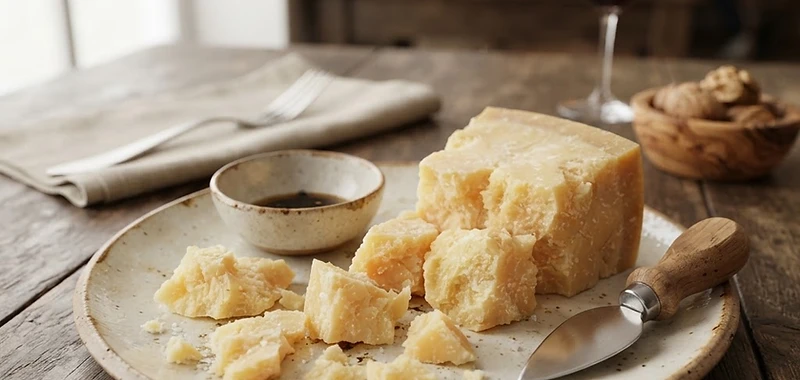
The most important cheese in Italy, and possibly in the world. Made from skimmed evening milk and whole morning milk, aged a minimum of 12 months (usually 24-36, sometimes 48+). Only from the zone between Parma and Reggio Emilia, from cows fed on local forage. Crystalline, granular, and umami-rich. The 36-month version is the everyday luxury; the 48-month is the revelation. No 'parmesan' is the same.
Why go
To taste real Parmigiano at its source, aged longer than anything you can buy at home.
The Field Guide take
Parmigiano Reggiano is the foundational cheese of Italy. It is a hard, granular cow's-milk cheese produced exclusively in a strictly defined geographic zone that includes the provinces of Parma, Reggio Emilia, Modena, and parts of Bologna and Mantua. While the term "parmesan" is often used loosely on international supermarket shelves, true Parmigiano Reggiano is a protected designation of origin (DOP) product. It is a dense, crystalline, and savory cheese that serves as the backbone of the culinary identity of Emilia-Romagna.
What it is
Parmigiano Reggiano is a long-aged cheese made from raw cow's milk, sea salt, and calf rennet. It contains no additives or preservatives. Its physical character is defined by its granular texture—the result of a long aging process that allows amino acid crystals to form. These crystals provide the cheese's signature crunch and concentrated umami profile. The cheese is produced in massive wheels, typically weighing about 40 kilograms. A minimum aging period of 12 months is legally required, though most examples found in high-quality shops have been aged for 24, 36, or even 48 months.
Origin and history
The history of Parmigiano Reggiano is tied to the Benedictine and Cistercian monasteries of the Middle Ages. In the marshy plains between Parma and Reggio Emilia, monks reclaimed land to create pastures for cattle. The surplus milk from these cows needed to be preserved, leading to the development of a large, cooked, hard cheese. Over the centuries, the methods remained remarkably stable. Today, the Consorzio del Formaggio Parmigiano Reggiano maintains strict oversight, ensuring that the milk comes only from cows fed on local forage and that the traditional production steps remain unchanged.
How it’s made
The production cycle begins with a mixture of skimmed evening milk and whole morning milk. This is poured into large, bell-shaped copper vats. The cheesemaker adds calf rennet and a natural whey starter, causing the milk to curdle. The curd is broken into tiny granules and cooked at a specific temperature. Once the curd settles at the bottom of the vat, it is lifted out in a cloth and placed into a mold. After a few days, the wheels are submerged in a brine bath for several weeks.
The aging takes place in humidity-controlled warehouses. At the 12-month mark, an official inspector from the Consorzio examines every wheel by tapping it with a small hammer. The inspector listens for hollow sounds that would indicate internal defects. Wheels that pass the rigorous physical and sensory tests are heat-branded with the Consorzio’s seal; those that do not are declassified.
Where to eat it
The best way to experience Parmigiano Reggiano is to visit a caseificio (dairy) in the heart of the production zone. Visiting a producer near Parma or Reggio Emilia allows a traveler to see the early morning production process, where the steam rises from the copper vats. Many of these producers have attached shops where you can purchase wheels or wedges aged to different specifications. If you are dining in restaurants in the region, the cheese will almost always appear as a primo course, shaved over tagliatelle al ragù or tortellini in brodo, or served as a standalone course at the end of a meal.
When and how
Parmigiano Reggiano is available year-round. When serving it, allow the cheese to come to room temperature for at least 30 minutes before eating to fully release its aroma. Rather than slicing it with a knife, use a traditional almond-shaped knife to pry chunks from the wheel, preserving the texture and the crystalline structure. A 24-month cheese is standard for cooking or grating; a 36-month or 48-month wheel is intended to be eaten in shards as a snack or a dessert course.
What to drink with it
Because of the cheese's saltiness and density, it requires a beverage with enough structure or acidity to provide balance. In Emilia-Romagna, the classic pairing is a glass of sparkling Lambrusco. The acidity and bubbles of this dry, local red wine act as a palate cleanser against the richness of the fat. For those preferring a still wine, a medium-bodied Sangiovese from the nearby hills of Romagna works well. Outside of wine, a few drops of Aceto Balsamico Tradizionale—the aged balsamic vinegar from neighboring Modena—poured directly over a chunk of 36-month Parmigiano is the most traditional way to consume it.
The Story
Where Parmigiano Reggiano comes from
Known as the king of cheeses, Parmigiano Reggiano has been produced in the Emilia-Romagna region for centuries, with origins tracing back to medieval Benedictine and Cistercian monks. The production process is strictly controlled by a consortium to ensure specific cattle breeds and traditional methods are upheld. It remains one of the most recognizable food products in Italy, defined by its strict geographical limitations.
What Defines It
Signature ingredients
Raw cow's milk
From cows fed primarily on locally grown forage, defining the subtle terroir of the cheese.
Sea salt
Applied during the brining process to preserve and develop the signature crystalline structure.
Rennet
The traditional calf-derived enzyme used to coagulate the milk.
The Method
How it's made
The curd is cooked, molded into large wheels, and then left to age in humidity-controlled rooms for at least 12 months. An expert inspector taps the wheel with a hammer to detect internal voids, ensuring only the highest quality product is branded.
Timing
When to eat it
Year-round.
Serve With
Classic pairings
Aceto Balsamico Tradizionale
foodThe sweetness of the aged vinegar creates a perfect contrast to the salty, savory crystals.
Sangiovese
wineThe earthy, medium-bodied red provides a structural match for the complex, long-aged cheese.
What makes it worth going
The king of Italian cheese — aged cow's milk, from a strictly defined zone around Parma and Reggio Emilia.
Things to do
- dairy
Caseificio in the Parma-Reggio zone
Book a morning tour (7am) to see the evening milk skimmed and the morning milk added, the copper vats, the break, the molding. The make takes 30 min; the magic is in the timing.
2 hrs
- museum
Museo del Parmigiano Reggiano (Soragna)
The history, the tools, the aging. A short visit, pairs with a caseificio tour.
1 hr
- cellar
The wheels in the aging cellar
After the make, see thousands of wheels on wooden boards, aging for 12, 24, 36 months. The smell is the lesson.
45 min
- salumeria
Salumeria in Parma (e.g. Salumeria Garibaldi)
Taste the 24, 36, and 48-month side-by-side. The difference is the whole story.
1 hr
Eat
- cheese
36-month Parmigiano
The everyday luxury. Crystalline, granular, and umami. Eat in shards, with nothing or with balsamic.
- cheese
48-month Parmigiano
The revelation. Drier, more crystalline, more savory. The酪 amino-acid crunch is the texture.
- salumi
Prosciutto di Parma
The pairing. Sweet, salty, and the cheese and the ham are from the same hills.
Stay
- city
Parma center
The base; near the salumerias, the train, and the food. Walkable to the best cheese counters.
- rural
Langhirano / countryside
If you're touring caseifici and prosciuttifici, stay in the hills. A car is required.
Experiences Worth Booking
Caseificio morning tour
2 hrsThe 7am make, the copper vats, the molding, the cellar. Often includes tasting.
You see the moment the milk becomes cheese; it's the craft in real time.
Suits: Anyone who wants to see the real thing; book ahead, the make is early.
Parmigiano + Prosciutto + Balsamic day
full dayA guided day: a caseificio, a prosciuttificio, and an acetaia (balsamic). The three products of the Parma zone.
The three are made within 50 km of each other; a tour covers what solo touring can't in a day.
Suits: Food travelers with one day for the Emilian trinity.
What's nearby & pairs with
More food from Emilia-Romagna
Dish
Tagliatelle al Ragù
The real Bolognese — flat egg pasta ribbons with a slow-cooked meat sauce, nothing like the version the world knows.
Dish
Tortellini in Brodo
Tiny filled pasta rings in a clear capon broth — the most refined dish of Bologna.
Cured Meat
Prosciutto di Parma
Dry-cured ham from Parma, aged 12-36 months, with only salt and air — the most famous Italian ham.
Cured Meat
Culatello di Zibello
The heart of the prosciutto, cured separately — the most refined cured pork in Italy.
Cured Meat
Mortadella di Bologna
Finely emulsified pork sausage from Bologna, studded with pistachios — the original 'bologna' and far better.
Ready to plan?
Ready to turn discovery into a trip?
Italy Field Guide helps you decide where to go. When you're ready to build the actual day-by-day itinerary, take your saved places to Travel Itinerary Co — your interests go with you.
Turn your saved Italy places into a trip