
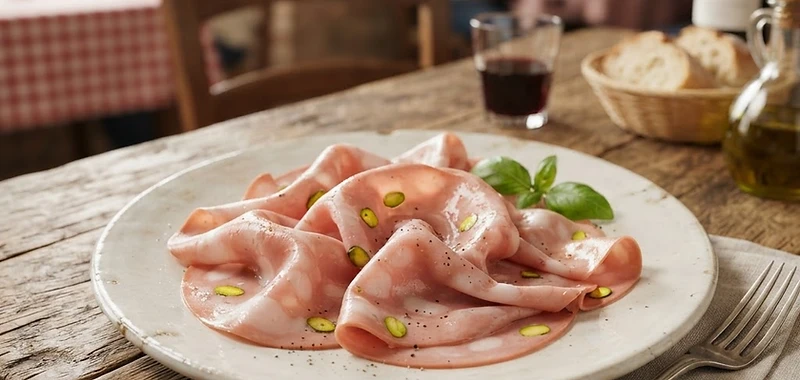
The Verdict
The cold cut that America renamed 'bologna' and forgot. The real Mortadella di Bologna is a vast, rosy-pink emulsion of pork, studded with pistachios, gently spiced, and sliced thin enough to see through. It's delicate, not the rubbery deli loaf it became. Eat it in Bologna on a piece of focaccia, or with a tigella (a small flatbread). IGP-protected, and a point of civic pride.
Why go
To taste the original bologna — in Bologna, where it's a civic institution.
The Field Guide take
In the city of Bologna, the local pride in Mortadella is not a marketing strategy; it is a point of civic identity. While the name has been exported and significantly altered globally to describe an entirely different class of mass-produced sausage, Mortadella di Bologna remains a distinct, IGP-protected product of the Emilia-Romagna region. To understand this meat is to move past the rubbery, industrial loaf often associated with the word "bologna" and engage with a product that relies on precise emulsification and high-quality pork fats.
What it is
Mortadella di Bologna is a large, heat-treated sausage made from a finely ground emulsion of pork. Its visual profile is unmistakable: a pale, rosy-pink cylinder speckled with cubes of opaque white pork throat fat (lardelli) and, in the most common traditional variation, vibrant green pistachios. Unlike coarse-ground salumi, a quality mortadella has a silky, uniform texture. When sliced thin, it should be delicate and soft to the touch, releasing a mild, savory aroma of black pepper, coriander, and sometimes nutmeg.
Origin and history
The history of the sausage is formally anchored in the 17th century. In 1661, Cardinal Farnese issued a decree in Bologna that established standards for the production of Mortadella, effectively creating one of the earliest systems for protecting a regional food product. While precursors to the sausage likely existed earlier, this legal recognition solidified the city’s role as the definitive center of production. The name itself is a matter of academic debate; some etymologists connect it to the Roman mortarium, a mortar and pestle used to pound the meat into a fine paste, while others suggest it refers to the addition of myrtle berries, which were used as a flavoring agent before the widespread import of black pepper.
How it’s made
The production process is technical. High-quality pork shoulder is ground repeatedly until it reaches the consistency of a fine paste. This meat is then mixed with specific seasonings and, crucially, the lardelli—cubes of fat taken from the pork throat, which is the firmest and most stable fat on the animal. The fat cubes are distributed throughout the emulsion to provide structural contrast to the silky meat. Pistachios are added, and the mixture is stuffed into a casing before being slowly steamed in dry-air ovens at relatively low temperatures. This slow cooking allows the sausage to retain its moisture and tenderness, preventing the rubbery texture common in lesser, high-speed industrial versions.
Where to eat it
The best place to eat Mortadella is within the city of Bologna. It is a staple of the salumerie (delicatessens) clustered around the Quadrilatero, the historic market district near the Piazza Maggiore. Because the meat is perishable once sliced, it is best sourced from a shop that slices it to order rather than a pre-packaged display. If you have a tree nut allergy, exercise caution; while some producers offer variations without pistachios, the nuts are a near-universal inclusion in the traditional recipe.
When and how
Mortadella is a year-round food. It is rarely served as a centerpiece of a hot meal; instead, it is a cold-cut staple meant to be eaten at room temperature to ensure the fat has softened sufficiently to release its flavor. It is most commonly served on gnocco fritto—pillowy, deep-fried pockets of dough—or inside tigelle, small, round flatbreads traditionally cooked in terracotta discs. Because the meat is delicate, it is often served as a simple snack or an antipasto, allowing the balance of the spiced meat and the creamy fat to remain the focus.
What to drink with it
In the context of Emilia-Romagna, the pairing logic is regional. The high fat content and delicate, savory profile of the Mortadella call for an acidic, effervescent wine to cleanse the palate. Lambrusco, the dry, sparkling red wine native to the region, is the standard accompaniment. The wine’s natural acidity and moderate tannins cut through the richness of the pork fat, making it a functional as well as a traditional choice. Avoid heavy, high-tannin reds, which will overwhelm the subtlety of the meat.
The Story
Where Mortadella di Bologna comes from
Mortadella di Bologna is an ancient recipe, with the first evidence of it found in a 1661 decree in Bologna that protected its production. Unlike American 'baloney', real Mortadella is a highly refined emulsion of pork cuts, seasoned with aromatics and studded with lard cubes and pistachios. It is a masterpiece of balance and texture.
What Defines It
Signature ingredients
Pork shoulder
Provides the lean meat for the foundation of the emulsion.
Pistachios
Add a snap and subtle, nutty flavor that cuts through the richness of the fat.
Pork throat fat
The specific fat used to provide the signature white cubes and velvety mouthfeel.
The Method
How it's made
The meat is ground to a fine paste, mixed with seasonings, and slowly steamed in ovens at low temperatures. A high-quality version should be aromatic and soft, practically silky, never rubbery.
Timing
When to eat it
Year-round.
Serve With
Classic pairings
Lambrusco
wineThe acidity and bubble of a good Lambrusco are essential for cutting through the meat's high fat content.
Gnocco fritto
foodWarm, fried dough that allows the fat in the Mortadella to soften just slightly.
What makes it worth going
Finely emulsified pork sausage from Bologna, studded with pistachios — the original 'bologna' and far better.
Things to do
- salumeria
Salumeria Tamburini (Bologna)
The historic Bologna salumeria. The mortadella is sliced thin, the pistachios are the test, the smell is the proof. Buy it, eat it on the spot.
1 hr
- salumeria
Simoni Laboratorio (Bologna)
The maker, in Bologna. The mortadella is fresh, the pistachios are whole, the slice is thin. Buy directly.
1 hr
- osteria
A mortadella tasting in a Bologna osteria
The mortadella is served with tigelle (small flatbreads) or crescentine. The bread and the mortadella are the pairing.
1.5 hrs
- experience
A Bologna food walk
The Quadrilatero, the salumerias, the tortellini, the mortadella. The full Bologna circuit.
Eat
- cured_meat
Mortadella di Bologna
The classic: a large, smooth, pink cured pork sausage from Bologna, with whole pistachios. Sliced thin, eaten with bread or tigelle. The IGP version; the pistachios are the test.
- bread
With tigelle or crescentine
The traditional companion; the small flatbreads of the Apennines. The bread and the mortadella are the pairing.
- use
In a tortellini filling
The mortadella is the filling of the tortellini; the prosciutto and the parmesan are the companions.
Stay
- neighborhood
Bologna center (Quadrilatero)
Near the salumerias and the best mortadella. Walkable and central.
- city
Modena or Parma
The other Emilian cities, with their own cured meats and good salumerias.
Experiences Worth Booking
Mortadella and salumi tasting
1.5 hrsA guided tasting of mortadella, prosciutto di Parma, and culatello, in a Bologna salumeria.
The mortadella is one of the Emilian salumi; a tasting compares it to the prosciutto and the culatello.
Suits: Cured-meat lovers who want the Emilian classics.
Bologna food walk
3 hrsThe salumerias, the tortellini, the mortadella, the tagliatelle. The full Bologna circuit.
Bologna's food is the salumi and the pasta; a walk covers both.
Suits: Eaters who want the city's food in a day.
What's nearby & pairs with
More food from Emilia-Romagna
Dish
Tagliatelle al Ragù
The real Bolognese — flat egg pasta ribbons with a slow-cooked meat sauce, nothing like the version the world knows.
Dish
Tortellini in Brodo
Tiny filled pasta rings in a clear capon broth — the most refined dish of Bologna.
Cheese
Parmigiano Reggiano
The king of Italian cheese — aged cow's milk, from a strictly defined zone around Parma and Reggio Emilia.
Cured Meat
Prosciutto di Parma
Dry-cured ham from Parma, aged 12-36 months, with only salt and air — the most famous Italian ham.
Cured Meat
Culatello di Zibello
The heart of the prosciutto, cured separately — the most refined cured pork in Italy.
Ready to plan?
Ready to turn discovery into a trip?
Italy Field Guide helps you decide where to go. When you're ready to build the actual day-by-day itinerary, take your saved places to Travel Itinerary Co — your interests go with you.
Turn your saved Italy places into a trip