The Verdict
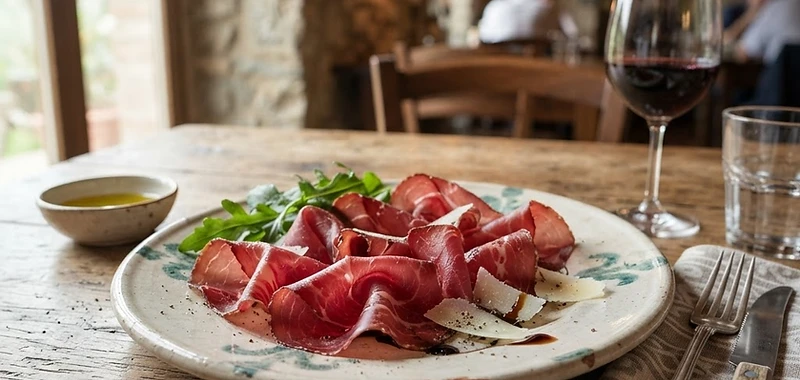
The luxury cut of Italian cured meat: the heart of the prosciutto, deboned and cured on its own, in the foggy lowlands near Zibello. Aged 12-36 months in damp cellars where the mold is part of the process. Sweeter, softer, and more expensive than whole prosciutto. If Parma ham is the everyday luxury, culatello is the special-occasion one.
Why go
To taste the filet mignon of Italian cured pork — and understand why it costs what it costs.
The Field Guide take
Culatello di Zibello stands apart from the typical landscape of Italian salumi. While most cured meats in Italy rely on the preservation of a whole muscle or a ground mixture, Culatello is an exercise in extraction. It is produced by isolating the most tender portion of the pork leg—the heart of the rump—and subjecting it to a precise, localized climate that cannot be replicated outside of the narrow floodplains of the Po River.
The anatomy of the cut
Culatello is, essentially, the filet mignon of the pig’s hind leg. To produce it, the craftsman debones a prosciutto, removing the femur and the surrounding muscle, and isolates the specific section of meat known as the noce. This single, lean muscle is then trimmed of excess fat and skin. Unlike prosciutto, which is cured with the bone and skin left on to protect the meat, Culatello is exposed and vulnerable, requiring an entirely different approach to preservation.
Origins in the fog
The production of Culatello is tethered to the geography of the Bassa Parmense, the low-lying region along the Po River. The history of the product is one of environmental necessity. In these humid, river-adjacent plains, the climate is defined by thick, persistent winter fog. This humidity is the critical variable in the maturation process. While mountain-cured meats rely on the dry, alpine air to dehydrate and preserve the pork, Culatello requires the dampness of the river valley to keep the meat supple and to encourage the growth of specific molds on the casing. The craft is concentrated in the area around Zibello, Polesine Parmense, and Busseto, where the river climate is most consistent.
The process of maturation
Once the meat is trimmed, it is seasoned with a mixture of salt, pepper, and sometimes garlic or dry white wine. It is then stuffed into a natural pig bladder, which acts as a protective, breathable barrier. The bladder is stitched by hand and wrapped in a tight network of twine, a process that gives the finished product its characteristic pear shape.
The aging occurs in cellars that are purposefully kept damp and cool. During the 12 to 36 months of maturation, the mold that develops on the exterior of the bladder is not a sign of spoilage, but an essential component of the aging process. These micro-flora help break down the proteins and fats within the meat, contributing to the funky, earthy, and deep savory notes that distinguish true Culatello from lesser cured meats.
Where to find it
To experience Culatello in its home, travel to the province of Parma, specifically the small towns situated directly along the Po River. The Consorzio del Culatello di Zibello protects the product’s designation; labels marked with the consortium’s stamp ensure that the meat was sourced and aged within this specific geographical zone. Because production volume is low and the aging process is long, Culatello is rarely found in standard supermarkets. It is best sought out at local salumerie in Zibello or served in specialized trattorias within the Bassa Parmense, where the innkeepers often maintain their own aging cellars.
Serving and consumption
Culatello should be sliced paper-thin. Because of its lean nature and intense concentration of flavor, thick slices would be difficult to chew and overwhelming to the palate. Before serving, the meat is often cleaned of its exterior mold and sometimes briefly dampened with a splash of dry white wine to soften the casing, making it easier to peel away.
It is traditionally served at room temperature. In the region, it is often paired with a smear of high-quality, unsalted butter on a piece of warm, crusty bread. This serves to cut the saltiness and provide a creamy textural contrast to the dense, concentrated pork.
What to drink with it
Given the salt and the deep, funky complexity of the aged meat, the wine pairing should provide a clean, acidic contrast. A crisp, dry Spumante from the nearby Emilia-Romagna region or a bright, high-acid white wine is the standard recommendation. The bubbles and acidity function as a palate cleanser, cutting through the richness of the meat and preparing the tongue for the next slice. Avoid heavy, tannic red wines, which can clash with the delicate, nuanced flavors of the cured pork.
The Story
Where Culatello di Zibello comes from
Culatello is the most prestigious cured meat in Italy, originating from the humid, fog-shrouded lowlands of the Po River near Zibello. It is made from the 'heart' of the pig's rear leg, which is removed from the bone and cured in a bladder. It is a product of patience and environmental necessity, as the river fog plays an essential role in its maturation.
What Defines It
Signature ingredients
Pork rump
The most tender part of the leg, devoid of the tougher outer muscle groups.
Wine and spices
Used in the traditional rub to add complexity and promote proper curing conditions.
The Method
How it's made
The meat is seasoned, stuffed into a natural bladder, and sewn by hand before being tied with twine. It is aged for at least a year in cellars where the river mist encourages a specific mold, which imparts a deep, funky complexity.
Timing
When to eat it
Year-round.
Serve With
Classic pairings
Spumante
wineA crisp sparkler that highlights the incredible, almost melting texture of the meat.
Butter
foodA small knob of unsalted butter on a warm piece of bread is the best way to serve it.
What makes it worth going
The heart of the prosciutto, cured separately — the most refined cured pork in Italy.
Things to do
- producer
A culatello producer in the Bassa Parmense
The home of culatello, in the Po valley fog. The ham is cured in the cellars, in the humid air; the fog is the cure. Visit a producer (e.g. Spigaroli at Antica Corte Pallavicina); book ahead.
2 hrs
- trattoria
A restaurant in Zibello or Polesine Parmense
At the source. The culatello is sliced thin, served with bread and butter; the potato tortelli are the companion. Reserve.
2 hrs
- festival
A culatello festival (e.g. Zibello, autumn-winter)
The village's 'Culatello con i piedi nel Po' festival, in the cold months. The ham is the show; the fog is the context.
full day
- experience
A cellar visit and tasting
The culatello is cured in the cellars, in the humid fog of the Po. The visit is the cure; the tasting is the result.
Eat
- cured_meat
Culatello di Zibello
The classic: the heart of the prosciutto, cured separately, in the humid fog of the Po valley. The 'king of hams'; the DOP version. Sliced thin, served with bread and butter.
- pasta
With potato tortelli
The Parmense companion; the potato-stuffed pasta of the Bassa. The culatello and the tortelli are the Bassa's two gifts.
- wine
A glass of Fortana or Lambrusco
The local red, the traditional pairing for the culatello and the humid cure.
Stay
- farm-stay
An agriturismo in the Bassa Parmense
At the source, in the Po fog. The culatello is cured on site.
- city
Parma or Busseto
The urban bases, with good restaurants and easier access.
Experiences Worth Booking
Culatello cellar visit and tasting
2 hrsA visit to a culatello cellar, with the cure and the tasting. The fog is the context.
The culatello is cured in the humid fog; a cellar visit shows you the cure and the tasting.
Suits: Cured-meat obsessives who want the king of hams at its source.
Bassa Parmense day
full dayA culatello producer, a potato tortelli lunch, a Verdi site (Busseto). The full Bassa arc.
The culatello, the tortelli, and Verdi are the Bassa's three gifts; a day covers all.
Suits: Food and culture travelers with a day for the Po valley.
What's nearby & pairs with
More food from Emilia-Romagna
Dish
Tagliatelle al Ragù
The real Bolognese — flat egg pasta ribbons with a slow-cooked meat sauce, nothing like the version the world knows.
Dish
Tortellini in Brodo
Tiny filled pasta rings in a clear capon broth — the most refined dish of Bologna.
Cheese
Parmigiano Reggiano
The king of Italian cheese — aged cow's milk, from a strictly defined zone around Parma and Reggio Emilia.
Cured Meat
Prosciutto di Parma
Dry-cured ham from Parma, aged 12-36 months, with only salt and air — the most famous Italian ham.
Cured Meat
Mortadella di Bologna
Finely emulsified pork sausage from Bologna, studded with pistachios — the original 'bologna' and far better.
Ready to plan?
Ready to turn discovery into a trip?
Italy Field Guide helps you decide where to go. When you're ready to build the actual day-by-day itinerary, take your saved places to Travel Itinerary Co — your interests go with you.
Turn your saved Italy places into a trip