
The Verdict
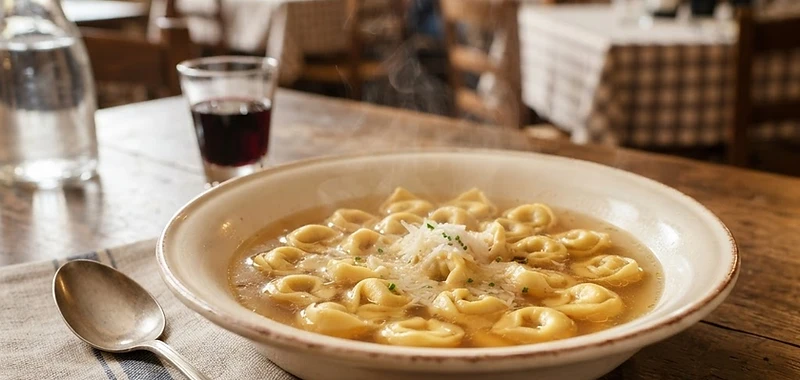
The dish that separates Bologna's cooks from everyone else's. Tortellini — tiny, hand-shaped pasta rings filled with pork, prosciutto, and Parmigiano — served in a clear, golden capon broth. The broth is the work: it must be clear, not cloudy, and deep in flavor. It's the dish Bolognese grandmothers are judged by. In Bologna, in winter, it's the most comforting thing on the menu.
Why go
To taste the dish that defines Bolognese cooking — in a clear broth, in winter.
The Field Guide take
In Bologna, the standard for a cook’s proficiency is not set by complex sauces or elaborate plating, but by a bowl of tortellini in brodo. This dish, consisting of miniature, meat-filled pasta rings served in a clear capon broth, represents the technical apex of Emilian cuisine. It is a slow, labor-intensive preparation that resists shortcuts, serving as both a ritual of the Italian household and a defining feature of the city’s restaurant culture.
What it is
Tortellini in brodo is a study in precise balance. The pasta must be rolled thin enough to be translucent, holding a savory core of pork loin, prosciutto di Parma, mortadella, and Parmigiano-Reggiano. The vessels for these tortellini are equally critical: the broth must be a clear, golden liquid derived from capon (a castrated rooster) and often beef. Unlike many pasta dishes that rely on thick sauces, this is a clean, restorative preparation where the quality of the raw ingredients is immediately exposed.
Origin and history
The history of tortellini is a point of regional pride, with written records tracing the pasta back to the Middle Ages. For centuries, the dish was reserved for high holidays, particularly Christmas. The labor required to shape thousands of tiny rings—a task traditionally performed by extended families—made it a communal undertaking. While Bologna is the undisputed home of the dish, neighboring Modena claims its own version. The Modenese variation often features a slightly larger pasta size and differences in the specific meat ratios used in the filling. The rivalry remains a staple of local conversation, though both cities agree that the broth is the definitive component of the dish.
How it’s made
The process begins with the pasta dough, made from high-quality flour and eggs. It is rolled out manually until it reaches a delicate, paper-thin consistency. Small squares of dough are cut, and a tiny amount of the meat-and-cheese filling is placed in the center. Each piece is then folded and pinched into the characteristic ring shape, a technique that requires significant dexterity.
The broth is the second, equally demanding half of the equation. It is simmered over several hours, skimmed constantly to ensure absolute clarity, and seasoned to provide a deep, savory foundation. The tortellini are boiled separately in salted water or directly in the broth, cooked only until al dente, and served immediately so the pasta does not lose its structural integrity in the liquid.
Where to eat it
When seeking tortellini in Bologna, look for establishments that emphasize the "sfoglia"—the hand-rolled dough. Restaurants that prioritize the traditional method will typically feature an open workspace where the sfogline (pasta makers) prepare the pasta by hand throughout the morning. Seek out trattorias within the city center that specify their broth is made from capon; these are the kitchens that respect the labor required to make a truly clarified, flavorful stock. As this is a labor-intensive dish, it is generally priced higher than standard pasta courses.
When and how
Tortellini in brodo is a seasonal dish. It is most commonly found on menus between late autumn and early spring, reaching its peak during the winter months. It is served steaming hot, usually as a first course. Because the dish is intended to be light yet nourishing, it is often consumed as a standalone meal or followed by a serving of boiled meats (bollito misto), which are frequently the source of the broth itself.
What to drink with it
To cut through the richness of the pork and the savory depth of the capon broth, the local preference is for high-acid, sparkling wines. A dry, crisp Lambrusco di Sorbara is the classic choice; its bright acidity and effervescence balance the fatty components of the filling. Alternatively, a Pignoletto, the indigenous white grape of the Bologna hills, provides a clean, mineral-forward pairing that respects the subtlety of the broth without overpowering it. Regardless of the choice, the wine should be served chilled to provide a contrast to the heat of the bowl.
The Story
Where Tortellini in Brodo comes from
Tortellini are the pride of Bologna, with historical records of the pasta dating back to the Middle Ages. They are traditionally served during high holidays, specifically Christmas, when the labor-intensive work of shaping each tiny piece by hand is a family ritual. The dish is considered a masterclass in regional balance, pairing rich meat with a clear, elegant broth.
What Defines It
Signature ingredients
Pork loin
The primary component of the filling, lending a subtle sweetness and texture.
Mortadella
Adds fat and a unique savory depth that defines the Bolognese flavor profile.
Capon broth
A slow-simmered, golden, and crystal-clear liquid that acts as the canvas for the pasta.
The Method
How it's made
The dough is rolled thin enough to be translucent before being folded over a small amount of meat filling. The resulting ring is boiled just until al dente and served swimming in the piping hot, clarified broth.
Across Italy
Regional variants
Modena
Often features slightly larger pasta and variations in the specific meat ratios.
Timing
When to eat it
Winter and holiday season, due to the warmth of the broth and tradition.
Serve With
Classic pairings
Lambrusco di Sorbara
wineThe light, dry, and sparkling nature of this red cuts through the fat of the meat.
Pignoletto
wineA local white that provides a crisp, neutral base that doesn't compete with the broth.
What makes it worth going
Tiny filled pasta rings in a clear capon broth — the most refined dish of Bologna.
Things to do
- trattoria
Trattoria di Via Serra (Bologna)
The benchmark tortellini in brodo, in the university quarter. The tortellini are hand-folded, the broth is capon. Reserve far ahead; the wait is the cost.
2 hrs
- osteria
Osteria Bottega (Bologna)
The refined version; the tortellini are tiny, the broth is clear, the filling is mortadella and prosciutto. Reserve.
2 hrs
- salumeria
A Bologna salumeria (e.g. Tamburini)
The source of the mortadella and the prosciutto for the filling. Buy the filling, eat the tortellini.
- experience
A tortellini-making class in Bologna
The tortellini is folded by hand, around a finger; the shape is the tradition. The class is the way to learn the gesture.
Eat
- pasta
Tortellini in brodo
The classic: tiny hand-folded stuffed pasta, filled with mortadella, prosciutto, and parmesan, served in a clear capon broth. The broth is the dish; the tortellini are the jewel.
- pasta
Tortellini alla panna
The cream sauce version, instead of broth. A good one, but the brodo is the Bolognese test.
- wine
A glass of Lambrusco
The Emilian red, the traditional pairing for the tortellini and the rich broth.
Stay
- neighborhood
Bologna center (Quadrilatero / Università)
Near the best trattorias and the salumerias. Walkable and central.
- city
Modena or Parma
The other Emilian capitals, with their own tortellini traditions and good trattorias.
Experiences Worth Booking
Tortellini-making class (Bologna)
3 hrsThe dough, the mortadella-prosciutto-parmesan filling, the hand-fold around a finger. The gesture is the technique.
The tortellini is folded by hand, around a finger; a class shows you the gesture and the tiny size.
Suits: Pasta makers who want the Bolognese classic; the fold is the test.
Emilia-Romagna food day
full dayA tortellini lunch in Bologna, a Parmigiano cellar in Parma, a balsamic tasting in Modena. The full Emilian arc.
The tortellini, the Parmigiano, and the balsamic are the Emilian trinity; a day covers all three.
Suits: Food travelers with a day for Emilia-Romagna.
What's nearby & pairs with
More food from Emilia-Romagna
Dish
Tagliatelle al Ragù
The real Bolognese — flat egg pasta ribbons with a slow-cooked meat sauce, nothing like the version the world knows.
Cheese
Parmigiano Reggiano
The king of Italian cheese — aged cow's milk, from a strictly defined zone around Parma and Reggio Emilia.
Cured Meat
Prosciutto di Parma
Dry-cured ham from Parma, aged 12-36 months, with only salt and air — the most famous Italian ham.
Cured Meat
Culatello di Zibello
The heart of the prosciutto, cured separately — the most refined cured pork in Italy.
Cured Meat
Mortadella di Bologna
Finely emulsified pork sausage from Bologna, studded with pistachios — the original 'bologna' and far better.
Ready to plan?
Ready to turn discovery into a trip?
Italy Field Guide helps you decide where to go. When you're ready to build the actual day-by-day itinerary, take your saved places to Travel Itinerary Co — your interests go with you.
Turn your saved Italy places into a trip