The Verdict
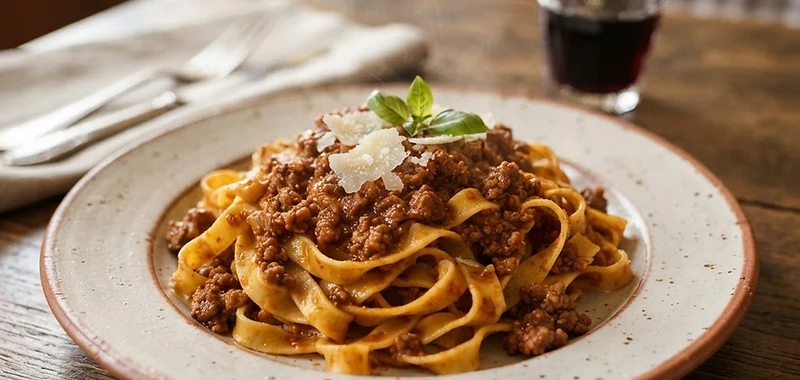
What the world calls 'spaghetti Bolognese' is not this. Tagliatelle al ragù is flat egg-ribbon pasta with a slow-cooked sauce of beef, pork, and pancetta, tomato, and wine, simmered for hours. No garlic, no herbs, no cream. It's rich, gentle, and entirely about the meat and the time. Bologna is Italy's food capital for a reason, and this is the reason.
Why go
To taste the original of the dish the world got wrong — in Bologna, the fat city.
The Field Guide take
In Bologna, the regional capital of Emilia-Romagna, a sharp distinction exists between the dish served in local trattorias and the iteration exported to the rest of the world. What is often misrepresented abroad as a tomato-heavy sauce poured over round noodles does not exist here. In its true form, tagliatelle al ragù is a deliberate, slow-cooked preparation that relies on the interaction between meat, fat, and fresh egg pasta. It is a defining dish of Bologna, a city characterized by its centuries-old wealth and its access to high-quality livestock and dairy.
What it is
Tagliatelle al ragù is a textured, meat-forward sauce served exclusively over fresh, wide, flat ribbons of egg pasta. The pasta’s porous surface is designed to hold the thick, clung-on sauce. The ragù itself is not a vegetable-based tomato sauce; it is a meat stew that has been broken down over several hours. It contains no garlic, no excessive dried herbs, and no cream. It is savory, dense, and serves as a testament to the agricultural prosperity of the Po Valley.
Origin and history
The history of the dish is tied to the wealth of Bologna. Historically, the city functioned as a crossroads for trade, granting it access to high-quality beef and pork that was unavailable in poorer, more mountainous regions. While the practice of simmering meat to serve over pasta existed in Italy for centuries, the specific Bolognese technique refined this into a luxury. The addition of milk is a traditional, documented step, serving to tenderize the meat and balance the acidity of the wine and the small amount of tomato used. It was designed to turn a simple meal into a substantial, rich offering that showcased the region’s primary culinary resources.
How it’s made
The foundation of a proper ragù begins with a soffritto of onion, carrot, and celery. To this, a blend of minced beef and pork is added, along with pancetta, which provides the necessary fat base. Once the meat is browned, it is deglazed with a dry white or red wine. The most critical phase is the long, slow simmer. Throughout this process, milk is added, which helps break down the connective tissue in the meat and creates a uniform, velvety consistency. The sauce is finished with a minimal amount of tomato paste or puree—the tomato acts as a seasoning rather than the primary ingredient. The final result should be a thick, clinging mixture that coats the ribbons of pasta without pooling in the bowl.
Where to eat it
The dish is ubiquitous in Bologna, but the best versions are found in traditional trattorias and osterie that specialize in sfoglia (hand-rolled pasta). Look for establishments where the pasta is made daily on-site. If you see a menu claiming the dish is served with spaghetti, move on; genuine Bolognese tagliatelle must be wide and flat, often measured to a specific width (historically 8 millimeters after cooking). The best kitchens allow the sauce to simmer for at least four to six hours, ensuring the flavors have fully integrated.
When and how
Tagliatelle al ragù is available year-round. It is considered a staple of the lunch hour or a substantial dinner. In local practice, it is common to finish the dish with a generous grating of Parmigiano Reggiano, which is produced in the surrounding provinces of the Emilia-Romagna region. When ordering, treat the dish as the centerpiece of your meal; the richness of the ragù is filling, and it is usually served in a single, well-portioned course.
What to drink with it
The intensity of the meat and the fat of the sauce require a wine with sufficient structure and acidity to provide balance. The most canonical pairing is a dry, sparkling Lambrusco, also from the region. The effervescence and bright, tart fruit notes of a quality Lambrusco cut through the richness of the meat, cleansing the palate between bites. If you prefer a still wine, a Sangiovese di Romagna—a medium-bodied, tannic red—is the standard alternative used by locals to complement the deep, savory profile of the beef and pork.
The Story
Where Tagliatelle al Ragù comes from
In Bologna, the ragù is not a quick tomato sauce; it is a long-simmered technique born from the city's wealth and access to high-quality meat. It was designed to enrich fresh egg pasta, turning a simple meal into a luxury. The authentic version is famously light on tomato, relying instead on dairy and meat essence.
What Defines It
Signature ingredients
Fresh egg tagliatelle
The ribbon shape is designed to capture the heavy, textured sauce.
Pork and beef blend
A mix of cuts ensures both richness and deep savory flavor.
Whole milk
Added toward the end to tenderize the meat and mellow the acidity.
The Method
How it's made
The meat and vegetables are sweated down and simmered for hours, often with a splash of wine and milk. The final sauce should be thick and clinging, not loose or watery.
Across Italy
Regional variants
Emilia-Romagna
Every household has a specific ratio of beef to pork.
Timing
When to eat it
Year-round
Serve With
Classic pairings
Lambrusco
wineThe bubbles and acidity cut perfectly through the rich, fatty sauce.
Parmigiano Reggiano
foodEssential to add a salty, umami finish to the plate.
What makes it worth going
The real Bolognese — flat egg pasta ribbons with a slow-cooked meat sauce, nothing like the version the world knows.
Things to do
- trattoria
Trattoria di Via Serra
The current best ragù in Bologna, in a working-class neighborhood. Reserve weeks ahead.
2 hrs
- osteria
Osteria Bottega
In the center, near the university. Traditional, correct, and the pasta is hand-rolled that morning.
2 hrs
- salumeria
Tamburini
A salumeria with a hot counter in the Quadrilatero. The ragù is by weight, the pasta is fresh. Eat at the counter.
1 hr
- market
Mercato di Mezzo
The covered market, with a pasta counter and a ragù. The cheapest authentic bowl in the center.
45 min
Eat
- pasta
Tagliatelle al ragù
The benchmark. The ragù should be the color of a brick, clinging to the ribbon, not pooling.
- pasta
Tortellini in brodo
The other Bologna classic. Order both, share, in winter.
- salumi
Mortadella
Bologna's other gift, sliced thin on focaccia. The starter.
Stay
- neighborhood
Quadrilatero
The medieval market, near Tamburini and the food counters. Walkable to everything edible.
- neighborhood
Bolognina
North of the station, where Trattoria di Via Serra is. Less pretty, more real.
Experiences Worth Booking
Sfoglia (pasta-making) class
3 hrsLearn to roll egg pasta by hand, with a matterello (rolling pin). Make tagliatelle and tortellini.
The dough is the secret; you can't learn it from a recipe, only from a sfoglina.
Suits: Anyone who wants to understand why Bolognese pasta is different.
Bologna food walk
4 hrsMortadella, Parmigiano, balsamic, ragù, gelato. A guided circuit of the food city.
Bologna is the food capital; a walk covers what a single meal can't.
Suits: First-timers who want the full Emilian food map in a day.
What's nearby & pairs with
More food from Emilia-Romagna
Dish
Tortellini in Brodo
Tiny filled pasta rings in a clear capon broth — the most refined dish of Bologna.
Cheese
Parmigiano Reggiano
The king of Italian cheese — aged cow's milk, from a strictly defined zone around Parma and Reggio Emilia.
Cured Meat
Prosciutto di Parma
Dry-cured ham from Parma, aged 12-36 months, with only salt and air — the most famous Italian ham.
Cured Meat
Culatello di Zibello
The heart of the prosciutto, cured separately — the most refined cured pork in Italy.
Cured Meat
Mortadella di Bologna
Finely emulsified pork sausage from Bologna, studded with pistachios — the original 'bologna' and far better.
Ready to plan?
Ready to turn discovery into a trip?
Italy Field Guide helps you decide where to go. When you're ready to build the actual day-by-day itinerary, take your saved places to Travel Itinerary Co — your interests go with you.
Turn your saved Italy places into a trip