
The Verdict
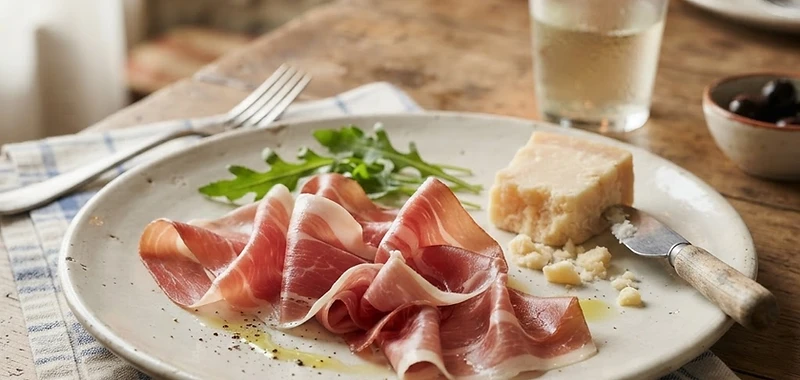
The ham that defines Italian cured meat. Pork leg, cured with only salt and air (no nitrates, no smoke), aged 12-36 months in the Parma hills, where the air from the sea and the mountains does the work. Sweet, silky, and pale. The 24-month version is the benchmark; the 36-month is deeper and more complex. Parma and San Daniele are the two great hams; Parma is the sweeter, more famous one.
Why go
To taste real Parma ham, aged 24 months, in Parma — where the air does the curing.
The Field Guide take
Prosciutto di Parma serves as the reference point for Italian cured meat. It is a dry-cured ham produced exclusively in the hills south of the city of Parma, in the Emilia-Romagna region. Its identity is defined by a reliance on only two ingredients—pork leg and sea salt—and the precise, seasonal movement of air through the Apennine foothills. While other regions of Italy produce excellent hams, Parma remains the standard-bearer for a delicate, silky texture and a flavor profile that leans toward the sweet rather than the sharp or fermented.
The nature of the product
Prosciutto di Parma is made from the hind legs of specific breeds of pig, typically Large White and Landrace, raised in Northern and Central Italy. The defining characteristic of this ham is its simplicity. By regulation, there are no additives such as nitrates, nitrites, or smoke.
The aging process, which spans a minimum of 12 months and can extend to 36 months, is designed to draw moisture from the meat through controlled dehydration. As the ham ages, the protein and fat break down, resulting in a texture that is buttery and a flavor that is fundamentally sweet. The 24-month mark is generally considered the peak for balance; the 36-month version develops a denser, more complex, and more intense savory profile.
Origin and the Parma microclimate
The production area is limited to a specific strip of land south of the Via Emilia, within the province of Parma. This geography is not incidental. The hills are positioned such that the air traveling from the Mediterranean Sea to the south is filtered through the Apennine Mountains. As it reaches the Parma region, this air is stripped of excess humidity, creating a dry, constant breeze. It is this natural air-curing that provides the ham with its characteristic finish. If a producer attempts to replicate these specific conditions outside of this geographic zone, the result is by definition not Prosciutto di Parma.
The production process
The process begins with the trimming and salting of the pork leg. A master salter (the maestro salatore) applies sea salt to the skin with a heavy hand, while leaving the lean muscle area to be treated with a lighter touch. The hams then rest in refrigerated rooms for several weeks to allow the salt to absorb evenly.
After resting, the hams are washed and hung in large, ventilated rooms known as stagionatura. These rooms feature windows that are strategically opened and closed to harness the mountain breezes. During the final months, the exposed muscle of the ham is coated with sugna—a mixture of pork fat, salt, and pepper—to prevent the exterior from drying out too quickly while the interior matures.
Where and how to consume it
While Prosciutto di Parma is available globally, traveling to the province of Parma offers the opportunity to taste the product at the source. In the city of Parma and the surrounding villages, the ham is usually served thinly sliced, often by machine, to preserve the integrity of the fat.
It is typically served at room temperature. If it is served too cold, the fat remains firm and the flavor is muted; at room temperature, the fat should begin to soften and glisten, essentially dissolving on the tongue. In local settings, it is commonly paired with torta fritta (fried dough) or fresh melon. While many equate the melon pairing with a seasonal summer dish, it is a year-round tradition in the region, relying on the contrast between the salt of the ham and the sugar of the fruit.
What to drink with it
In Emilia-Romagna, the standard pairing is a glass of dry Lambrusco. The wine’s natural effervescence and acidity serve to cleanse the palate of the ham’s silky, high-fat mouthfeel. A sparkling white wine or a crisp, dry Malvasia from the Parma hills also functions well, as they do not compete with the subtle, sweet notes of the meat.
When to seek an alternative
Travelers should note that Prosciutto di Parma is not a robust or aggressively seasoned ham. If you are seeking a product with a sharp, vinegar-forward bite or the heavy, acrid profile of smoked meat, this is not the ham for you. Prosciutto di Parma is an exercise in restraint. It is meant to be delicate, clean, and understated, relying on the quality of the raw material and the influence of the mountain air to do the work. If you prefer intensity over elegance, look elsewhere.
The Story
Where Prosciutto di Parma comes from
Prosciutto di Parma is the standard-bearer for Italian cured ham, produced in the hills surrounding Parma. Its fame is built on a specific microclimate, where the sea breezes from the Mediterranean are filtered through the Apennine Mountains, creating the perfect conditions for natural drying. It is a product of simplicity, requiring only pork, salt, and time.
What Defines It
Signature ingredients
Large White/Landrace pork
Heritage breeds that offer the ideal fat-to-meat ratio for long-term curing.
Sea salt
The only preservative allowed, applied by master salters who measure the intake exactly.
The Method
How it's made
The hams are salted, rested, and then hung in airy rooms to cure. A good version should be buttery and sweet, not overly salty, with a clean finish that dissolves on the tongue.
Timing
When to eat it
Year-round.
Serve With
Classic pairings
Lambrusco
wineThe dry, effervescent local wine effectively cuts through the salt and fat of the ham.
Melon
foodThe quintessential pairing; the cold, sweet fruit amplifies the nutty flavor of the aged pork.
What makes it worth going
Dry-cured ham from Parma, aged 12-36 months, with only salt and air — the most famous Italian ham.
Things to do
- producer
Prosciuttificio in Langhirano
The hill town above Parma where the air cures the ham. Book a cellar tour; the sea-mountain air is the secret. Many prosciuttifici open to visitors by appointment.
2 hrs
- museum
Museo del Prosciutto di Parma (Langhirano)
The history, the tools, the curing process. A short visit, pairs with a prosciuttificio tour.
1 hr
- salumeria
Salumeria Garibaldi (Parma)
In Parma center. Taste the 18, 24, and 36-month side-by-side. The difference is the lesson.
1 hr
- estate
Antica Corte Pallavicina (Polesine Parmense)
A working estate with culatello and prosciutto aging cellars, on the Po river. The full Emilian cured-meat experience in one place.
half day
Eat
- salumi
Prosciutto di Parma 24-month
The benchmark. Sweet, silky, pale. Eat in thin slices, with nothing or with melon.
- salumi
Prosciutto di Parma 36-month
Deeper, more complex, more intense. The aged version; the salt has done more work.
- antipasto
Prosciutto e melone
The summer classic: cold sliced melon and Parma ham. The sweet-salt contrast is the point.
Stay
- city
Parma center
The base; near the salumerias, the train, and the food. Walkable to the best counters.
- rural
Langhirano
In the hills, near the prosciuttifici. A car is required; the air here is the cure.
Experiences Worth Booking
Prosciutto cellar tour in Langhirano
2 hrsThe aging cellars, the 12-36 month wheels of ham, the salt-and-air cure, the tasting.
The air of Langhirano (sea-mountain) is the secret; a cellar visit is the only way to feel it.
Suits: Cured-meat lovers who want to see the air do the work.
Parma food day (Prosciutto + Parmigiano + Culatello)
full dayA prosciuttificio, a caseificio, and a culatello cellar. The three products of the Parma zone.
The three are made within 40 km; a guided day covers what solo touring can't.
Suits: Food travelers with one day for the Parma trinity.
What's nearby & pairs with
More food from Emilia-Romagna
Dish
Tagliatelle al Ragù
The real Bolognese — flat egg pasta ribbons with a slow-cooked meat sauce, nothing like the version the world knows.
Dish
Tortellini in Brodo
Tiny filled pasta rings in a clear capon broth — the most refined dish of Bologna.
Cheese
Parmigiano Reggiano
The king of Italian cheese — aged cow's milk, from a strictly defined zone around Parma and Reggio Emilia.
Cured Meat
Culatello di Zibello
The heart of the prosciutto, cured separately — the most refined cured pork in Italy.
Cured Meat
Mortadella di Bologna
Finely emulsified pork sausage from Bologna, studded with pistachios — the original 'bologna' and far better.
Ready to plan?
Ready to turn discovery into a trip?
Italy Field Guide helps you decide where to go. When you're ready to build the actual day-by-day itinerary, take your saved places to Travel Itinerary Co — your interests go with you.
Turn your saved Italy places into a trip