
The Verdict
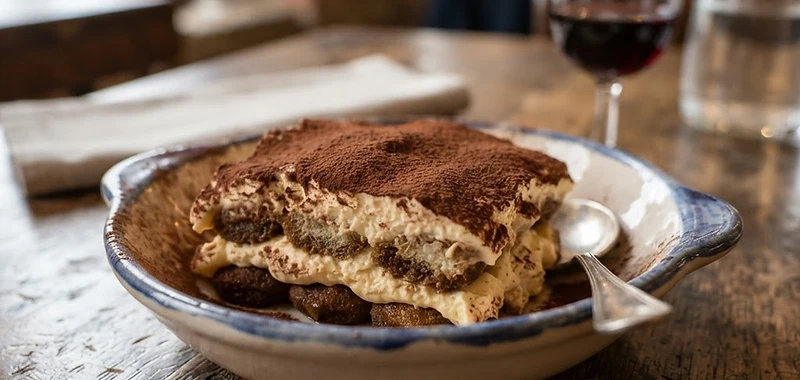
The dessert every Italian restaurant in the world serves, born in Treviso in the 1960s. Ladyfingers dipped in espresso, layered with a cream of mascarpone, egg yolks, and sugar, dusted with cocoa. Simple, rich, and better than its reputation — the bad imitations gave it a bad name. In Treviso and Venice, the original is worth re-evaluating.
Why go
To taste the original of the dessert everyone knows — in Treviso, where it was invented.
The Field Guide take
Tiramisù is the most globally recognized Italian dessert, a fixture on menus from Tokyo to New York. Despite its ubiquity, the dish has a specific geographic and temporal origin: the province of Treviso, in the Veneto region, during the late 1960s. While many versions exist abroad—often overly sweet or heavy with whipped cream—the original is a precise study in balance, relying on the structural integrity of biscuits and the bitterness of coffee to offset the richness of mascarpone.
What it is
At its most fundamental, Tiramisù is an assembly of espresso-soaked savoiardi (ladyfingers) layered with a custard-like cream made from mascarpone, egg yolks, and sugar, finished with a dusting of bitter cocoa powder. It is not baked. When prepared correctly, the result should be stable enough to be sliced into a neat square, yet possess a texture that dissolves instantly on the palate. The success of the dish depends entirely on the quality of the ingredients: the freshness of the eggs, the strength of the espresso, and the richness of the mascarpone.
Origin and history
Unlike many Italian dishes with origins lost to antiquity, Tiramisù is a modern invention. It appeared in Treviso in the late 20th century. While historical claims regarding its exact birthplace have been subject to local debate, it is widely accepted by culinary historians and the Accademia Italiana della Cucina that the dish emerged from the kitchens of the Veneto. It was conceived as a restorative, high-energy dessert, which is reflected in its name—tira mi sù, literally "pick me up," a reference to the caffeine and sugar content.
How it’s made
The assembly process is straightforward, though it demands patience. The savoiardi are dipped briefly into a cold, strong espresso; the goal is to saturate the biscuit without making it disintegrate. These are layered with a mixture of mascarpone, tempered egg yolks, and sugar. The inclusion of egg whites, often whipped into stiff peaks and folded into the mascarpone, is a common point of contention; some traditionalists insist on only yolks for density, while others prefer the lighter, aerated structure provided by the whites. Once layered, the dessert must be chilled for several hours to allow the cream to firm and the flavors to permeate the biscuits. The cocoa is added only at the moment of serving to prevent it from becoming damp or bitter.
Where to eat it
The most authentic experience is found in Treviso, the provincial capital. In the city center, several historic establishments maintain a direct lineage to the dessert’s inception. Outside of Treviso, Venice offers high-quality renditions, particularly in traditional bacari and long-standing restaurants that favor the classic ratios over modern modifications. When evaluating a restaurant, look for a version that is served from a large tray or a glass dish, indicating it has been set properly over time, rather than a single-serving portion that appears overly stabilized with gelatin or excessive cream.
When and how
Tiramisù is a year-round staple. Because it is served chilled, it is particularly suited to the warm, humid summers of the Venetian plain. It is rarely served as a heavy, multi-course meal conclusion; its density makes it a dessert intended to be shared or enjoyed in a small, deliberate portion. It is typically eaten with a small spoon to maintain the integrity of the layers as you work through the dish.
What to drink with it
The intensity of the espresso and the fat content of the mascarpone require a beverage that can cut through the richness without being eclipsed by the sweetness. A chilled glass of Recioto di Soave is the canonical pairing; this sweet, golden wine from the nearby Verona hills offers enough acidity and structure to complement the cocoa and cream. Avoid heavy, tannic red wines, which clash with the espresso notes. If opting for a non-alcoholic accompaniment, a small piece of hazelnut biscotti on the side can add a textural contrast to the velvet-soft cream of the Tiramisù.
The Story
Where Tiramisù comes from
Tiramisù is a relatively modern invention, surfacing in the Veneto region in the late 20th century. It quickly became the world's most famous Italian dessert due to its comforting combination of coffee and mascarpone. It is a balanced dish, with the bitterness of the coffee checking the sweetness of the cream.
What Defines It
Signature ingredients
Mascarpone
A triple-cream cheese that gives the dessert its characteristic richness.
Ladyfingers
Must be soaked just enough to be moist, but not disintegrated.
Strong espresso
The dark, bitter coffee is the essential foil to the heavy cream.
The Method
How it's made
Layers of cream and coffee-soaked biscuits are built and chilled. A good version should have a firm enough texture to be sliced cleanly, while remaining velvet-soft to the bite.
Timing
When to eat it
Year-round
Serve With
Classic pairings
Recioto di Soave
wineA sweet local dessert wine that highlights the creaminess.
Hazelnut biscotti
foodAdds an extra layer of crunch if served on the side.
What makes it worth going
Coffee-soaked ladyfingers layered with mascarpone and egg — the dessert the world adopted, born in Treviso.
Things to do
- pasticceria
I Treni (Treviso)
The pastry bar, in Treviso, that claims the invention. The tiramisù here is the original, with mascarpone, savoiardi, espresso, and Marsala. The custard is the test.
45 min
- ristorante
Ristorante La Caravella (Venice)
The historic Venice ristorante, near San Marco. The tiramisù is the benchmark; the savoiardi are soaked, not soggy. Reserve.
2 hrs
- pasticceria
Pasticceria Tonolo (Venice)
The Venice pastry institution. The tiramisù is by the portion, the coffee is the rival. Eat at the counter.
30 min
- experience
A tiramisù crawl in Treviso
The town claims the invention; the pastry bars all have a version. The crawl is the way to compare.
Eat
- dessert
Tiramisù
The classic: savoiardi (ladyfingers) soaked in espresso, layered with mascarpone, egg, and sugar, dusted with cocoa. The original has Marsala or rum; the modern is often alcohol-free.
- dessert
Tiramisù al pistacchio
The modern variation, with pistachio cream. A good one, but not the original; the classic is the test.
- drink
An espresso
The correct companion; the tiramisù is coffee, and the coffee should follow.
Stay
- city
Treviso center
The home of tiramisù; the pastry bars are here. A quieter, prettier base than Venice, 30 min by train.
- neighborhood
Venice (Cannaregio or San Polo)
Near Tonolo and the best pastry bars. The most authentic Venice base, away from San Marco.
Experiences Worth Booking
Tiramisù-making class
2 hrsThe mascarpone cream, the savoiardi, the espresso, the layering. The original with Marsala.
The cream is the technique — the eggs, the sugar, the mascarpone, the fold; a class shows you the texture.
Suits: Sweet tooths who want the original; the cream is the secret.
Treviso food day
full dayTiramisù, radicchio, prosecco. The three gifts of Treviso, in a day.
Treviso is the tiramisù capital and the radicchio capital; the prosecco is from here too.
Suits: Food travelers with a day for the Veneto hinterland.
What's nearby & pairs with
More food from Veneto
Dish
Risotto al Nero di Seppia
Rice blackened with cuttlefish ink — Venice's most dramatic plate and the cleanest seafood risotto.
Dish
Sarde in Saor
Fried sardines in a sweet-sour onion and raisin marinade — Venice's original sailors' snack.
Dish
Fegato alla Veneziana
Calf's liver and onions, cooked soft and sweet — the dish that made liver famous.
Dish
Bigoli all'Anatra
Thick, rough-stranded whole-wheat pasta with duck ragù — the rustic pasta of the Veneto.
Ready to plan?
Ready to turn discovery into a trip?
Italy Field Guide helps you decide where to go. When you're ready to build the actual day-by-day itinerary, take your saved places to Travel Itinerary Co — your interests go with you.
Turn your saved Italy places into a trip