
The Verdict
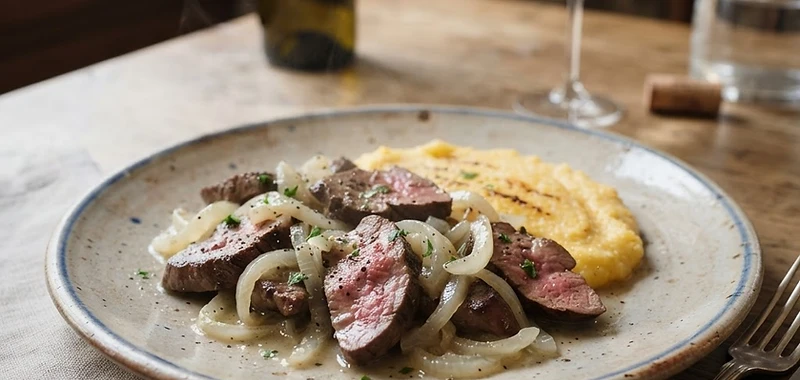
The liver dish that turned liver-haters into believers. Thin slices of calf's liver, cooked quickly with a pile of softened, caramelized onions, white wine, and a splash of vinegar or polenta on the side. The onions make the liver sweet; the speed keeps it tender. One of the great Venetian classics, and the dish that proves liver can be a luxury.
Why go
To taste the only liver dish worth ordering in Italy — soft, onion-sweet, in Venice.
The Field Guide take
Fegato alla Veneziana is the rare liver dish that has achieved a universal, almost legendary status in Italian dining. It is a defining plate of the Veneto region, transforming an organ meat often maligned for its metallic intensity into something soft, sweet, and fundamentally refined. By balancing the savory depth of calf’s liver with the natural sugars of slowly sweated white onions, this dish demonstrates the Venetian talent for elevating simple ingredients through precise technique.
What it is
At its most essential, Fegato alla Veneziana is a composition of thin strips of calf’s liver and a generous portion of white onions. It is not a heavy, stewed dish, but rather a study in timing. The onions are cooked until they lose their bite and become jam-like, while the liver is seared briefly, maintaining a tender, pink interior. It is served with a side of soft-cooked polenta, which acts as a vessel for the juices of the onion and meat.
Origin and history
The history of this dish links to the Roman practice of cooking liver with figs, a technique used to neutralize the liver’s inherent mineral sharpness. In the Venetian lagoon and the surrounding mainland, figs were eventually replaced by the region’s abundant white onions, particularly those sourced from nearby Chioggia or Treviso.
While the dish is categorized under cucina povera—the cooking of the poor—it was historically a luxury. Calf’s liver was a prized, expensive cut. The dish represents the Venetian mastery of trade and resourcefulness, using minimal pantry staples to frame a high-quality protein. Over the centuries, it moved from the domestic kitchen into the Venetian trattoria, becoming a fixed pillar of the regional menu.
How it’s made
The success of the dish relies entirely on two stages: the slow cooking of the onions and the rapid searing of the meat. The onions are sliced thin and sweated in olive oil over low heat. They should turn translucent and sweet, not dark brown or charred.
The liver, cut into uniform strips or medallions, is introduced only at the final moment. It must hit a hot pan and be cooked quickly; any prolonged time on the heat causes the proteins to seize, resulting in a grainy, dry, and unpleasantly metallic texture. A final splash of dry white wine or vinegar is used to deglaze the pan, picking up the rendered juices and coating the meat in a light, savory emulsion.
Regional variations
While Venice is the home of the dish, nearby provinces offer subtle variations. In Treviso, it is common to see the dish prepared with the addition of Radicchio di Treviso. The characteristic bitterness of the radicchio serves as a sharp, structural contrast to the sweetness of the white onions. In Vicenza, variations often depend on the local harvest, frequently utilizing larger, sweeter storage onion varieties common to the foothills of the Alps.
Where to eat it
Seek out traditional trattorias or osterie in the historic districts of Venice, such as Cannaregio or Castello. Look for establishments that emphasize a short, seasonal menu rather than those that display expansive, multi-page offerings. The dish is a staple in the Venetian culinary canon and does not require a luxury setting to be authentic; in fact, the most reliable versions are found in quiet, family-run rooms where the kitchen focuses on traditional technique.
When and how
While Fegato alla Veneziana appears on menus throughout the year, it is best ordered during the cooler months. This aligns with the seasonal harvest of high-quality onions and the appetite for the warm, comforting profile of the dish. It is served as a secondo (main course), almost always accompanied by a scoop of creamy, unadorned polenta.
What to drink with it
The pairing depends on the acidity and the weight of the dish. A Valpolicella Ripasso—a medium-bodied red from the Veneto—provides enough fruit and structure to stand up to the richness of the liver. Alternatively, for those who prefer white wine, a Soave Classico offers the necessary acidity and mineral quality to cut through the sweetness of the onions and the creamy texture of the polenta. Both are local to the Veneto and highlight the symbiotic relationship between the region's food and its vineyards.
The Story
Where Fegato alla Veneziana comes from
Fegato alla Veneziana is a historic staple of Venetian cuisine, rooted in the city's long-standing connection to trade and animal husbandry. The dish relies on the combination of calf's liver and white onions, a pairing that reflects the influence of the Romans, who were known to cook liver with figs to balance the organ's metallic intensity. In the Venetian context, the figs were eventually replaced by the abundant, mild-tasting onions of the region, particularly those from Chioggia or Treviso.
While simple in composition, the dish was historically considered a luxury due to the cost of high-quality calf's liver. It solidified its place in the Venetian culinary canon as a domestic comfort food that demanded high-quality, fresh ingredients. It is a quintessential example of 'cucina povera' techniques applied to what was essentially a prized, nutrient-dense cut, transformed through careful temperature control and the balancing of sweet and acidic notes.
What Defines It
Signature ingredients
Calf's liver
Must be sourced from a young calf to ensure a mild, creamy texture rather than the iron-heavy toughness of beef liver.
White onions
Specifically the sweet, thin-skinned white onions of Chioggia or similar varieties; they must be translucent and buttery, not browned or crisp.
White wine
Used to deglaze the pan and provide a necessary acidic lift that cuts through the richness of the liver.
Extra virgin olive oil
Provides the fat for cooking the onions low and slow, acting as the base for the final emulsion.
Polenta
Standard serving vessel, acting as a neutral, soft foundation to soak up the onion-infused juices.
The Method
How it's made
The process begins by sweating thinly sliced onions in oil over low heat until they are soft and translucent, not caramelized to a dark brown state. The liver is cut into thin, uniform strips or medallions and added to the pan only at the very end. The meat must be seared rapidly over high heat; overcooking is the most common error, which renders the liver grainy and metallic. A splash of white wine or vinegar is added just before finishing to deglaze the pan, creating a slight sauce that ties the sweet onions to the savory meat. A well-made version remains pink and tender at the center.
Across Italy
Regional variants
Venice
The canonical version focusing on the pure balance of onion sweetness and tender liver.
Treviso
Often features the addition of Radicchio di Treviso, which provides a bitter contrast to the sweetness of the onions.
Vicenza
May incorporate local variations in the type of onion used, specifically utilizing larger, sweeter local storage varieties.
Timing
When to eat it
While available year-round, it is most frequently prepared in the cooler months when onions are harvested and the appetite for heartier, warm dishes increases. It is a standard feature in traditional trattorias throughout the year.
Serve With
Classic pairings
Valpolicella Ripasso
wineThe red fruit and medium body complement the richness of the liver without overpowering it.
Soave Classico
wineA structured white wine with enough minerality to hold up against the sweet onions.
Polenta e osei
foodThe traditional, essential starch side that provides the necessary texture to balance the soft liver.
What makes it worth going
Calf's liver and onions, cooked soft and sweet — the dish that made liver famous.
Things to do
- trattoria
Trattoria alla Madonna (Venice)
The benchmark fegato alla veneziana, in the Cannaregio. The liver is cooked with onions and vinegar; the polenta is the companion. Reserve.
2 hrs
- osteria
Osteria Anice Stellato
In the Cannaregio, on a quiet canal. The fegato is correct; the polenta is the base. Reserve.
2 hrs
- trattoria
A Venetian trattoria off the tourist path
The dish is traditional; the best version is in a trattoria that the Venetians go to, not the one the tourists find. Ask a local.
- experience
A Venetian cooking class
The fegato is the lesson; the onions and the vinegar are the technique, the polenta is the base.
Eat
- main
Fegato alla veneziana
The classic: sliced calf's liver, cooked with onions and vinegar, served on polenta. The sweet-sour is the mark; the liver is the base.
- side
Polenta
The companion; soft polenta, or grilled polenta. The base for the liver and the sauce.
Stay
- neighborhood
Venice (Cannaregio)
Near the best trattorias for the fegato. The most authentic Venice base.
- neighborhood
Venice (San Polo / Dorsoduro)
Quieter, with good trattorias and fewer tourists.
Experiences Worth Booking
Venetian cooking class
3 hrsFegato alla veneziana, risotto al nero di seppia, sarde in saor. The Venetian classics in one class.
The fegato is an offal dish; a class shows you the slice, the onions, the vinegar, and the rest.
Suits: Adventurous home cooks who want the Venetian offal and fish.
Venice food walk
4 hrsCicchetti, the fish market, a fegato lunch. The full Venetian arc.
Venice's food is the sea and the offal; a walk covers the bacari, the market, and the trattoria.
Suits: Eaters who want the city's food in a day.
What's nearby & pairs with
More food from Veneto
Dish
Risotto al Nero di Seppia
Rice blackened with cuttlefish ink — Venice's most dramatic plate and the cleanest seafood risotto.
Dish
Sarde in Saor
Fried sardines in a sweet-sour onion and raisin marinade — Venice's original sailors' snack.
Dish
Bigoli all'Anatra
Thick, rough-stranded whole-wheat pasta with duck ragù — the rustic pasta of the Veneto.
Dish
Tiramisù
Coffee-soaked ladyfingers layered with mascarpone and egg — the dessert the world adopted, born in Treviso.
Ready to plan?
Ready to turn discovery into a trip?
Italy Field Guide helps you decide where to go. When you're ready to build the actual day-by-day itinerary, take your saved places to Travel Itinerary Co — your interests go with you.
Turn your saved Italy places into a trip