
The Verdict
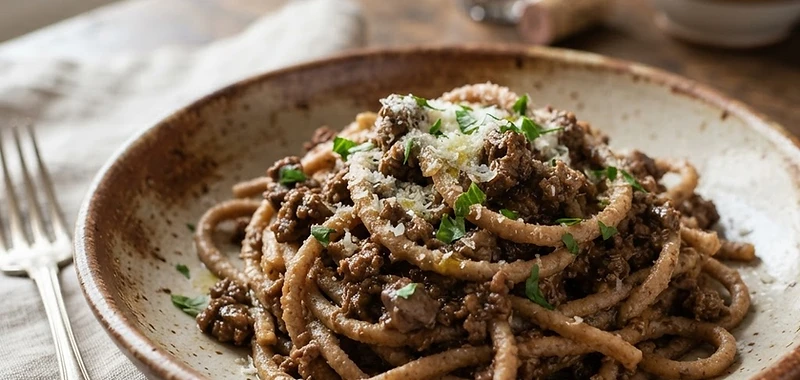
The pasta that's the opposite of refined Venetian food, and is loved for it. Bigoli: thick, long, extruded through a press, so the strand is rough and holds sauce. With a slow duck ragù — duck, onion, tomato, and herbs, simmered until the meat shreds. Heavy, gamey, and the cold-weather pasta of the Veneto mainland. Wash it down with a Valpolicella or an Amarone.
Why go
To taste the rustic side of Venetian food — thick pasta, duck, and red wine.
The Field Guide take
Bigoli all’anatra is the definitive pasta dish of the Venetian mainland. It is a dense, utilitarian meal born from the agricultural plains of the Veneto, favoring the heartiness of whole-wheat flour and farm-raised duck over the delicate, egg-based pastas common further south in Emilia-Romagna. It is a dish that exists as a practical response to the cold, damp winters of northern Italy.
What it is
Bigoli is a thick, extruded pasta strand with a noticeably rough, porous surface. This texture is intentional; it is designed to grip heavy sauces rather than allow them to slide off. When paired with a ragù made from duck—specifically in the provinces of Vicenza and Padua—the result is a heavy, gamey, and exceptionally filling dish. It is a staple of the region's inland cuisine, distinct from the fish-centric menus of the Venetian lagoon.
Origins and history
The history of bigoli is rooted in the cucina povera of the Venetian hinterland. Traditionally, the dough was made using simple staples: whole-wheat flour, water, and sometimes duck eggs. The use of duck in the sauce stems from the rural tradition of the Venetian plains, where families kept ducks on smallholdings. Because these birds were an accessible, seasonal protein, they became the centerpiece for Sunday meals and significant celebrations. The dish remains a primary link to the agrarian history of the region, emphasizing substance and caloric density.
How it’s made
The identity of bigoli is defined by the torchio bigolaro, a hand-cranked press that forces dough through a die to create the long, thick strands. The friction caused by this manual extrusion creates a microscopic roughness on the surface of the pasta, which is essential to the dish's final quality. Modern industrial pasta, which is typically smooth, cannot replicate this.
The ragù is a slow-cooked process. The duck meat, often including the giblets to add depth and mineral complexity, is minced and sautéed with a generous base of aromatics—typically onion. The mixture is then simmered for several hours with red wine and stock until it reduces into a concentrated, dark, and almost jam-like consistency. A proper version is never rushed; the meat must be fully broken down and tender, ensuring the sauce is uniform rather than chunky.
Where to eat it
If you are traveling in the Veneto, look for this dish in the rural towns of the Vicenza and Padua provinces. These areas maintain the strongest links to the traditional preparations that use locally raised poultry. While the dish can be found in restaurants within the city of Venice, it is worth noting that Venetian culinary history historically favored bigoli in salsa—a sauce of onions and salted anchovies—due to the city’s maritime trade routes. For the authentic duck-based version, moving away from the lagoon and into the mainland plains is the most reliable approach. Seek out trattorias that emphasize local, farm-to-table sourcing, as the quality of the duck is the primary variable in the success of the ragù.
When and how
Bigoli all’anatra is a seasonal dish, intended for the autumn and winter months. It is particularly associated with the feast day of San Martino in November, a traditional marker for the end of the agricultural cycle, when the year’s ducks would have reached their peak maturity. Because it is a heavy dish, it is rarely served in warmer seasons. It is best eaten as a single, substantial main course, often accompanied by Radicchio di Treviso, which provides a necessary bitter contrast to the richness of the duck and the density of the pasta.
What to drink with it
The intensity of the duck ragù requires a wine with sufficient structure and acidity to cut through the fat and match the gamey flavor of the meat. A Valpolicella Ripasso, which offers a balance of fruit and moderate tannins, is a standard pairing. For a more robust experience, an Amarone della Valpolicella provides the depth required to stand up to the concentrated, slow-cooked sauce. Both wines reflect the viticulture of the Veneto and complement the dish's rustic profile.
The Story
Where Bigoli all'Anatra comes from
Bigoli is a signature pasta of the Veneto, traditionally made using a 'torchio bigolaro,' a hand-cranked wooden or metal press that produces thick, porous strands with a distinct, rough texture. Unlike the egg-rich, silky pasta doughs of Emilia-Romagna, bigoli dough relies on whole-wheat flour, water, and sometimes duck eggs, resulting in a firm, chewy bite that is designed to stand up to heavy, gamey sauces. The tradition of using duck in the sauce is centered in the provinces of Vicenza and Padua, where the rural tradition of keeping ducks on farms made them a staple protein for special occasions and Sunday family meals. The dish is essentially a product of the 'cucina povera' of the Venetian mainland, reflecting the ingenuity of using seasonal, farm-raised poultry and grains to create a substantial, filling meal. It is a dish born of the flat, agricultural plains of the Veneto, distinct from the fish-heavy cuisine of the Venetian lagoon.
What Defines It
Signature ingredients
Whole-wheat flour
Provides the characteristic nutty flavor and structural density required for the heavy ragù.
Duck meat
The primary protein; it offers a high fat content and deep, gamey flavor profile that defines the sauce.
Onions
Used in significant quantities to provide a natural sweetness and body to the sauce as they break down during the slow braise.
Duck giblets
Often included in traditional recipes to intensify the depth of the sauce's savory character.
Red wine
Used to deglaze the pan and braise the duck, adding acidity to balance the richness of the fat.
The Method
How it's made
The defining step is the extrusion. A quality version of bigoli must have a rough surface texture, which is achieved through the use of a traditional press; this friction ensures the sauce clings to the pasta rather than sliding off. The ragù is a slow-cooked affair where the duck is finely chopped or minced, then sautéed with a generous base of aromatics before being simmered for several hours with wine and stock. A well-made ragù should be dark, concentrated, and nearly jam-like in consistency. A careless version often uses store-bought, smooth-surfaced pasta or undercooked duck that lacks the essential tenderness and depth of a true, long-simmered ragù.
Across Italy
Regional variants
Vicenza
Often features the most classic preparation using a higher proportion of duck meat and giblets in the ragù.
Padua
Similar to the Vicentine style but may occasionally incorporate a broader range of garden herbs and varying ratios of onion sweetness.
Venice (City)
Historically, versions here might replace duck with 'bigoli in salsa,' a sauce made of onions and salted anchovies, due to the city's maritime trade history.
Timing
When to eat it
This is a quintessential autumn and winter dish. It is frequently associated with the feast day of San Martino in November, marking the end of the agricultural cycle when the duck would be at its peak maturity.
Serve With
Classic pairings
Valpolicella Ripasso
wineProvides the necessary fruit-forward profile and acidity to cut through the richness of the duck fat.
Amarone della Valpolicella
wineThe robust tannins and higher alcohol content match the intensity of the gamey meat.
Radicchio di Treviso
foodThe bitter profile of this grilled or roasted vegetable serves as a necessary palate cleanser against the heavy pasta.
What makes it worth going
Thick, rough-stranded whole-wheat pasta with duck ragù — the rustic pasta of the Veneto.
Things to do
- trattoria
Trattoria alla Madonna (Venice)
In the Cannaregio. The bigoli all'anatra is the benchmark; the bigoli is the thick, rough pasta that holds the duck ragù. Reserve.
2 hrs
- osteria
Osteria al Squero (Venice)
Near the last gondola yard. The bigoli is hand-extruded, the duck ragù is slow. A classic Venetian osteria.
1.5 hrs
- trattoria
A trattoria in Verona or Padua
On the mainland, where the bigoli is made. The duck is from the Veneto; the ragù is the slow cook.
2 hrs
- experience
A bigoli-making demonstration
The bigoli is extruded through a torchio (a press), which gives it the rough texture that holds the sauce. The technique is Venetian.
Eat
- pasta
Bigoli all'anatra
The classic: thick, rough whole-wheat bigoli, with a slow duck ragù. The roughness holds the sauce; the duck is the depth.
- pasta
Bigoli in salsa
The other classic, with an anchovy and onion sauce. The salt and the sweet are the marks.
- wine
A glass of Valpolicella or Soave
The Veneto red or white; the correct pairing.
Stay
- neighborhood
Venice (Cannaregio or San Polo)
Near the best trattorias and the bigoli. The most authentic Venice base, away from San Marco.
- city
Verona or Padua
The mainland bases, with good trattorias and easier access.
Experiences Worth Booking
Bigoli-making class with a torchio
3 hrsThe dough, the extrusion through the press, the rough texture. The duck ragù, slow-cooked.
The bigoli is extruded, not rolled; a class shows you the press and the rough surface that holds the sauce.
Suits: Pasta makers who want the Venetian technique; the torchio is the secret.
Venetian food day
full dayCicchetti, bigoli, sarde in saor. The full Venetian arc, with the bigoli as the main.
Venice has its own food; a day covers the cicchetti, the pasta, and the fish.
Suits: Food travelers with a day for Venice.
What's nearby & pairs with
More food from Veneto
Dish
Risotto al Nero di Seppia
Rice blackened with cuttlefish ink — Venice's most dramatic plate and the cleanest seafood risotto.
Dish
Sarde in Saor
Fried sardines in a sweet-sour onion and raisin marinade — Venice's original sailors' snack.
Dish
Fegato alla Veneziana
Calf's liver and onions, cooked soft and sweet — the dish that made liver famous.
Dish
Tiramisù
Coffee-soaked ladyfingers layered with mascarpone and egg — the dessert the world adopted, born in Treviso.
Ready to plan?
Ready to turn discovery into a trip?
Italy Field Guide helps you decide where to go. When you're ready to build the actual day-by-day itinerary, take your saved places to Travel Itinerary Co — your interests go with you.
Turn your saved Italy places into a trip