
The Verdict
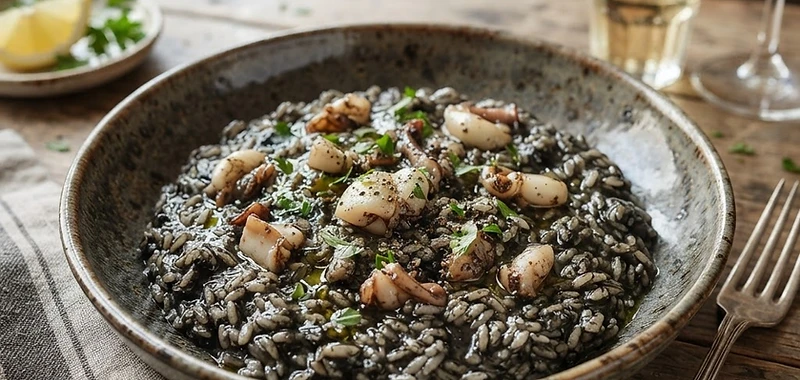
The dish that turns a plate black and a fork purple. Carnaroli rice, cooked with cuttlefish, white wine, and the cuttlefish's own ink, until the rice is a glossy, jet-black mass. Briny, mineral, and elegant — the ink is not a flavor, it's a texture and a color. Eaten in a Venetian bacaro or trattoria, looking at a canal. The stain on your lips is the proof you ate it.
Why go
To eat the most dramatic plate in Italy — black rice, from a Venice backstreet.
The Field Guide take
Risotto al Nero di Seppia is the defining plate of the Venetian lagoon. While the city’s cuisine is often defined by its historical status as a trading crossroads, this dish remains strictly local, born from the brackish waters that surround the islands. It is a striking, monochromatic experience that prioritizes the salinity of the Adriatic over the typical richness of northern Italian risottos.
What it is
The dish is a risotto colored and flavored with the ink sacs of the seppia (cuttlefish). The final result is a glossy, jet-black mound that coats the tongue and leaves a temporary dark stain on the lips. The ink itself does not possess a strong, fishy flavor; instead, it provides a savory, mineral depth that binds the rice. It is not heavy with butter or cheese, as is common in the risotto traditions of Milan or Piedmont. In Venice, the focus is on the clean, briny essence of the sea.
History and evolution
The dish is a byproduct of a necessity-driven fishing culture. Historically, Venetian lagoon fishermen operated on a principle of total usage; because the ink sacs were an inherent part of the cuttlefish, they were incorporated into cooking rather than discarded. What began as a humble, utilitarian meal prepared on boats or in waterside kitchens evolved into a signature of the city’s trattoria culture. While the exact timeline of its move from the fishing nets to the dining table is not recorded, it has long been the standard by which a Venetian kitchen is measured. It serves as a culinary marker of the city’s identity, representing a reliance on the lagoon’s biodiversity that has persisted for centuries.
The preparation
A successful risotto al nero relies on the delicate handling of the ink. The process begins with cleaning the cuttlefish and extracting the ink sacs intact. If the sac breaks prematurely, the ink loses potency or becomes difficult to measure. The mantle of the cuttlefish is sliced and sautéed with a base of onion and occasionally garlic or parsley. Carnaroli rice is toasted in this mixture before white wine is added and evaporated. As the rice cooks, the cook gradually adds hot fish stock. The ink is stirred in toward the end of the process, transforming the rice into a uniform, obsidian black.
A well-executed version should be creamy but distinct; the grains should remain firm to the bite. A poorly made version—often found in establishments prioritizing convenience over technique—results in mushy rice and a metallic, harsh flavor if the ink ratio is unbalanced.
Where to find it
Venice is the canonical home of this dish. You will find it in the city’s traditional trattorias and bacari (wine bars). While variants exist—Trieste offers versions with slightly different aromatic profiles reflecting its Balkan and Austro-Hungarian influences, and parts of Puglia occasionally serve an ink-stained pasta—the Venetian preparation is the standard. If you travel outside the Veneto, the quality and the intent of the dish often diminish. Stick to the kitchens that have a clear, direct connection to the Rialto fish market.
When and how to eat it
While you will see the dish on menus throughout the year in high-traffic tourist areas, it is at its best during the spring and early summer. This is when the Adriatic catch of cuttlefish is most abundant, ensuring that the seafood is fresh rather than frozen. When dining, expect an informal experience. This is not a dish for formal attire, as the ink is unforgiving. It is best enjoyed in a quiet trattoria near the water, where the salt air complements the salinity of the risotto.
What to drink with it
Because the dish is built on the salinity of the lagoon, the wine pairing should follow a similar logic. A crisp, dry white wine from the nearby hills is the standard choice. A Soave Classico provides the necessary acidity to cut through the starch of the rice without overpowering the mild seafood notes. Alternatively, a dry Prosecco di Valdobbiadene works well; its effervescence and clean finish mirror the lightness of a well-prepared risotto. If starting a meal with sarde in saor—the sweet-and-sour sardine dish—a glass of the same white wine will carry you perfectly through to the arrival of the black risotto.
The Story
Where Risotto al Nero di Seppia comes from
Risotto al Nero di Seppia is deeply rooted in the fishing traditions of the Venetian lagoon. Historically, coastal communities valued every part of the catch, and ink sacs—often discarded in other culinary traditions—were utilized to add moisture and depth to rice dishes. It evolved as a humble, utilitarian meal for fishermen who used the freshest, ink-filled cuttlefish caught in the brackish waters of the Adriatic. Over time, it transitioned from a local home-cooked staple to a signature dish of Venetian trattorias, serving as an expression of the city's unique maritime environment. While its origins are debated regarding specific timelines, it is undeniably tied to the Venetian identity and the city's historical reliance on the lagoon’s biodiversity.
What Defines It
Signature ingredients
Cuttlefish ink
Provides the essential dark color and a subtle, saline, mineral undertone that binds the dish.
Carnaroli rice
Preferred for its high starch content and ability to hold a firm al dente texture while absorbing the ink.
Fresh cuttlefish
Adds firm, tender texture to contrast with the creamy rice.
Dry white wine
Used to deglaze the pan and provide the necessary acidity to balance the richness of the ink.
Extra virgin olive oil
Used for the base sauté, adding a fruity depth that complements the seafood.
The Method
How it's made
The process begins by cleaning the cuttlefish and carefully removing the ink sac without rupturing it prematurely. The mantle is sliced and sautéed with onion, garlic, and sometimes parsley before the rice is toasted to toast the grains. White wine is added and evaporated, followed by the gradual addition of hot fish stock. The ink is stirred in during the final minutes of cooking. A well-made version is glossy and maintains a distinct creaminess without being soupy. A careless version often suffers from overcooked, mushy rice or an excessive, metallic-tasting ink concentration that overwhelms the delicate flavor of the cuttlefish.
Across Italy
Regional variants
Venice
The canonical version, prioritizing the natural salinity of the lagoon.
Trieste
Often prepared with slightly different variations in aromatics, reflecting the city's historical Austro-Hungarian and Balkan culinary influences.
Apulia
While less common than in the north, some coastal towns serve a variant using pasta instead of rice, showcasing their own regional seafood preferences.
Timing
When to eat it
While available year-round in tourist-facing restaurants, the dish is best when cuttlefish is in season, typically in the spring and early summer when the catch is most abundant in the Adriatic.
Serve With
Classic pairings
Soave Classico
wineA crisp, mineral-forward white wine from the nearby Veneto region that stands up to the briny quality of the dish.
Prosecco di Valdobbiadene
wineThe effervescence and acidity help cut through the richness of the starchy rice.
Sarde in Saor
foodA traditional Venetian sweet-and-sour sardine appetizer that balances the intensity of the black risotto.
What makes it worth going
Rice blackened with cuttlefish ink — Venice's most dramatic plate and the cleanest seafood risotto.
Things to do
- osteria
Osteria al Squero (Venice)
The benchmark risotto al nero di seppia, near the gondola yard. The cuttlefish ink is the color and the flavor; the rice is the base. Reserve.
1.5 hrs
- trattoria
Trattoria alla Madonna
In the Cannaregio. The risotto is correct; the cuttlefish is the source, the ink is the mark.
2 hrs
- market
The Rialto fish market
The source of the cuttlefish and the ink. The market is where the freshest is sold; the risotto is only as good as the cuttlefish.
- experience
A Venetian cooking class
The risotto al nero di seppia is the lesson; the ink, the stock, the all'onda. The black is the show.
Eat
- risotto
Risotto al nero di seppia
The classic: Carnaroli rice, cuttlefish, cuttlefish ink, white wine, onion, and broth. The ink is the color and the flavor; the rice should be all'onda (wavy).
- main
With fritto misto di pesce
The Venetian fried seafood, as a companion or a second. Order both, share.
Stay
- neighborhood
Venice (Cannaregio or San Polo)
Near the best trattorias and the fish market. The most authentic Venice base.
- neighborhood
Rialto area
Near the fish market; the central, walkable base.
Experiences Worth Booking
Venetian risotto class
3 hrsThe risotto al nero di seppia, the all'onda texture, the ink. The stock and the stir are the technique.
The risotto is all'onda; a class shows you the stock, the toast, the stir, and the ink.
Suits: Home cooks who want the Venetian risotto; the ink is the show.
Venice fish market and lunch
4 hrsA guided market visit, a risotto al nero di seppia lunch. The market is the source.
The risotto is the market; a guide finds the best cuttlefish and the best trattoria.
Suits: Eaters who want the fish at its freshest.
What's nearby & pairs with
More food from Veneto
Dish
Sarde in Saor
Fried sardines in a sweet-sour onion and raisin marinade — Venice's original sailors' snack.
Dish
Fegato alla Veneziana
Calf's liver and onions, cooked soft and sweet — the dish that made liver famous.
Dish
Bigoli all'Anatra
Thick, rough-stranded whole-wheat pasta with duck ragù — the rustic pasta of the Veneto.
Dish
Tiramisù
Coffee-soaked ladyfingers layered with mascarpone and egg — the dessert the world adopted, born in Treviso.
Ready to plan?
Ready to turn discovery into a trip?
Italy Field Guide helps you decide where to go. When you're ready to build the actual day-by-day itinerary, take your saved places to Travel Itinerary Co — your interests go with you.
Turn your saved Italy places into a trip