
The Verdict
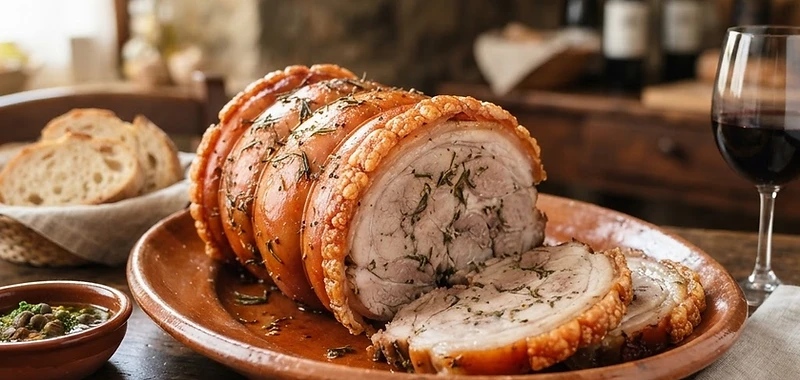
The great Italian street meat. A whole pig, deboned, stuffed with garlic, rosemary, fennel, and wild herbs, rolled and slow-roasted for hours until the skin is crackling and the inside is herb-scented and tender. Sliced and served in a roll, it's the food of markets and festivals across central Italy. The Lazio and Umbrian versions (Ariccia and Norcia) are the famous ones. No sandwich beats it.
Why go
To eat the best pork sandwich in Italy — from a market, in a roll, with crackling.
The Field Guide take
Porchetta is the definitive street food of central Italy. It is a whole deboned pig, stuffed with aromatics, rolled, and slow-roasted until the skin shatters and the meat turns succulent. You will find it served from the back of vans at roadside markets, in specialized butcher shops, and at local festivals throughout the Castelli Romani region and beyond. It is not a formal meal; it is food meant to be eaten standing up, usually tucked into a simple roll of local bread.
What it is
At its core, porchetta is a technical exercise in patience and heat management. It is a whole, young pig—deboned and butterflied—that is seasoned heavily on the interior with garlic, salt, pepper, and wild fennel. The carcass is rolled tightly, tied, and roasted in a specialized oven. The goal is a uniform result: the rind must become glassy and crisp, while the interior meat remains moist and deeply infused with the herbal aromatics. When sliced, it presents as a swirl of pale meat, darker, herb-marinated sections, and a thick, jagged collar of crackling.
Origin and history
The practice of roasting a whole pig is ancient, with roots in the rural traditions of the Roman countryside. Historically, it was a practical solution for feeding large groups of laborers and farmers during festivals or market days. Because it utilizes the entire animal, it served as a centerpiece for community celebrations. Over centuries, the technique migrated from farmhouse ovens to the town squares of Lazio and Umbria. While many towns in central Italy claim their own version, the influence of the Roman tradition remains the dominant standard for the product.
How it’s made
The process begins with the selection of the pig, which must be lean enough to prevent excess grease but mature enough to hold the structure of the roll. After the bones are removed, the inside of the animal is coated with a mixture of salt and wild fennel—the latter is non-negotiable for the authentic flavor profile. Garlic is added, sometimes crushed or slivered, to permeate the meat during the long hours in the oven. The tight binding of the meat ensures that as the fat renders, it bastes the muscle tissue from the inside out. The roast is finished when the skin achieves a consistent, golden-brown crust that yields with a distinct crunch when cut.
Where to eat it
If you are seeking the benchmark for this preparation, head to Ariccia. This town in the Castelli Romani, southeast of Rome, holds a status for porchetta that is essentially the industry standard. Ariccia produces a protected version of the meat, and the town is filled with fraschette—rustic establishments where porchetta is the primary feature. You can also find high-quality specimens in Norcia, where the local butchery tradition emphasizes a slightly different herbal balance. In Rome, look for specialized porchettari—vendors who specialize exclusively in this product—often parked near markets or high-traffic pedestrian areas.
When and how
Porchetta is available year-round. It is best consumed as panino con la porchetta. The meat should be sliced to order, never pre-cut and sitting out, as the moisture will cause the skin to lose its structural crispness. It is served inside pane di Genzano, a local bread with a thick crust and a dense crumb that holds up well to the fat and juices of the meat. There is no need for condiments like mayonnaise or mustard; the flavor of the fennel, garlic, and rendered fat is intended to be the only seasoning.
What to drink with it
The salt and fat of the pork require a wine with high acidity to cleanse the palate. The local pairing is consistently Frascati Superiore. This white wine from the hills surrounding Rome is crisp, mineral-forward, and light enough that it does not compete with the intensity of the herbs. Because porchetta is almost exclusively a casual, street-side experience, you will frequently find it served in plastic cups alongside the sandwich. Do not look for complexity in the glass; look for a refreshing, acidic counterpoint to the richness of the roast.
The Story
Where Porchetta comes from
Porchetta is the quintessential Italian street food, with its roots deep in the Roman countryside. It was a celebratory meal for laborers and farmers, utilizing the whole pig to feed a crowd. The slow-roasting method is ancient, designed to transform tough cuts into tender meat while rendering the skin to a glass-like crisp.
What Defines It
Signature ingredients
Whole pig
The animal must be of specific size for even cooking of the meat and skin.
Wild fennel
Provides a critical aromatic hit that cuts through the intense fat.
Garlic
Infuses the meat from the inside out during the long roast.
The Method
How it's made
The pig is deboned, seasoned with herbs and salt inside, rolled tight, and roasted whole. A good version is defined by the contrast between the juicy, herb-infused interior meat and the perfectly shattered, crispy rind.
Across Italy
Regional variants
Ariccia
Widely considered the gold standard, often protected by local heritage status.
Timing
When to eat it
Year-round
Serve With
Classic pairings
Frascati Superiore
wineA crisp white wine that cuts through the heavy fat of the pork.
Pane di Genzano
foodA dense crusty bread perfect for holding thick slices of porchetta.
What makes it worth going
Whole deboned pig, stuffed with herbs and garlic, slow-roasted until crackling — the great Italian street meat.
Things to do
- street food
A porchetta stand (porchettaro) in a Lazio or Umbria town
The porchetta is the street food of central Italy; the porchettaro is the vendor. The pork is deboned, stuffed with herbs, rolled, and roasted. The sandwich is the dish.
20 min
- street food
A porchettaro in Ariccia (the home)
Ariccia, in the Castelli Romani, is the home of the porchetta. The porchettari are in the square; the sandwich is the tradition.
1 hr
- festival
A porchetta festival (e.g. Ariccia, September)
The town's 'Sagra della Porchetta', with the pork in the square. The roast is the show; the herbs are the smell.
full day
- trattoria
A central-Italian restaurant for porchetta as a main
The porchetta is the street food, but it's also a main in a trattoria; the sliced pork, the herbs, the crackling.
2 hrs
Eat
- street food
Porchetta sandwich
The classic: a roll of pork (deboned, stuffed with rosemary, garlic, fennel, and wild herbs), roasted, sliced, and served in a bread roll. The crackling (cotenna) is the luxury.
- main
Porchetta sliced, as a main
The same pork, sliced on a plate, in a trattoria. The herbs are the flavor; the crackling is the texture.
- wine
With a Cesanese or Montepulciano
The central-Italian red; the correct pairing for the pork and the herbs.
Stay
- town
Ariccia or the Castelli Romani
The home of the porchetta, in the hills south of Rome. A car or the train (FLR) is useful.
- town
Norcia (the other home)
In Umbria, the other porchetta capital; the herbs are the local wild fennel. A car is required.
Experiences Worth Booking
Porchetta stand crawl in Ariccia
2 hrsA guided tour of the Ariccia porchettari, with tastings at 3-4 stands. The crackling is the test.
The porchetta is the street food; a crawl finds the best porchettari and the best crackling.
Suits: Street-food lovers who want the porchetta at its source.
Castelli Romani food day
full dayA porchetta lunch in Ariccia, a Frascati wine cellar, a Nemi visit. The full Castelli arc.
The porchetta, the Frascati, and the lakes are the Castelli; a day covers all.
Suits: Food and wine travelers with a day for the hills south of Rome.
What's nearby & pairs with
More food from Lazio
Dish
Carbonara
Rome's most famous pasta — guanciale, pecorino, egg yolk, and pepper, emulsified into a sauce with no cream.
Dish
Cacio e Pepe
Rome's minimalist masterpiece — pasta, pecorino, and pepper, emulsified with pasta water into a sauce.
Dish
Amatriciana
Rome's tomato pasta — guanciale, tomato, pecorino, and chili. The root of the Roman pasta family.
Dish
Gricia
The oldest Roman pasta — guanciale and pecorino, no tomato, no egg. 'White amatriciana.'
Cheese
Pecorino Romano
Sheep's milk cheese, salty and sharp — the grating cheese of Rome and the base of cacio e pepe.
Ready to plan?
Ready to turn discovery into a trip?
Italy Field Guide helps you decide where to go. When you're ready to build the actual day-by-day itinerary, take your saved places to Travel Itinerary Co — your interests go with you.
Turn your saved Italy places into a trip