The Verdict
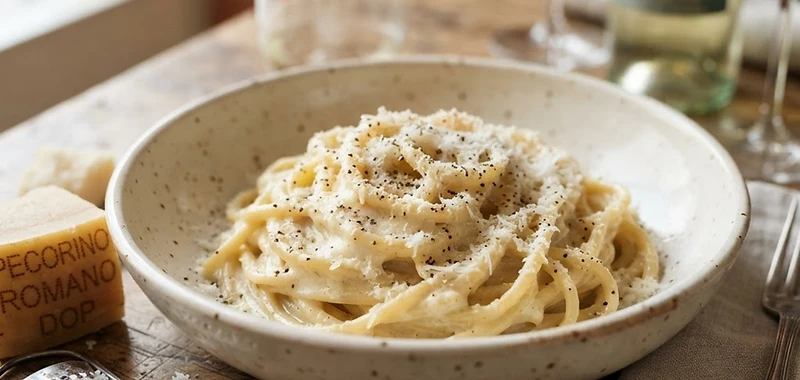
The cheese that makes Roman pasta work. Sheep's milk, aged 5-8 months for table use, longer for grating. Salty, sharp, and dry — it's the pecorino in cacio e pepe, carbonara, and amatriciana. Most is now made in Sardinia (the milk is the same; the zone was extended), but the Roman tradition is the reason it exists. Try it young and soft, not just grated and dry.
Why go
To taste the cheese that is the soul of Roman pasta — young and soft, not just grated.
The Field Guide take
Pecorino Romano is the foundational ingredient of Rome’s most iconic pasta dishes. It is a dry, salted sheep’s milk cheese that provides the necessary sharp, savory backbone to cacio e pepe, carbonara, and amatriciana. While its name ties it to the capital, the geography of its production is complex, and its flavor profile is defined entirely by its intense salt content and the distinct characteristics of sheep’s milk.
What it is
Pecorino Romano is a hard, cooked cheese made exclusively from the milk of sheep grazing in the pastures of Lazio, Sardinia, and the province of Grosseto in Tuscany. It is defined by a pale, compact paste and an assertive, piquant flavor. Because it is dry-salted multiple times during the aging process, it is exceptionally firm, making it the standard choice for grating. While often relegated to a kitchen ingredient for finishing dishes, it can be eaten on its own; when young, it is milder and softer, whereas, after eight months of aging, it becomes brittle and pungent.
Origin and history
The cheese dates back to the Roman Empire. Its durability made it a standard ration for Roman legionnaires; it provided a portable source of calories that resisted spoilage during long campaigns. Historically, it was produced in the Agro Romano, the countryside surrounding Rome. Over the 20th century, the production zone was officially expanded to include Sardinia, where the sheep-rearing tradition is robust. Today, the vast majority of Pecorino Romano is produced in Sardinia, though the original Roman specifications remain the governing standard for the Protected Designation of Origin (DOP) label.
How it’s made
The process begins with whole sheep’s milk, which is coagulated using lamb rennet. Once the curd is formed, it is broken down, pressed into cylindrical molds, and then subjected to an intensive salting process. Producers use dry salt on the surface of the wheels repeatedly over a period of months. This rigorous salting dehydrates the cheese, creating a dense, crystalline structure. The minimum aging period for a cheese intended for table consumption is five months, but wheels destined for grating are typically aged for eight months or longer, which concentrates the salt and deepens the sharpness.
Where to eat it
If you are in Rome, you will find Pecorino Romano in every traditional trattoria and osteria. It is the essential component of the city’s “four pastas”: cacio e pepe (pecorino and pepper), carbonara (pecorino, egg, and guanciale), amatriciana (pecorino, tomato, and guanciale), and gricia (pecorino and guanciale). Beyond restaurant kitchens, visit the local alimentari shops in the Testaccio or Trastevere neighborhoods. Look for wedges that are labeled with the DOP stamp to ensure you are buying the genuine product, rather than a generic sheep’s milk cheese.
When and how
Pecorino Romano is available year-round. While most travelers encounter it as a finely grated powder atop pasta, it is worth seeking out in wedges at a cheese counter. Tasting it sliced thinly allows you to appreciate the texture, which ranges from slightly waxy in younger wheels to granular and crystalline in older ones. If the cheese is too intense, pair it with fresh fava beans or pears, both of which provide a sweetness that balances the saltiness of the sheep’s milk.
What to drink with it
The saltiness and fat content of Pecorino Romano require a wine with enough structure to stand up to the cheese without being overwhelmed. A Cannonau di Sardegna—a robust, tannic red wine made from Grenache grapes—is the classic pairing, as it mirrors the rugged, pastoral origins of the sheep milk. If you prefer white wine, choose something with high acidity and mineral notes, such as a Vermentino, which cuts through the density of the cheese. Avoid light, delicate whites, which will vanish against the sharp, lingering finish of the Pecorino.
The Story
Where Pecorino Romano comes from
Pecorino Romano has roots dating back to the Roman Empire, when it was a staple ration for legionnaires because of its ability to travel and store well. Historically produced in the countryside around Rome, today the vast majority is made in Sardinia. It is an intensely salty and sharp cheese, explicitly designed for grating over bold, spicy pasta dishes.
What Defines It
Signature ingredients
Sheep's milk
High fat and protein content give the cheese its sharp, piquant finish.
Lamb rennet
Crucial to the final flavor profile, providing the distinct sharpness found in no other cheese.
The Method
How it's made
The milk is processed, pressed into wheels, and dry-salted repeatedly over a long period. This rigorous salting results in a very firm, dense cheese that can be grated into a powder without losing its structural integrity.
Timing
When to eat it
Year-round.
Serve With
Classic pairings
Cannonau di Sardegna
wineA robust, spicy red that holds its own against the intense salt of the cheese.
Black pepper
foodThe defining partner for the Roman trio of Cacio e Pepe, matching the cheese's heat.
What makes it worth going
Sheep's milk cheese, salty and sharp — the grating cheese of Rome and the base of cacio e pepe.
Things to do
- salumeria
A Rome salumeria (e.g. Volpetti)
The historic Testaccio salumeria. The pecorino romano is the benchmark; the age is the taste. Buy it, taste it, ask.
1 hr
- trattoria
A Roman trattoria for cacio e pepe or carbonara
The pecorino romano is the cheese of the four Roman pastas; the trattoria is the context. Felice, Flavio, or Armando.
2 hrs
- producer
A Sardinian producer (the real source)
The pecorino romano is mostly made in Sardinia, from Sardinian sheep, then aged in Lazio. A Sardinian producer is the true source; book ahead.
1.5 hrs
- experience
A cheese-tasting at different ages
The pecorino romano changes by age: fresh (table), semi-stagionato, stagionato (grating). The tasting is the age.
Eat
- cheese
Pecorino romano (fresco)
The fresh version; the paste is soft, the flavor is mild. The table cheese.
- cheese
Pecorino romano (stagionato)
The aged version; the paste is hard, the flavor is sharp and salty. The grating cheese of the Roman pastas.
- use
In cacio e pepe or carbonara
The grating cheese of the four Roman pastas; the pecorino is the backbone of the Roman table.
Stay
- neighborhood
Rome center (Testaccio / Trastevere)
Near the salumerias and the best Roman trattorias. Walkable.
- island
Sardinia (if you want the source)
The pecorino romano is mostly Sardinian; the producers are in the interior. A car is required.
Experiences Worth Booking
Roman pasta and cheese class
3 hrsThe four Roman pastas (carbonara, cacio e pepe, amatriciana, gricia) and the pecorino. The cheese is the backbone.
The pecorino is the four Roman pastas; a class shows you the cheese and the emulsion.
Suits: Anyone who wants the Roman pastas correct at home.
Sardinian pecorino day
full dayA pecorino romano producer, a sheep farm, a pecorino sardo tasting. The full Sardinian pecorino arc.
The pecorino romano is Sardinian; a day covers the source and the cheese.
Suits: Cheese travelers who want the source.
What's nearby & pairs with
More food from Lazio
Cured Meat
Porchetta
Whole deboned pig, stuffed with herbs and garlic, slow-roasted until crackling — the great Italian street meat.
Dish
Carbonara
Rome's most famous pasta — guanciale, pecorino, egg yolk, and pepper, emulsified into a sauce with no cream.
Dish
Cacio e Pepe
Rome's minimalist masterpiece — pasta, pecorino, and pepper, emulsified with pasta water into a sauce.
Dish
Amatriciana
Rome's tomato pasta — guanciale, tomato, pecorino, and chili. The root of the Roman pasta family.
Dish
Gricia
The oldest Roman pasta — guanciale and pecorino, no tomato, no egg. 'White amatriciana.'
Ready to plan?
Ready to turn discovery into a trip?
Italy Field Guide helps you decide where to go. When you're ready to build the actual day-by-day itinerary, take your saved places to Travel Itinerary Co — your interests go with you.
Turn your saved Italy places into a trip