
The Verdict
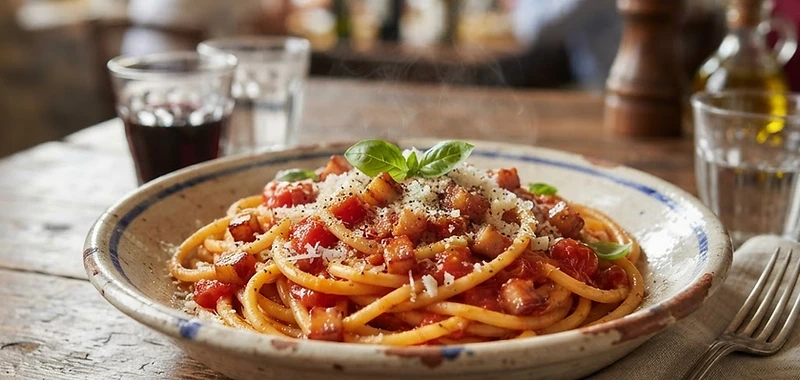
The Roman pasta with an origin story: from Amatrice, a town on the Lazio-Marche border, brought to Rome. Guanciale, tomato, pecorino, chili, and a little white wine. It's the savory, tangy one — less rich than carbonara, less minimalist than cacio e pepe, and arguably the most balanced of the four. The town of Amatrice was badly damaged in the 2016 earthquake; eating the dish is a small act of memory.
Why go
To taste the Roman pasta that has both richness and acid — the most balanced of the four.
The Field Guide take
Amatriciana is the defining tomato-based pasta of Lazio. While it is now a fixture of the Roman trattoria, its identity remains tied to the mountain town of Amatrice, located on the border of Lazio and Abruzzo. It is a dish of high contrast: the rendered fat of cured pork cheek, the sharp acidity of tomatoes, and the salty intensity of sheep’s milk cheese. Among Rome’s four canonical pasta dishes, Amatriciana sits between the minimalist Cacio e Pepe and the heavy richness of Carbonara, offering a balance that relies on precise timing rather than the emulsion of eggs or excess fats.
What it is
Amatriciana is a sauce composed of five primary elements: guanciale (cured pork cheek), tomato, pecorino romano, dried chili pepper, and a splash of dry white wine to deglaze the pan. It is traditionally served with long pasta—usually bucatini in Rome, or spaghetti in Amatrice. The flavor profile is characterized by the rendered fat of the guanciale, which provides a savory foundation, cut through by the brightness of the tomato and the bite of the chili. It is not a creamy dish; the sauce should coat the pasta tightly without pooling.
Origin and history
The dish is a direct evolution of pasta alla gricia, the white, tomato-free ancestor still eaten in the mountains of the Rieti province. The gricia was the standard ration for the pastori (shepherds) who traveled between the mountains and the plains with their flocks. When tomatoes—an American import—became a staple in the Italian diet in the 18th and 19th centuries, the existing shepherd's pasta was updated.
The dish moved from the high-altitude town of Amatrice to Rome via the many tavern keepers who migrated to the capital, eventually becoming so synonymous with the city that it is considered a pillar of Roman cuisine. Following the 2016 earthquake that devastated Amatrice, the dish has gained a renewed status as a symbol of regional resilience and cultural heritage.
How it's made
The success of Amatriciana lies in the rendering of the guanciale. The pork cheek is cut into thick strips or cubes and cooked in a pan until the fat is translucent and the edges have turned crisp. Once the pork is removed, the pan is deglazed with a small amount of white wine. Peeled tomatoes (typically San Marzano) are added to the rendered fat along with dried chili. The sauce simmers for a short period—just long enough for the tomatoes to break down and incorporate the pork fat, but not so long that the sauce loses its fresh, acidic character. The cooked pasta is tossed into the pan with the sauce and a generous amount of grated Pecorino Romano, which binds the components together.
Where to eat it
In Rome, you will find Amatriciana in almost every traditional trattoria. It is standard fare in the Testaccio and Trastevere neighborhoods, where the influence of 20th-century market food culture remains strong. When in the region, seeking out a trattoria that sources its guanciale from local producers in the Rieti province is advisable, as the quality of the pork cheek is the deciding factor in the depth of the dish's flavor. If you find yourself traveling near the border of Lazio and Marche, the town of Amatrice remains the most authentic place to understand the dish in its mountain context.
When and how
Amatriciana is available year-round. It is a hearty dish, commonly served as a primo piatto during lunch or dinner. Because it is a relatively robust preparation, it does not require elaborate sides. If you are eating in a traditional setting, it is often served alongside simple country breads, which are useful for cleaning the plate.
What to drink with it
Because the sauce is defined by the acidity of tomatoes and the high salt content of the pecorino and guanciale, it requires a wine with enough character to stand up to the fat, but enough acidity to mirror the tomato. A local red such as Cesanese—a native grape from the Lazio region—is the traditional choice. Its moderate tannins and earthy, dark fruit notes complement the cured pork without overwhelming the balance of the sauce. Avoid overly oaky or high-tannin wines, which can clash with the sharp, salty nature of the pecorino.
The Story
Where Amatriciana comes from
The Amatriciana finds its roots in the town of Amatrice, though it has become a central pillar of Roman cooking. It is a descendant of the simpler 'gricia,' updated with the addition of tomatoes when they became available in the region. It is the defining tomato-based pasta of the Italian capital.
What Defines It
Signature ingredients
Guanciale
The rendered fat base provides the deep, funky flavor profile.
San Marzano tomatoes
Provides the bright, acidic sweetness to offset the salt.
Pecorino Romano
Adds the final sharp, salty punch at the table.
The Method
How it's made
Guanciale is rendered until crispy, followed by tomatoes and chili, simmered briefly to maintain freshness. The pasta is then finished directly in the sauce, integrating the flavors completely.
Across Italy
Regional variants
Amatrice
The original version often uses spaghetti, though bucatini is more common in Rome.
Timing
When to eat it
Year-round
Serve With
Classic pairings
Cesanese
wineA rustic, peppery red from the Lazio region that matches the pasta's heat.
Focaccia
foodHelpful for mopping up the sauce remaining in the bowl.
What makes it worth going
Rome's tomato pasta — guanciale, tomato, pecorino, and chili. The root of the Roman pasta family.
Things to do
- trattoria
Armando al Pantheon
The most classic Roman trattoria, for the amatriciana. The guanciale is rendered, the pecorino is sharp, the chili is present. Reserve; no à la carte.
1.5 hrs
- trattoria
Da Enzo al 29 (Trastevere)
The amatriciana is reliable and correct. The most tourist-friendly of the Roman classics; the queue is the cost.
1.5 hrs
- salumeria
Roscioli
The most deliberate version, with curated guanciale and a sharp pecorino. Reserve; the salumi counter is the other reason to go.
2 hrs
- day trip
A trip to Amatrice (if you have a car)
The town that gives the dish its name, in the Lazio-Abruzzo hills, 2 hours from Rome. The amatriciana there is the original; the 2016 earthquake damaged the town, but the restaurants are back.
Eat
- pasta
Bucatini all'amatriciana
The benchmark: bucatini, guanciale (cured pork cheek, never bacon), tomato, pecorino romano, a pinch of chili. The guanciale is the difference; the cheese is the finish.
- pasta
Amatriciana bianca
The original, pre-tomato version: guanciale and pecorino, no tomato. The dish before Columbus. Ask for it; not every trattoria makes it.
Stay
- neighborhood
Trastevere
Across the river, near Da Enzo and the classic trattorias. The most authentic food neighborhood.
- neighborhood
Centro Storico
Near Armando and Roscioli; the most walkable base for the Roman pastas.
Experiences Worth Booking
Roman four-pasta class
3 hrsCarbonara, cacio e pepe, amatriciana, gricia — the four, in one class, with a Roman cook.
The four share technique; a class shows the differences and the emulsion.
Suits: Anyone who wants the Roman pastas correct at home.
Amatrice food day
full dayA drive to Amatrice, lunch in a local trattoria, the original amatriciana.
The town is the origin; the post-earthquake recovery is part of the story.
Suits: Pilgrims who want the source; a car and a day are required.
What's nearby & pairs with
More food from Lazio
Cured Meat
Porchetta
Whole deboned pig, stuffed with herbs and garlic, slow-roasted until crackling — the great Italian street meat.
Dish
Carbonara
Rome's most famous pasta — guanciale, pecorino, egg yolk, and pepper, emulsified into a sauce with no cream.
Dish
Cacio e Pepe
Rome's minimalist masterpiece — pasta, pecorino, and pepper, emulsified with pasta water into a sauce.
Dish
Gricia
The oldest Roman pasta — guanciale and pecorino, no tomato, no egg. 'White amatriciana.'
Cheese
Pecorino Romano
Sheep's milk cheese, salty and sharp — the grating cheese of Rome and the base of cacio e pepe.
Ready to plan?
Ready to turn discovery into a trip?
Italy Field Guide helps you decide where to go. When you're ready to build the actual day-by-day itinerary, take your saved places to Travel Itinerary Co — your interests go with you.
Turn your saved Italy places into a trip