The Verdict
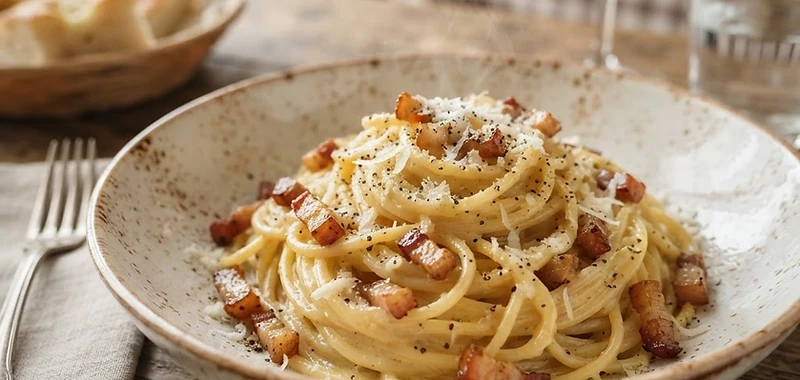
The Roman pasta the world gets most wrong. Real carbonara is guanciale (cured pork jowl), pecorino romano, egg yolk, and black pepper — no cream, no garlic, no bacon. The heat of the pasta cooks the egg into a glossy sauce. It's rich, sharp, and takes 10 minutes. The version with cream is a different dish; this is the one.
Why go
To eat the original of the pasta the world keeps reinventing — in a Roman trattoria, made right.
The Field Guide take
Carbonara is Rome’s most recognizable pasta dish, though it is frequently misunderstood outside the borders of Lazio. It is an exercise in technique rather than complexity, relying on the quality of its four primary components: guanciale, pecorino romano, egg yolks, and black pepper. In a proper Roman kitchen, cream is absent. The texture is achieved through the careful emulsification of pasta water, cheese, and yolk.
What it is
Carbonara is a pasta dish built on high-impact, shelf-stable ingredients long staples of the Roman pantry. It consists of dried pasta—usually spaghetti, rigatoni, or tonnarelli—tossed with a sauce of rendered pork fat, cured jowl, sheep’s milk cheese, and tempered egg yolks. The result should be a silky, cohesive coating on the pasta, neither soupy nor scrambled. It is a savory, sharp, and fatty dish that serves as a cornerstone of the cucina romana canon.
Origin and history
The history of carbonara is subject to persistent debate. While some popular theories attempt to link the dish to the carbonari (charcoal burners) of the Apennine Mountains, evidence for this is largely anecdotal. What is historically verified is the dish’s emergence in post-World War II Rome. It rose to prominence in the mid-20th century as a simple, efficient way to combine the high-protein ingredients readily available in the city. Regardless of its precise inception, it is firmly established as a Roman tradition, distinct from the culinary lineages of northern or southern Italy.
How it’s made
The success of carbonara depends on timing and temperature control. The guanciale—cured pork jowl—is sliced into strips and rendered in a pan until the fat is translucent and the meat is crisp. Simultaneously, the eggs (yolks primarily) are beaten with finely grated Pecorino Romano and a generous amount of freshly cracked black pepper to form a thick paste.
The critical phase occurs when the pasta is removed from the boiling water. It is transferred to the pan with the pork, but crucially, off the heat. The residual heat of the pasta and the addition of a small amount of starchy pasta water emulsify the egg and cheese mixture. If the pan is too hot, the eggs will scramble, resulting in a grainy texture. If the heat is too low, the sauce will not tighten. When executed correctly, the sauce glosses the pasta without clumping.
Where to eat it
To understand carbonara, eat it in Rome. Seek out traditional trattorie or osterie in neighborhoods like Testaccio or Trastevere, where the focus is on regional classics. A reliable indicator of a kitchen's commitment to the dish is the texture of the sauce and the use of guanciale rather than bacon or pancetta. If the menu mentions cream, garlic, or parsley, the kitchen is preparing a derivative version; look elsewhere for the traditional preparation.
When and how
Carbonara is a year-round staple in Rome. It is typically served as a primo course. Because of its density and richness, it is often paired with lighter, acidic appetizers, such as carciofi alla giudia (crispy fried artichokes), which are common in the city’s Jewish quarter. The saltiness of the pecorino and the fat of the guanciale make it a demanding dish, so it is rarely served with a heavy protein course following it.
What to drink with it
The intensity of the pecorino and the fatty mouthfeel of the emulsified egg require a wine with enough acidity to cut through the richness. A crisp white wine from the nearby Castelli Romani, such as a Frascati Superiore, is the classic local pairing. Its mineral profile and bright acidity provide the necessary balance to the sharp, salty, and oily profile of the pasta. Avoid heavy, tannic reds, which can clash with the metallic bite of the egg and the sharpness of the pecorino.
The Story
Where Carbonara comes from
Carbonara's history is debated, but it rose to prominence in Rome in the mid-20th century. It is a dish born of the simple, high-impact ingredients found in every Roman kitchen: eggs, cheese, and cured pork. It requires no cream, as the silkiness comes solely from the emulsification of egg yolk and pasta water.
What Defines It
Signature ingredients
Guanciale
Cured pork jowl, which renders a superior, silky fat compared to bacon.
Pecorino Romano
A sharp, salty sheep's milk cheese that provides the sauce's body.
Fresh egg yolks
The essential binder that creates the creamy, rich sauce texture.
The Method
How it's made
The pasta is tossed off the heat with the egg, cheese, and fat mixture, using starchy pasta water to emulsify into a glossy sauce. Scrambled eggs indicate poor technique and too much heat.
Timing
When to eat it
Year-round
Serve With
Classic pairings
Frascati
wineA local white with enough body to stand up to the salt and egg.
Crispy fried artichokes
foodAdds a bitter, crunchy textural contrast to the heavy pasta.
What makes it worth going
Rome's most famous pasta — guanciale, pecorino, egg yolk, and pepper, emulsified into a sauce with no cream.
Things to do
- salumeria
Salumeria Roscioli
The most deliberate carbonara in Rome, with a curated salumi counter. Reserve. The carbonara is the reason to go.
2 hrs
- trattoria
Felice a Testaccio
The classic Testaccio trattoria. The carbonara is rich and correct, the cacio e pepe is the rival. Reserve.
2 hrs
- trattoria
Da Enzo al 29
In Trastevere. The most reliable Roman trattoria for tourists; the carbonara is the standard. Queue.
1.5 hrs
- trattoria
Trattoria Pennestri
In Ostiense. Modern Roman, more care than nostalgia. The carbonara is the test.
Eat
- pasta
Carbonara
The egg should be a glossy sauce, not scrambled. Guanciale, never bacon. Pecorino, never Parmigiano alone.
- pasta
Tonnarelli cacio e pepe
Order carbonara and cacio e pepe, share, compare. The two Roman pastas at their best.
- side
Carciofi alla giudia
Deep-fried artichokes, the Roman-Jewish classic, in season (spring). The right starter to carbonara.
Stay
- neighborhood
Testaccio
The working-class food quarter, home to Felice and the old market. The most authentic Roman food neighborhood.
- neighborhood
Trastevere
Across the river, near Da Enzo. Touristy but beautiful, and walkable to the best trattorias.
Experiences Worth Booking
Roman pasta class
3 hrsCarbonara, cacio e pepe, amatriciana, and gricia — the four, in one class.
The emulsion technique is the secret; you can't learn it from a recipe.
Suits: Anyone who wants to make the Roman pastas correctly at home.
Testaccio food market walk
3 hrsThe old slaughterhouse quarter, the new market, the street food, the trattorias.
Testaccio is where Roman cooking was born; the walk explains the offal tradition.
Suits: Eaters who want the working food neighborhood, not the postcard.
What's nearby & pairs with
More food from Lazio
Cured Meat
Porchetta
Whole deboned pig, stuffed with herbs and garlic, slow-roasted until crackling — the great Italian street meat.
Dish
Cacio e Pepe
Rome's minimalist masterpiece — pasta, pecorino, and pepper, emulsified with pasta water into a sauce.
Dish
Amatriciana
Rome's tomato pasta — guanciale, tomato, pecorino, and chili. The root of the Roman pasta family.
Dish
Gricia
The oldest Roman pasta — guanciale and pecorino, no tomato, no egg. 'White amatriciana.'
Cheese
Pecorino Romano
Sheep's milk cheese, salty and sharp — the grating cheese of Rome and the base of cacio e pepe.
Ready to plan?
Ready to turn discovery into a trip?
Italy Field Guide helps you decide where to go. When you're ready to build the actual day-by-day itinerary, take your saved places to Travel Itinerary Co — your interests go with you.
Turn your saved Italy places into a trip