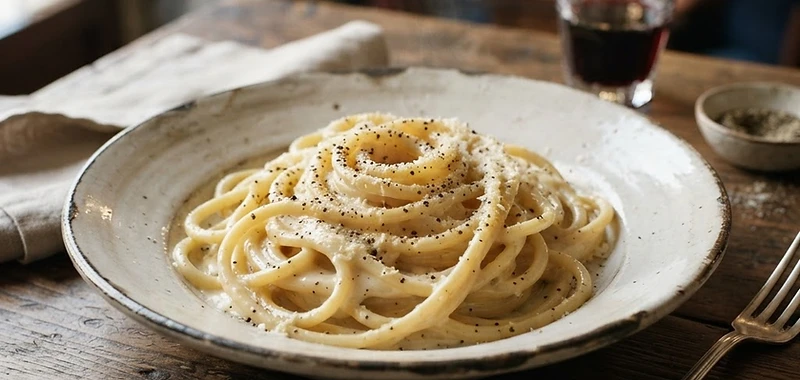
The Verdict
The simplest Roman pasta and the hardest to get right. Three ingredients: tonnarelli pasta, pecorino romano, black pepper. The magic is the emulsion — the starchy pasta water melts the cheese into a sauce that clings to every strand. When it's right, it's the best three-ingredient dish in the world. When it's wrong, it's a clumpy mess.
Why go
To taste how good three ingredients can be, when all three are right.
The Field Guide take
Cacio e pepe is Rome’s definitive pasta dish. It is a study in economy, consisting of nothing more than pecorino romano cheese, black pepper, and pasta. Despite this simplicity, it is widely considered the most difficult Roman pasta to execute well. When the preparation is correct, the cheese and starchy water form a silky, cohesive emulsion that coats the noodles. When it fails, the cheese clumps into a rubbery mass or separates into oil and solids.
Origins and the shepherd’s pantry
The dish is rooted in the history of transhumance—the seasonal movement of livestock between mountain pastures and lowland valleys. Shepherds traveling with their flocks required lightweight, non-perishable food that provided high caloric density. Pecorino, a hard sheep’s milk cheese that keeps well, and black peppercorns, which provided heat and preserved the palate, were staples of the shepherd’s satchel. When combined with dry pasta, they formed a meal that was easy to prepare over a portable fire. This minimalist approach remains the bedrock of Roman cooking: a focus on high-impact, readily available ingredients handled with technical precision.
The mechanics of the emulsion
Making cacio e pepe relies on a specific chemical reaction between the fat in the cheese, the starch in the pasta water, and the heat of the cooking process. The traditional choice of pasta is tonnarelli (sometimes called spaghetti alla chitarra), a fresh, egg-based pasta with a square cross-section, though dried spaghetti or bucatini are also common in Roman trattorias.
The preparation begins with toasting crushed black peppercorns in a pan to release their aromatic oils. Simultaneously, the pasta is boiled in a smaller-than-usual volume of water; this ensures the water becomes heavily concentrated with starch. The cheese is finely grated—coarsely grated cheese will not melt properly—and mixed with a small amount of warm pasta water to create a thick paste. When the pasta is cooked al dente, it is moved to the pan with the pepper, and the cheese paste is folded in. The goal is a creamy, uniform sauce that clings to the pasta without hardening as it cools on the plate.
Where to eat it
Cacio e pepe is ubiquitous across the Lazio region, particularly within Rome’s historic neighborhoods such as Testaccio, Trastevere, and the Jewish Ghetto. You will find it on nearly every menu in the city, but it is best sought in established trattorias that specialize in traditional Roman cuisine.
Because the dish is so technically unforgiving, it serves as a reliable indicator of a kitchen's proficiency. If a restaurant cannot master the emulsion of a three-ingredient pasta, it is rarely worth exploring the rest of their menu. Avoid establishments that rely on heavy cream or butter to "cheat" the texture; authentic cacio e pepe relies solely on the union of sheep’s milk cheese and starchy water.
When and how
Cacio e pepe is served year-round. It is a hearty, intense dish, though it is usually served as a primo course rather than a standalone meal. In its classic form, it is served as a singular, intense experience. If you are looking for variety or subtle flavor profiles, this dish will disappoint; it is intentionally one-note, focusing entirely on the sharpness of the pecorino and the bite of the pepper. In the Roman spring, you may occasionally see it served alongside fresh fava beans, which add a vegetal texture that cuts through the richness of the cheese.
What to drink with it
Given the high salt content and intense flavor of Pecorino Romano, the wine pairing should be chosen to balance the palate. A crisp, acidic white wine from the nearby Lazio region, such as a Frascati Superiore, provides enough structure to hold up to the cheese while cleansing the tongue of the pepper’s heat. If you prefer red, look for a regional wine with moderate tannins, such as a Cesanese del Piglio; its earthy, dark-fruit notes complement the peppery finish of the dish without overpowering the sheep’s milk profile of the cheese. Avoid heavy, high-tannin reds, which can turn metallic when paired with the saltiness of the pecorino.
The Story
Where Cacio e Pepe comes from
This is the ultimate test of a Roman cook, relying on only three ingredients that must be handled with perfect precision. It originates from the needs of shepherds, who carried pecorino and pepper during transhumance. It is the purest expression of the Roman culinary philosophy: minimal, bold, and high-impact.
What Defines It
Signature ingredients
Pecorino Romano
Must be high-quality and finely grated to ensure a smooth melt.
Black peppercorns
Toasted first to release aromatic oils before being ground.
Starchy pasta water
The 'glue' that allows the cheese and pepper to coat the pasta evenly.
The Method
How it's made
The cheese and pepper are combined with hot pasta water to form a cream, which is then vigorously tossed with the cooked pasta. The goal is a perfect, emulsified sauce that coats every strand.
Timing
When to eat it
Year-round
Serve With
Classic pairings
Pecorino d'Abruzzo
wineA zesty white that refreshes the palate between bites of salty pasta.
Fava beans
foodA fresh, vegetal crunch that balances the intensity of the pepper.
What makes it worth going
Rome's minimalist masterpiece — pasta, pecorino, and pepper, emulsified with pasta water into a sauce.
Things to do
- trattoria
Felice a Testaccio
The benchmark cacio e pepe, in Testaccio. The emulsion is the test, and it's right here. Reserve.
1.5 hrs
- trattoria
Flavio al Velavevodetto
On the Monte dei Cocci (the Testaccio hill of broken amphorae). The cacio e pepe is the reason.
1.5 hrs
- salumeria
Salumeria Roscioli
The most deliberate version, with three pecorinos. Reserve.
2 hrs
- trattoria
Trattoria da Danilo
In Esquilino. The cacio e pepe is the specialty; the tonnarelli is hand-cut.
Eat
- pasta
Tonnarelli cacio e pepe
The square-stranded tonnarelli hold the sauce better. The pepper should bite; the cheese should cling, not clump.
- side
Insalata
A plain green salad. You need it — cacio e pepe is one note, and the note is cheese.
- wine
Frascati
The Lazio white, from the Castelli Romani. The correct, light, local pairing.
Stay
- neighborhood
Testaccio
The home of cacio e pepe; Felice and Flavio are here. The most authentic food quarter.
- neighborhood
Monti
Near the Colosseum, with good trattorias and less crowd than Trastevere.
Experiences Worth Booking
Cacio e pepe masterclass
2 hrsThe emulsion technique, with a Roman cook. The pasta water is the whole secret.
The emulsion is the failure point; a live class shows you the water-to-cheese ratio.
Suits: Home cooks who've tried and failed; the class fixes it.
Roman pasta crawl
4 hrsCarbonara at one, cacio e pepe at another, amatriciana at a third.
You can't eat all four at one trattoria; a crawl is the way.
Suits: Eaters who want all four Roman pastas in one night.
What's nearby & pairs with
More food from Lazio
Cured Meat
Porchetta
Whole deboned pig, stuffed with herbs and garlic, slow-roasted until crackling — the great Italian street meat.
Dish
Carbonara
Rome's most famous pasta — guanciale, pecorino, egg yolk, and pepper, emulsified into a sauce with no cream.
Dish
Amatriciana
Rome's tomato pasta — guanciale, tomato, pecorino, and chili. The root of the Roman pasta family.
Dish
Gricia
The oldest Roman pasta — guanciale and pecorino, no tomato, no egg. 'White amatriciana.'
Cheese
Pecorino Romano
Sheep's milk cheese, salty and sharp — the grating cheese of Rome and the base of cacio e pepe.
Ready to plan?
Ready to turn discovery into a trip?
Italy Field Guide helps you decide where to go. When you're ready to build the actual day-by-day itinerary, take your saved places to Travel Itinerary Co — your interests go with you.
Turn your saved Italy places into a trip