The Verdict
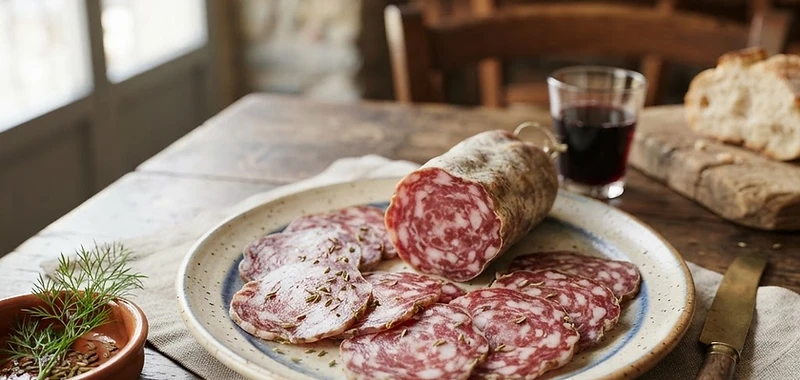
The salami of Tuscany, and the one you'll eat most without knowing its name. Coarsely ground pork, cured with fennel seeds (finocchio), black pepper, and red wine. The fennel gives it a sweet, anise scent that cuts the richness. Eaten in every Florentine panino and every Tuscan antipasto. The most everyday, and one of the best, of the Tuscan cured meats.
Why go
To taste the fennel salami that's in every Florentine sandwich — and learn its name.
The Field Guide take
Finocchiona is the definitive salami of Tuscany. If you walk into a deli in Florence or a rural tavern in the Maremma, this is the cured meat most likely to be offered on a platter or tucked into a crusty roll. Its distinct character comes from wild fennel seeds, which provide an aromatic, anise-like scent that cuts through the fat of the pork. It is approachable, widely available, and foundational to the Tuscan diet.
What it is
Finocchiona is a coarsely ground pork salami. Unlike harder, more densely packed salamis from northern regions, it is prized for a texture that is notably soft and supple. The defining ingredient is finocchio (fennel), specifically the wild seeds gathered in the Tuscan hills. Along with black pepper and a splash of red wine, these seeds infuse the meat with a sharp, herbal fragrance. While there are regional variations in the ratio of fat to lean meat, a good Finocchiona should never feel greasy; the fennel is intended to cleanse the palate, making the meat feel lighter than its fat content suggests.
Origin and history
The history of Finocchiona is an example of medieval resourcefulness. In the Middle Ages, black pepper was an expensive, imported commodity that was often out of reach for local butchers. Faced with high costs, Tuscan butchers began experimenting with wild fennel seeds, which grew in abundance in the surrounding countryside. They discovered that the seeds mimicked the aromatic intensity of black pepper at almost no cost. Over centuries, what began as a substitute became the preferred flavor profile of the region, eventually cementing the meat’s status as the signature salume of Florence.
How it’s made
The production process relies on the quality of the pork and the timing of the cure. Producers use a coarse grind to ensure the texture remains loose rather than paste-like. The meat is seasoned with salt, black pepper, red wine, and a generous amount of fennel seeds or pollen. Once mixed, the meat is stuffed into natural casings.
Because the salami is aged for a relatively short period, it retains significant moisture, which is what gives it that signature melt-in-the-mouth consistency. Today, consumers will frequently see labels marked "Finocchiona IGP." This indicates that the product follows strict geographic and quality guidelines, ensuring the ingredients were sourced and processed within the traditional Tuscan territory.
Where to eat it
You will find Finocchiona in virtually every alimentari (grocery store) and osteria across Tuscany. In Florence, it is the standard filling for a panino. Because it is not a rare or artisanal secret, you do not need to hunt for it in high-end specialty shops. The best places to eat it are the small, neighborhood spots where the deli slicer is used constantly throughout the day. A fresher slice, cut to order, is always superior to pre-packaged versions. When buying at a counter, ask for a "sottile" (thin) slice; the texture of the fat is best appreciated when the slice is translucent enough to hold up to the light.
When and how
Finocchiona is a year-round staple. It is most commonly served as part of an antipasto board, where it sits alongside Pecorino Toscano—a sheep’s milk cheese that pairs well with the herbal notes of the fennel. Because of its soft texture, it is not well-suited for recipes that require heavy cooking or frying. It is designed to be eaten raw, either on its own, with a piece of unsalted Tuscan bread (pane sciocco), or as the primary component of a sandwich. Avoid anything that masks its flavor, such as heavy dressings or acidic condiments.
What to drink with it
The standard pairing is a glass of Chianti Classico. The high acidity and firm tannins of a Sangiovese-based wine act as a necessary counterweight to the fat of the salami. The red wine used in the curing process of the Finocchiona itself creates a natural bridge to the glass, making the pairing intuitive. If you are eating in a more casual setting, a simple, rustic red table wine from the Tuscan hills will serve the purpose just as well.
The Story
Where Finocchiona comes from
Finocchiona evolved in the Middle Ages as a way for clever Tuscan butchers to stretch expensive pepper, which was imported and costly. They used wild fennel seeds—abundant in the Tuscan countryside—to provide a similar aromatic intensity at no cost. Over time, it became the signature salume of Florence.
What Defines It
Signature ingredients
Coarse pork grind
Provides the essential structure and mouthfeel of the sausage.
Wild fennel seeds
The defining flavor that gives the meat a floral, anise-like finish.
Red wine
Used in the curing process to assist fermentation and add body.
The Method
How it's made
The meat is ground coarsely and seasoned with fennel and wine before casing. The aging process is relatively short, leading to a softer, more supple texture compared to other Italian cured meats.
Across Italy
Regional variants
Tuscany
Versions labeled 'Finocchiona IGP' follow strict aging and ingredient guidelines.
Timing
When to eat it
Year-round
Serve With
Classic pairings
Chianti Classico
wineThe high acidity of Sangiovese works perfectly with the fatty pork.
Pecorino Toscano
foodA slightly salty cheese that highlights the fennel aromatics.
What makes it worth going
Tuscan fennel-seed salami — the everyday salume of Florence, coarsely ground and fragrant with wild fennel.
Things to do
- salumeria
A Florence salumeria (e.g. Schiavone or Perini)
The historic Florence salumeria. The finocchiona is the benchmark; the fennel seeds are the test, the age is the taste. Buy it, eat it on the spot.
1 hr
- trattoria
A Tuscan trattoria for a tagliere
The finocchiona is the centerpiece of the Tuscan tagliere (the salumi board); the trattoria is the context.
1.5 hrs
- producer
A Tuscan producer in the Chianti or the Val d'Orcia
The home of the finocchiona, in the Tuscan hills. The pork is local, the fennel is the seed, the age is the cave. Visit a producer; book ahead.
1.5 hrs
- experience
A salumi-tasting with bread and wine
The Tuscan tagliere: finocchiona, prosciutto toscano, salame, lardo, with bread and a Chianti. The board is the tasting.
Eat
- cured_meat
Finocchiona
The classic: a Tuscan cured pork salami, flavored with fennel seeds (finocchio) and black pepper. The fennel is the flavor; the age is the taste. Sliced thick, with unsalted Tuscan bread.
- bread
With pane toscano
The traditional companion; the unsalted Tuscan bread, which lets the finocchiona sing.
- wine
A glass of Chianti
The Tuscan red; the correct pairing for the fennel and the pork.
Stay
- neighborhood
Florence center (Mercato Centrale / San Lorenzo)
Near the best salumerias. Walkable and central.
- rural
A Tuscan village (Chianti / Val d'Orcia)
In the hills, where the finocchiona is made. A car is required.
Experiences Worth Booking
Tuscan salumi tasting
1.5 hrsA guided tasting of finocchiona, prosciutto toscano, salame toscano, lardo di Colonnata, with bread and Chianti.
The finocchiona is one of the Tuscan salumi; a tasting compares it to the prosciutto and the lardo.
Suits: Cured-meat lovers who want the Tuscan board.
Chianti food and wine day
full dayA finocchiona producer, a Chianti cellar, a ribollita lunch. The full Tuscan arc.
The finocchiona, the Chianti, and the ribollita are the Tuscan table; a day covers all.
Suits: Food and wine travelers with a day for Chianti.
What's nearby & pairs with
More food from Toscana
Dish
Bistecca alla Fiorentina
T-bone steak from Chianina beef, grilled over wood, served rare with nothing but salt and olive oil.
Dish
Pappardelle al Cinghiale
Wide egg pasta ribbons with wild boar ragù — the dish of the Tuscan hunting season.
Dish
Ribollita
Bread and bean soup with cavolo nero, reboiled (ribollita) until thick — the peasant dish of Tuscany.
Cheese
Pecorino di Pienza
Sheep's milk cheese from the Val d'Orcia — pecorino at its most varied, from fresh to aged and ash-rubbed.
Cured Meat
Lardo di Colonnata
Cured pork fatback, aged in marble troughs with herbs — the marble-quarry town's most singular product.
Ready to plan?
Ready to turn discovery into a trip?
Italy Field Guide helps you decide where to go. When you're ready to build the actual day-by-day itinerary, take your saved places to Travel Itinerary Co — your interests go with you.
Turn your saved Italy places into a trip