The Verdict
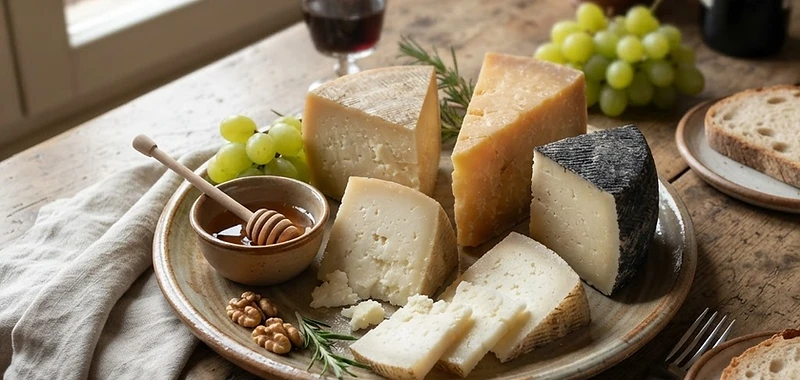
The pecorino that proves Tuscany does sheep's milk as well as Lazio. From the hills around Pienza, in the Val d'Orcia, made in styles from fresh (pecorino fresco, soft and mild) to aged (stagionato, hard and nutty) to ash-rubbed (infossato, buried in walnut leaves). The aged version is a great pecorino for eating, not just grating. Buy it in Pienza and eat it with honey.
Why go
To taste pecorino in five ages and styles, in the prettiest cheese town in Tuscany.
The Field Guide take
Pecorino di Pienza is the definitive sheep’s milk cheese of the Val d’Orcia, a product that shifts the regional focus of pecorino away from the aggressive, salty intensity often associated with Lazio to a more nuanced, floral profile. Centered on the town of Pienza in the province of Siena, this cheese captures the essence of the surrounding clay-heavy hills, where the local pastures influence the milk’s character throughout the year.
The character of the cheese
Pecorino di Pienza is defined by its range. Unlike mass-produced pecorinos that aim for a uniform sharp bite, this cheese is typically presented in a spectrum of maturation. Pecorino fresco is ivory-colored, semi-soft, and mild, with a texture similar to young fontina. As it moves toward stagionato (aged) status, the paste firms, turning pale yellow, and develops a concentrated, savory depth. The most distinct iterations are those treated with additives—specifically walnut leaves or grape must—which introduce earthy, tannic, or slightly fruity notes to the rind and paste. It is a cheese designed for eating in wedges, not merely as an ingredient for grating over pasta.
Origin and history
The history of this cheese is rooted in the transhumance practices of the Val d’Orcia. The tradition of keeping ewes in this region predates the Roman era, with Etruscan settlers likely forming the foundation of local sheep-herding methods. The modern reputation of Pienza as a cheese capital is relatively recent in the scope of Tuscan history, gaining momentum in the mid-20th century as local producers formalized their methods. The landscape is the primary driver of quality; the grazing lands are rich in wild herbs and grasses that provide a complex diet for the sheep, resulting in a milk with a distinct, honeyed sweetness that is difficult to replicate elsewhere.
How it is made
The process begins with raw or pasteurized ewe’s milk, which is inoculated with starter cultures and rennet. The curd is cut, drained, and pressed into circular molds. The critical phase is the environment of the aging rooms or caves, where temperature and humidity are strictly controlled to maintain a supple, non-brittle paste in the younger cheeses.
For the traditional variations, the finished wheels are placed in terracotta jars or pits layered with walnut leaves or grape must. This is not simply for flavor; it is an old preservation method that allows the cheese to "breathe" while absorbing the oils and aromas of the plant matter. This process ensures that the cheese stays moist while developing a complex, often pungent, outer layer.
Where to find it
Pienza remains the primary destination to source these cheeses. The town serves as a marketplace for dairies operating within the Val d’Orcia. Travelers should look for small-scale caseifici (dairies) that operate on the periphery of the town. These shops often offer tastings of different aging stages, from the mild thirty-day varieties to the year-old wheels. If you are visiting outside of Pienza, look for labels specifically identifying the Val d’Orcia as the origin; this designation is the best indicator that the cheese was produced using the local milk that gives the product its characteristic sweetness.
When and how to eat it
Pecorino di Pienza is available year-round, but the profile of the cheese changes with the season. Spring cheeses are the most delicate, reflecting the abundance of fresh, green forage. Autumn and winter cheeses are typically more robust.
When serving, bring the cheese to room temperature for at least 30 minutes before eating to allow the fats to soften. It is most commonly served with local Tuscan honey, which balances the saltiness of the milk, or with fresh fava beans in the spring. In the Val d’Orcia, it is also standard to serve aged pecorino alongside a glass of Brunello di Montalcino, as the tannic structure of the Sangiovese grape holds up well against the dense, nutty protein of the aged cheese.
Who should skip it
If your preference is for mild, industrially produced sheep's milk cheese, be aware that the traditional varieties of Pienza can be assertive. The ash-rubbed or leaf-aged versions, in particular, carry a heavy, earthy scent that some may find overwhelming. If you prefer a consistent, neutral flavor profile, these artisanal, terroir-driven cheeses may challenge your palate.
The Story
Where Pecorino di Pienza comes from
Born in the rolling hills of the Val d'Orcia, Pecorino di Pienza is a product of the Etruscan tradition of sheep herding. Unlike harder, sharper pecorinos, this cheese is celebrated for its versatility and the impact of the local flora on the final taste. It is deeply connected to the landscape of Tuscany, often reflecting the herbs found in the grazing fields.
What Defines It
Signature ingredients
Ewe's milk
Provides a floral, grassy base that reflects the diversity of the Val d'Orcia pastures.
Walnut leaves or grape must
Traditional coatings used for aging that impart earthy, unique aromatics to the rind.
The Method
How it's made
The cheese is typically aged for a short period to keep it semi-soft, though longer-aged versions are common. The handling process involves careful temperature control, often in caves, to ensure a supple paste.
Across Italy
Regional variants
Val d'Orcia
The definitive zone where the terroir imparts a specific honeyed sweetness to the milk.
Timing
When to eat it
Year-round, with spring cheeses being the most delicate.
Serve With
Classic pairings
Brunello di Montalcino
wineThe local connection is undeniable; the wine's depth complements the cheese's aged nuttiness.
Fresh fava beans
foodA classic seasonal pairing that highlights the rustic, fresh quality of the cheese.
What makes it worth going
Sheep's milk cheese from the Val d'Orcia — pecorino at its most varied, from fresh to aged and ash-rubbed.
Things to do
- producer
A pecorino producer in Pienza
The home of the pecorino di Pienza, in the Val d'Orcia. The sheep are local; the age is the taste. Visit a producer (e.g. Pienza Caseificio or Cugusi); book ahead.
1.5 hrs
- salumeria
A Pienza salumeria or enoteca
In the town, for pecorino at different ages and pairings. The honey, the jam, and the wine are the companions.
1 hr
- trattoria
A Val d'Orcia restaurant for pici or pappardelle
The pecorino is the finish of the pici cacio e pepe and the pappardelle; the Val d'Orcia table is the context.
2 hrs
- experience
A cheese-tasting with honey and jams
The pecorino di Pienza is paired with honey, jams, or pears; the sweet cuts the sharp. The tasting is the pairing.
Eat
- cheese
Pecorino di Pienza (fresco, semi-stagionato, stagionato)
The three ages: fresh (soft, mild), semi-stagionato (firmer, tangier), stagionato (hard, crumbly, sharp). The age is the taste; the Val d'Orcia milk is the base.
- cheese
Pecorino di Pienza al tartufo
The truffle version; the pecorino is aged with black truffle. A modern variation; the truffle is the season.
- pairing
With honey or pears
The classic companion; the honey or the pears cut the sharp of the aged pecorino.
Stay
- town
Pienza center
The Renaissance town, in the Val d'Orcia. Walkable; the producers are in the town.
- town
Montepulciano or Montalcino
The other Val d'Orcia towns, with good restaurants and easier access. A car is required.
Experiences Worth Booking
Pecorino producer visit and tasting
2 hrsThe sheep, the milk, the cave, the tasting at three ages. The Val d'Orcia is the context.
The pecorino di Pienza is the Val d'Orcia; a producer visit shows you the sheep, the age, and the taste.
Suits: Cheese lovers who want the Tuscan pecorino at its source.
Val d'Orcia food and wine day
full dayA pecorino tasting in Pienza, a Brunello cellar in Montalcino, a pici lunch. The full Val d'Orcia arc.
The pecorino, the Brunello, and the pici are the Val d'Orcia trinity; a day covers all.
Suits: Food and wine travelers with a day for southern Tuscany.
What's nearby & pairs with
More food from Toscana
Cured Meat
Finocchiona
Tuscan fennel-seed salami — the everyday salume of Florence, coarsely ground and fragrant with wild fennel.
Dish
Bistecca alla Fiorentina
T-bone steak from Chianina beef, grilled over wood, served rare with nothing but salt and olive oil.
Dish
Pappardelle al Cinghiale
Wide egg pasta ribbons with wild boar ragù — the dish of the Tuscan hunting season.
Dish
Ribollita
Bread and bean soup with cavolo nero, reboiled (ribollita) until thick — the peasant dish of Tuscany.
Cured Meat
Lardo di Colonnata
Cured pork fatback, aged in marble troughs with herbs — the marble-quarry town's most singular product.
Ready to plan?
Ready to turn discovery into a trip?
Italy Field Guide helps you decide where to go. When you're ready to build the actual day-by-day itinerary, take your saved places to Travel Itinerary Co — your interests go with you.
Turn your saved Italy places into a trip