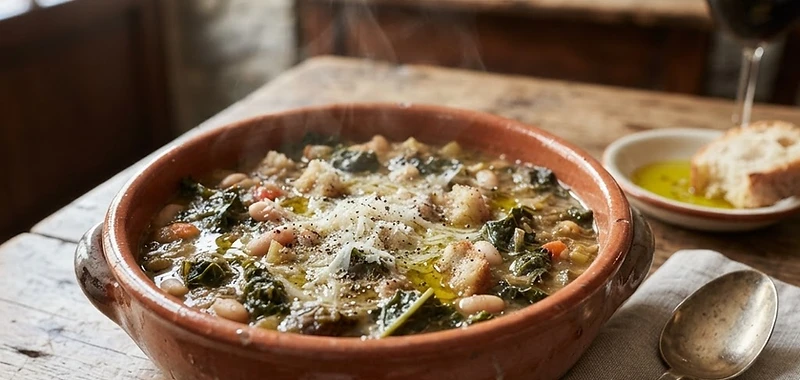
The Verdict
The Tuscan peasant dish that proves poverty cookery is its own cuisine. Stale bread, cannellini beans, cavolo nero (black kale), carrots, celery, and onion, simmered and then reboiled the next day (ribollita means 'reboiled') until it's thick enough to stand a spoon in. It's the opposite of bistecca — cheap, slow, and, done right, one of the best things in Tuscan cooking.
Why go
To taste the dish that proves Tuscan cooking isn't just steak — it's beans and bread and time.
The Field Guide take
Ribollita is the definitive dish of Tuscan cucina povera. It is a soup built from the most humble components of the regional pantry: beans, greens, and stale bread. While Florence and other Tuscan cities have popularized refined dining, ribollita serves as a reminder that the historical bedrock of the region is defined by frugality, labor, and the necessity of using every scrap of food available.
The mechanics of the dish
At its core, ribollita is a secondary preparation. The name literally translates to "reboiled." Traditionally, a household would prepare a large pot of minestra di pane (bread soup) or bean stew. Once the initial meal was finished, the remaining soup was kept and heated again the following day.
During this second heating, the stale, saltless Tuscan bread—which has been layered into the pot—breaks down and absorbs the liquid, thickening the stew until it reaches a dense, porridge-like consistency. A finished bowl should be thick enough to hold a spoon upright. It is rarely served as a clear soup; it is a hearty, cohesive mass that balances the earthiness of cannellini beans with the slight bitterness of winter greens.
Origin and history
The history of ribollita is rooted in the agricultural reality of the Tuscan countryside. Historically, bread was baked in large wood-fired ovens once a week or every ten days. By the end of the cycle, the loaves were rock-hard. Rather than discard them, peasants developed recipes to rehydrate the crusty bread.
The dish was a practical solution to poverty. Beans provided the necessary protein, and the vegetable garden provided the onions, carrots, celery, and the signature cavolo nero (lacinato kale). Because it was made in large batches, it was a practical meal for field workers—easy to transport, easy to reheat, and capable of keeping a person full through a long day of manual labor.
Signature ingredients
The quality of a ribollita depends entirely on the quality of its baseline components.
- Cannellini beans: These are the standard. They should be creamy and hold their shape slightly before being partially mashed into the soup to act as a natural thickener.
- Cavolo nero: Also known as Tuscan kale or dinosaur kale, this dark, pebbled green is essential. It is best harvested after the first frost, which makes the leaves tender and mellows their bitter edge.
- Stale Tuscan bread: You must use pane sciocco—the unsalted, crusty bread traditional to Tuscany. Salted bread would make the final dish unpalatable once the flavors concentrate.
- Extra Virgin Olive Oil: This is the final, non-negotiable step. A generous pour of fresh, peppery Tuscan olive oil over the top of the bowl is what provides the necessary brightness to cut through the heavy, starch-laden stew.
Where to find it
Ribollita is a seasonal staple. You are most likely to encounter it on menus from late autumn through early spring. It is rarely found in high-end, tablecloth restaurants; instead, look for it in trattorie or osterie in smaller towns throughout the provinces of Florence, Siena, and Arezzo.
In Florence, the preparation is often more rustic, with a heavy emphasis on the texture of the beans. In the countryside, you may find variations that lean more heavily into the specific wild herbs or garden greens available in that immediate microclimate. If a restaurant serves ribollita in mid-July, it is likely not authentic to the season and may be a concession to tourist demand rather than a kitchen staple.
When and how to eat it
Ribollita is heavy, restorative food. It is best eaten as a main course during the colder months when the cavolo nero is at its peak. It is meant to be eaten slowly, ideally with a hunk of bread on the side if the soup itself hasn't already reached its saturation point.
The pairing
The natural companion to ribollita is a glass of Chianti Classico. The high acidity and moderate tannins of the Sangiovese grape are designed to cut through the starch of the bread and the density of the beans. The wine acts as a palate cleanser against the olive oil finish. If you are ordering oil at the table, do not be shy about the finishing pour; it is the final, vital ingredient that elevates the dish from a simple peasant porridge to a hallmark of regional identity.
The Story
Where Ribollita comes from
Ribollita originated as a classic cucina povera dish designed to waste nothing. Tuscan peasants would gather leftover minestrone and day-old bread, simmering them together with beans to create a hearty, restorative meal. It was often made in large batches and reboiled the next day, which is how it earned its name.
What Defines It
Signature ingredients
Cavolo nero
A dark, bumpy kale that provides the necessary earthy bitterness to cut through the starch.
Cannellini beans
They contribute a creamy texture and nutty base that defines the body of the soup.
Stale Tuscan bread
Salt-free bread is essential; it absorbs the broth without disintegrating into mush.
The Method
How it's made
The dish is layered with beans, vegetables, and bread before being slowly reheated, allowing the bread to swell and thicken the liquid. A good version should be spoon-thick and glistening with high-quality olive oil.
Across Italy
Regional variants
Florence
Often keeps the texture slightly coarser with more emphasis on the beans.
Timing
When to eat it
Winter months when cavolo nero is at its peak after the first frost.
Serve With
Classic pairings
Chianti Classico
wineThe high acidity and tannins stand up to the rustic, hearty nature of the beans.
Tuscan extra virgin olive oil
foodAn essential finishing touch that adds a peppery, raw bite to the final bowl.
What makes it worth going
Bread and bean soup with cavolo nero, reboiled (ribollita) until thick — the peasant dish of Tuscany.
Things to do
- trattoria
Trattoria Sostanza (Florence)
The benchmark ribollita, since 1869. The bread, the beans, the cavolo nero, the re-boil. The stew should be thick enough to hold a spoon. Reserve.
2 hrs
- trattoria
Trattoria da Burde (Florence)
In the outskirts, the most authentic. The ribollita is the specialty; the beans and the cavolo nero are the test. Reserve; a taxi is needed.
2 hrs
- farm
A Tuscan farmhouse / agriturismo
The ribollita is a farmhouse dish; the bread is the day-old, the beans are the farm's. The re-boil is the technique.
half day
- experience
A Tuscan cooking class
The ribollita is the lesson; the stale bread, the cavolo nero, the beans, the re-boil. The technique is the peasant kitchen.
Eat
- soup
Ribollita
The classic: a Tuscan bread and vegetable soup, with cavolo nero, cannellini beans, carrots, celery, onion, and day-old Tuscan bread, re-boiled (ribollita) the next day. The bread dissolves; the soup thickens.
- cheese
With pecorino toscano
The finish; a grating of pecorino. The traditional accompaniment.
- wine
A glass of Chianti
The Tuscan red; the correct pairing for the bread and the bean.
Stay
- neighborhood
Florence center (Oltrarno / San Lorenzo)
Near the best trattorias. Walkable and central.
- farm-stay
A Tuscan agriturismo in Chianti
In the hills, where the ribollita is made on the farm. A car is required.
Experiences Worth Booking
Tuscan peasant cooking class
3 hrsRibollita, pappa al pomodoro, panzanella. The bread-based Tuscan classics in one class.
The ribollita is a bread soup; a class shows you the stale bread, the cavolo nero, and the re-boil.
Suits: Anyone who wants the Tuscan cucina povera at home.
Chianti food day
full dayA ribollita lunch, a Chianti cellar, a pecorino tasting. The full Tuscan arc.
The ribollita and the Chianti are the Tuscan table; a day covers both.
Suits: Food and wine travelers with a day for Chianti.
What's nearby & pairs with
More food from Toscana
Cured Meat
Finocchiona
Tuscan fennel-seed salami — the everyday salume of Florence, coarsely ground and fragrant with wild fennel.
Dish
Bistecca alla Fiorentina
T-bone steak from Chianina beef, grilled over wood, served rare with nothing but salt and olive oil.
Dish
Pappardelle al Cinghiale
Wide egg pasta ribbons with wild boar ragù — the dish of the Tuscan hunting season.
Cheese
Pecorino di Pienza
Sheep's milk cheese from the Val d'Orcia — pecorino at its most varied, from fresh to aged and ash-rubbed.
Cured Meat
Lardo di Colonnata
Cured pork fatback, aged in marble troughs with herbs — the marble-quarry town's most singular product.
Ready to plan?
Ready to turn discovery into a trip?
Italy Field Guide helps you decide where to go. When you're ready to build the actual day-by-day itinerary, take your saved places to Travel Itinerary Co — your interests go with you.
Turn your saved Italy places into a trip