The Verdict
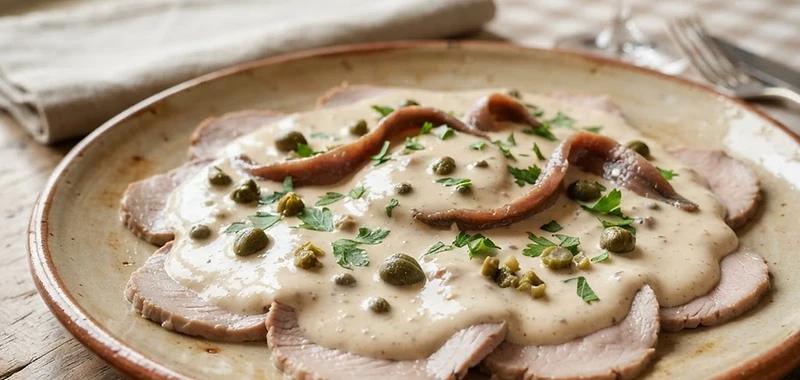
The cold dish that defines a Piedmontese summer, and that the rest of Italy now eats too. Thin slices of cold braised veal, covered in a sauce of tuna, capers, anchovy, olive oil, and egg — emulsified into a creamy, savory blanket. The sauce is the work; the veal is the canvas. Invented in Turin, eaten across the north all summer. Best made a day ahead, so the flavors marry.
Why go
To taste the original of Italy's most copied cold dish — in Turin, where it was invented.
The Field Guide take
Vitello tonnato is the definitive cold dish of the Piedmontese summer. It consists of thin, chilled slices of braised veal blanketed in a savory, emulsified sauce of tuna, capers, and anchovies. While versions of this dish now appear on menus across northern Italy, it remains a pillar of the culinary identity of Turin and the surrounding Piedmont region, where it serves as a testament to the historical intersection of local agriculture and the trade of imported luxury goods.
What it is
The dish is an exercise in contrast: the lean, neutral profile of veal serves as a canvas for a rich, saline sauce. The meat is braised until tender, sliced thin, and covered in a thick, mayonnaise-based emulsion containing tuna, salt-cured anchovies, and capers. It is served cold, often after a rest period that allows the proteins to absorb the aromatics of the sauce. It is rarely served as a main course; in the context of a traditional Piedmontese meal, it is an antipasto.
Origin and history
Vitello tonnato emerged in the Piedmont region during the 18th and 19th centuries. Its origins are tied to the landed gentry and the bourgeoisie of Turin. At the time, the dish functioned as a status symbol. It required access to expensive cuts of veal, as well as imported pantry staples like canned tuna and Mediterranean salt-cured anchovies—goods that were costly to transport to the landlocked north. These ingredients were used to create a centerpiece for grand banquets. Because it could be prepared entirely in advance, it was the ideal meal for summer celebrations in the heat of the Po Valley, allowing hosts to serve a refined, labor-intensive dish without working in the kitchen when guests arrived.
How it's made
The quality of vitello tonnato depends on the patience of the cook. The process begins by braising the veal in white wine, aromatics, and seasonal vegetables. Crucially, the meat must be allowed to cool completely within its own poaching liquid to maintain its moisture.
The sauce is a stable emulsion of egg yolks, olive oil, tuna, anchovies, and capers. A high-quality version relies on a thick, creamy consistency—it should coat the meat without running off the plate. The defining step of the preparation is the resting period. A traditional kitchen will plate the veal and spread the sauce over it at least 24 hours before service. This allows the brine of the capers and the depth of the fish to penetrate the grain of the meat.
Regional variations
While the Piedmontese standard uses a dense, mayonnaise-style base, regional adaptations shift the texture and profile. In neighboring Lombardy, the sauce is often thinner and relies on the natural oils of the tuna rather than an egg emulsion. Moving south toward the Ligurian coast, versions become more herb-forward, often incorporating significant amounts of fresh parsley or toasted pine nuts to reflect the proximity to the Mediterranean. Despite these variations, the Piedmontese version—firm, cool, and rich—remains the baseline for the dish.
When and how
Though vitello tonnato was historically reserved for late spring and summer due to its cooling nature, it is now a year-round staple in northern Italian trattorias. It is most commonly served as the opening course of a meal, often alongside insalata russa (a vegetable and mayonnaise salad). It is a dish that rewards the traveler looking for stability; because it is meant to be made ahead of time, it is consistently reliable in traditional establishments.
What to drink with it
Because the dish is saline and creamy, it requires a wine with enough acidity to cut through the richness of the egg and oil. A crisp, white Arneis from the Roero district is the standard local pairing, offering enough structure to balance the tuna. For those who prefer red, a glass of young, bright Dolcetto provides the necessary fruit and low tannins to accompany the veal without clashing with the savory, fish-forward notes of the sauce.
The Story
Where Vitello Tonnato comes from
Vitello tonnato originates from the Piedmont region in northwest Italy, with its strongest ties to the province of Turin. While the exact date of its inception remains a subject of minor historical debate, it solidified as a staple of the Piedmontese culinary identity during the 18th and 19th centuries. It is widely considered a dish of the wealthy landed gentry and bourgeoisie, as it utilized both expensive cuts of veal and imported preserved goods like salt-cured anchovies and canned tuna, which were luxury items in landlocked northern Italy at the time. Historically, it served as a centerpiece for grand banquets and mid-summer feasts, designed to be prepared in advance and served cool to combat the heat of the Po Valley. Today, it has transcended its regional boundaries to become an ubiquitous presence on menus across Northern Italy, though the Piedmontese version remains the standard against which all others are measured.
What Defines It
Signature ingredients
Veal
Specifically the magatello or girello cut, chosen for its lean, uniform texture and lack of connective tissue, providing a neutral, tender canvas for the sauce.
Canned Tuna
High-quality, oil-packed tuna is essential; it provides the savory base and depth that defines the sauce, distinguishing the dish from standard meat-based preparations.
Salt-cured Anchovies
They contribute a necessary umami intensity and salinity that balances the richness of the emulsified oil and egg yolk.
Capers
These provide the vital acidic pop and briny brightness required to cut through the heavy, creamy mouthfeel of the sauce.
Egg Yolks
Either hard-boiled or emulsified in a mayonnaise base, these are required to achieve the velvety, smooth consistency that binds the other ingredients together.
The Method
How it's made
The process begins with braising the veal in a light broth of white wine, aromatics, and vegetables until tender, then letting it cool completely within the liquid to retain moisture. The sauce is prepared by blending the tuna, anchovies, capers, and egg yolks with olive oil—and sometimes a portion of the poaching liquid—until it achieves a stable, spoonable consistency. A superior version is defined by the thinness of the veal slices and the deliberate marination period. Allowing the meat and sauce to rest together for at least 24 hours is the primary marker of quality, as it allows the tuna-anchovy notes to fully penetrate the grain of the veal.
Across Italy
Regional variants
Lombardy
Variants often omit the egg-based emulsion, preferring a slightly more liquid, broth-based sauce that relies more heavily on the tuna's natural oils.
Liguria
Proximity to the coast often influences versions that emphasize higher quantities of fresh herbs like parsley or sometimes the addition of pine nuts.
Piedmont (Traditional)
The most classic preparation strictly utilizes a mayonnaise-style base for the sauce, ensuring a thick, coating texture that adheres to the meat without dripping.
Timing
When to eat it
Traditionally consumed during the late spring and summer months, as it is a cold dish meant for warmer weather. In contemporary dining, it is frequently served as a standard antipasto year-round in northern Italian trattorias.
Serve With
Classic pairings
Arneis
wineA crisp, medium-bodied white wine from the Roero district of Piedmont that matches the acidity of the capers without overpowering the veal.
Dolcetto
wineA light-bodied red with low tannins that provides enough structure to hold up to the savory, fishy elements of the sauce.
Insalata Russa
foodOften served alongside the vitello tonnato as part of a classic Piedmontese antipasto platter to provide textural contrast.
What makes it worth going
Cold sliced veal with a tuna-caper sauce — the dish of the Piedmontese summer that everyone copies.
Things to do
- trattoria
Trattoria Scannabue (Turin)
The benchmark vitello tonnato, in a quiet street. The veal is poached, the sauce is tuna, capers, anchovy, and lemon; the taste is cold and the texture is silken. Reserve.
2 hrs
- ristorante
Ristorante Del Cambio (Turin)
The historic Turin ristorante, since 1757. The vitello tonnato is the refined version; the sauce is the test. Reserve; expensive.
2 hrs
- trattoria
A trattoria in the Langhe
In the hills, the vitello tonnato is the summer starter before the tajarin. The cold veal is the relief from the heat.
2 hrs
- experience
A Piedmontese summer lunch
Vitello tonnato, agnolotti del plin, a Barolo. The full Piedmontese summer arc, with the cold veal as the opener.
Eat
- antipasto
Vitello tonnato
The classic: sliced cold poached veal, with a sauce of tuna, capers, anchovy, lemon, and olive oil (often with egg yolk for emulsion). The cold veal and the tuna sauce are the dish.
- pasta
Agnolotti del plin
The companion; the Piedmontese stuffed pasta. Order both, the tonnato first.
- wine
A glass of Arneis or Gavi
The Piedmont white; the correct pairing for the cold veal and the tuna sauce.
Stay
- neighborhood
Turin center (Centro / Quadrilatero Romano)
Near Scannabue and Del Cambio. Walkable and central.
- rural
The Langhe
In the hills, with the vitello tonnato as the summer starter and the tajarin as the main. A car is required.
Experiences Worth Booking
Piedmontese cooking class
4 hrsVitello tonnato, agnolotti del plin, bagna cauda. The three Piedmontese classics in one class.
The tonnato is a poach and a sauce; the class shows you the cold rest and the emulsion.
Suits: Anyone who wants the Piedmontese summer table at home.
Langhe wine and food day
full dayA vitello tonnato lunch, a Barolo cellar, an agnolotti dinner. The full Langhe arc.
The tonnato and the Barolo are the Piedmontese summer; a day covers both.
Suits: Wine and food travelers with a day for Piedmont.
What's nearby & pairs with
More food from Piemonte
Dish
Tajarin al Tartufo
Egg-yolk-rich ribbon pasta with butter and white truffle — the signature dish of the Alba truffle season.
Dish
Bagna Càuda
A warm dip of garlic, anchovy, and butter for raw vegetables — the communal dish of Piedmont's cold months.
Dish
Grissini di Torino
Long, thin, crisp breadsticks from Turin — the breadstick the world copied, at its source.
Dish
Gianduiotto
A hazelnut-and-chocolate confection from Turin — the original hazelnut chocolate, the forefather of Nutella.
Dish
Agnolotti del Plin
Tiny pinched pasta parcels filled with roast meat, from the Langhe and Monferrato — Piedmont's most refined pasta.
Ready to plan?
Ready to turn discovery into a trip?
Italy Field Guide helps you decide where to go. When you're ready to build the actual day-by-day itinerary, take your saved places to Travel Itinerary Co — your interests go with you.
Turn your saved Italy places into a trip