Cheese · Piemonte
Castelmagno
The Verdict
Castelmagno is the most distinctive cheese in Piedmont and one of the few Italian mountain cheeses with real character. It is dry, salty, and faintly blue, and the best versions are made on the summer pastures above the village. Buy it at altitude if you can.
Why go
A single-valley cheese made on alpine pasture, in mountains almost no foreign visitor reaches.
The Field Guide take
Castelmagno is the defining cheese of the Piedmontese mountains. Produced exclusively in the Grana Valley, a narrow corridor in the Cuneo province, it resists the creaminess typical of northern Italian cheeses. Instead, it is firm, friable, and sharply flavored. If your palate leans toward mild, spreadable cheeses, look elsewhere. If you value depth, salt, and the distinct bite of mountain-pasture milk, prioritize a detour to the Cottian Alps.
What it is
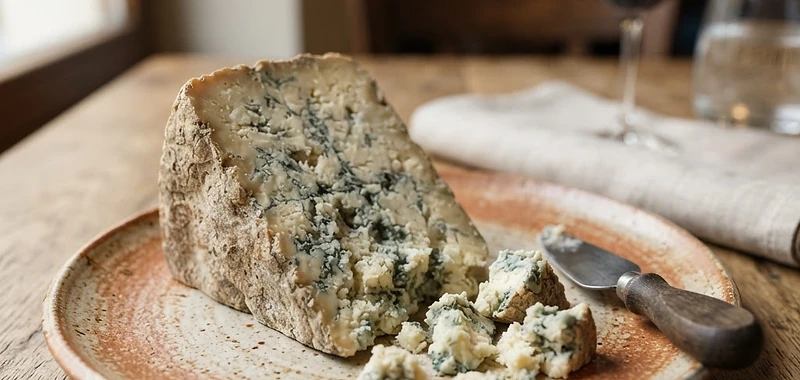
Castelmagno is a semi-hard cow’s milk cheese with a PDO (Protected Designation of Origin) status. It is defined by a dense, crumbly texture and an irregular, often blue-green vein that develops during aging. When young, it is salty and sharp; when aged, it becomes intense, piquant, and dry enough to require a robust liquid pairing. Because it is made in high-altitude pastures where biodiversity is high, the flavor profile changes slightly depending on the specific meadow the cows grazed.
Origin and history
The cheese takes its name from Castelmagno, a small commune in the Grana Valley. Documents from the thirteenth century mention the cheese, noting its role as a form of currency used by tenants to pay rent to the local Marquis of Saluzzo and the monks of the San Magno abbey. Its survival as a regional staple for nearly a millennium is due to its durability; it was designed to withstand long periods of storage and transport from the high alpine meadows down to the lowland markets.
Production
Production is restricted to the municipalities of Castelmagno, Pradleves, and Monterosso Grana. The process begins with raw cow’s milk, which is curdled and then cut into small pieces. Unlike soft cheeses that are lightly pressed, Castelmagno undergoes a rigorous pressing to achieve its characteristically dense paste. After the curds are formed, the wheels are aged in mountain caves. The characteristic veining occurs naturally; the environment of these high-altitude caves encourages the growth of specific molds that infiltrate the cheese over several months. Genuine Castelmagno di Alpeggio is made only during the summer months when cows graze on the highest, freshest alpine grasses, resulting in a significantly more complex final product than the year-round, industrial versions.
Where to eat it
To experience Castelmagno at its peak, travel into the Grana Valley. Avoid purchasing it in the tourist shops of Turin or Alba if you have the time to drive toward Cuneo. Small dairies and farmsteads scattered throughout the Grana Valley offer the freshest wheels. Look for labels that specify di Alpeggio—this indicates the milk was sourced from summer pastures. If you are dining in the region, mountain trattorias in the villages of Pradleves and Castelmagno will serve it both as a stand-alone course and as the primary component in local risottos and gnocchi. Opening hours in these mountain outposts are inconsistent; confirm schedules locally before heading up the valley.
When and how
Castelmagno is at its best in the autumn, immediately following the conclusion of the summer pasture season. This is when the summer-produced wheels have completed their essential aging cycle. Serve the cheese at room temperature. Because it is brittle and prone to shattering, do not attempt to slice it into thin, uniform pieces. Instead, use a knife to break off irregular chunks. It is frequently served with a drizzle of acacia or chestnut honey to balance the salt and the sharpness of the blue veins.
What to drink with it
This is not a cheese for delicate white wines. The salt and piquant character of Castelmagno require a wine with significant structure and tannin. A mature Barolo DOCG is the classic choice; the deep, earthy qualities of the Nebbiolo grape complement the fermented, complex notes of the cheese. If you prefer a lighter pairing, look for a Nebbiolo d’Alba, which provides enough acidity to cut through the density of the paste without being completely overpowered by the intensity of the aging process. Avoid light, floral whites, which will vanish against the cheese’s finish.
The Story
Where Castelmagno comes from
The cheese is named for the village in the Grana valley, where it has been documented since the thirteenth century and was once used as currency to pay rent to the abbey.
The Method
How it's made
Milk from cows grazing high pastures in summer is curdled, cut, and pressed, then aged in caves for months, during which the natural molds in the environment give it a blue-green veining.
Timing
When to eat it
Best in autumn, after the summer pasture season.
Serve With
Classic pairings
Barolo DOCG
wineHoney
produceWhat makes it worth going
A crumbly blue-veined mountain cheese from one valley in the Cottian Alps, made in summer on high pastures.
More food from Piemonte
Dish
Tajarin al Tartufo
Egg-yolk-rich ribbon pasta with butter and white truffle — the signature dish of the Alba truffle season.
Dish
Bagna Càuda
A warm dip of garlic, anchovy, and butter for raw vegetables — the communal dish of Piedmont's cold months.
Dish
Vitello Tonnato
Cold sliced veal with a tuna-caper sauce — the dish of the Piedmontese summer that everyone copies.
Dish
Grissini di Torino
Long, thin, crisp breadsticks from Turin — the breadstick the world copied, at its source.
Dish
Gianduiotto
A hazelnut-and-chocolate confection from Turin — the original hazelnut chocolate, the forefather of Nutella.
Dish
Agnolotti del Plin
Tiny pinched pasta parcels filled with roast meat, from the Langhe and Monferrato — Piedmont's most refined pasta.
Ready to plan?
Ready to turn discovery into a trip?
Italy Field Guide helps you decide where to go. When you're ready to build the actual day-by-day itinerary, take your saved places to Travel Itinerary Co — your interests go with you.
Turn your saved Italy places into a trip