
The Verdict
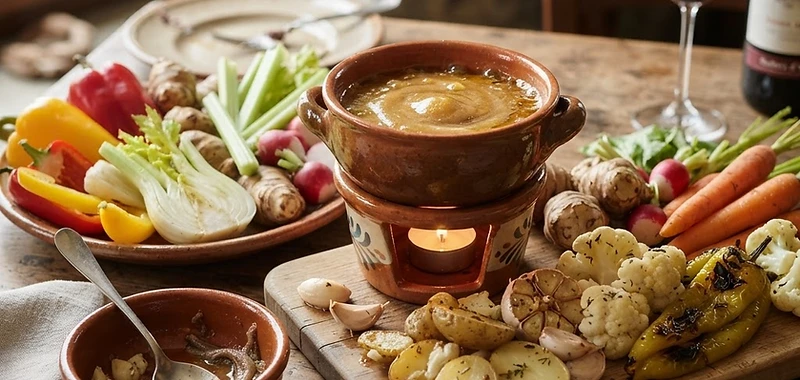
The dish that proves Piedmont eats like no one else in Italy. A warm bath of melted butter, garlic, and salted anchovy (bagna cauda = 'hot sauce'), served in a terrine, with raw winter vegetables — cardoon, jerusalem artichoke, peppers, cabbage, carrots — to dip. Pungent, fishy, and communal — eaten slowly, with friends, with wine. Not for the faint of palate; a revelation for the bold.
Why go
To taste Piedmont's strangest, most communal dish — anchovy and garlic, dipped with raw vegetables.
The Field Guide take
Bagna càuda—Piedmontese for "hot sauce"—is a dish that defies the common perception of Italian cuisine. There is no pasta, no tomato, and no pretense. It is a warm, pungent, emulsified dip of garlic, salt-cured anchovies, and fat, served in a communal vessel and meant to be eaten with a wide array of raw and cooked winter vegetables. It is the defining meal of the Piedmontese harvest season, representing a culinary tradition rooted in the geography and historical trade routes of the region.
What it is
Bagna càuda is a social ritual as much as it is a meal. It is traditionally served in a fujot, a small terracotta pot heated by a tea light or coal ember, which keeps the sauce at a consistent temperature throughout the meal. The base is aggressive: a heavy concentration of garlic and anchovies, bound together by oil or butter. Diners use seasonal produce—the pinzimonio—to scoop up the sauce. It is a demanding dish; the combination of raw garlic and high-sodium fish creates a flavor profile that lingers for days. It is rarely eaten alone, as the process is inherently communal, designed to be shared among friends over a long evening.
Origin and history
The dish emerged from the rural working culture of the Monferrato, Langhe, and Roero areas. Its existence is tied to the historical "Salt Road," a trade route that connected the Mediterranean coast of Liguria to the inland hills of Piedmont. Piedmontese merchants traded grain and wine for sea salt and salted anchovies. While anchovies were a staple for many, they were essential to the inland, landlocked worker who needed a durable, high-protein seasoning to make simple garden vegetables palatable. Following the grape harvest in late autumn, the dish served as a caloric, warming reward for laborers as the temperature began to drop.
How it’s made
The quality of a bagna càuda depends on the cook’s patience. To avoid a harsh, acrid result, the garlic is typically cleaned and often simmered in milk or water to mellow its bite before it is combined with the anchovies. The mixture is then cooked slowly in oil—or a blend of oil and butter—until the anchovies dissolve completely into the garlic, creating a cohesive, emulsified sauce.
Regional variations exist. In the Asti and Monferrato areas, the recipe is often kept austere, using only olive oil to maintain a sharp, clean finish. In the Langhe, it is common to enrich the sauce with a knob of butter or a splash of cream for a smoother mouthfeel. In Cuneo, some variations include toasted, crushed hazelnuts or walnuts, incorporating the local nut harvest into the dip. A successful version is smooth and thick; a poor one will appear as a broken, oily mess with gritty, undissolved anchovy bits.
Where to eat it
Because bagna càuda is a ritualistic, multi-course affair that leaves a lingering aroma in any dining room, it is not found on every restaurant menu. It is most authentically experienced in traditional trattorie or osterie throughout the rural towns of the Langhe and Monferrato, particularly during the autumn and winter months. Many establishments require advance notice if you intend to order it, as the preparation of the vegetables alone is time-consuming. You will find it most frequently in the provinces of Asti and Cuneo, where the dish is celebrated during harvest festivals and local sagre.
When and how
Bagna càuda is strictly seasonal. You will rarely see it offered outside of the period between late autumn and early spring. The dipping vegetables are the soul of the dish: raw cardoons (a relative of the artichoke), Jerusalem artichokes, peppers, cabbage, and carrots. Some hosts provide pieces of roasted squash or baked onions to complement the raw items. The meal is intended to be a slow process, accompanied by conversation and significant amounts of wine.
What to drink with it
The intensity of the garlic and salt requires a wine with enough acidity and structure to cut through the oil, but enough earthiness to mirror the rustic nature of the meal. Barbera d'Asti and Dolcetto d'Alba are the standard pairings. These wines provide a bright, high-acid profile that cleanses the palate after each mouthful of the rich, fishy sauce. For those who want to follow the local tradition to its conclusion, the remnants of the sauce in the fujot are often scrambled with a fresh egg, cooked directly in the residual heat of the pot to finish the meal.
The Story
Where Bagna Càuda comes from
Bagna Càuda, which translates from Piedmontese dialect as 'hot sauce,' originated in the vineyards and cellars of Piedmont, particularly in the lower Monferrato, Langhe, and Roero areas. Historically, it served as a hearty, communal meal for vintners and harvesters celebrating the completion of the grape harvest in late autumn. The dish relies on ingredients that were easily accessible and preserved through trade routes from Liguria, specifically anchovies, which were brought inland by salt merchants in exchange for Piedmontese grain and wine. It is a dish born of peasant utility, designed to sustain workers during the transition into the cold winter months. By the 20th century, it evolved from a utilitarian harvest meal into a ritualized social experience, deeply tied to the hearth and communal bonding.
What Defines It
Signature ingredients
Garlic
The backbone of the flavor profile; it is typically used in generous quantities, often simmered until it dissolves into the base.
Salt-cured Anchovies
Essential for the umami depth and salinity. High-quality, jarred or tinned whole anchovies are necessary to avoid a metallic aftertaste.
Extra Virgin Olive Oil
Provides the medium for the sauce, though some traditions incorporate butter or cream to stabilize the emulsion and soften the intensity.
Raw and Roasted Vegetables
Cardoons, Jerusalem artichokes, bell peppers, and cabbage provide the necessary textural contrast and sweetness to balance the pungent sauce.
The Method
How it's made
The preparation requires patience; the garlic is peeled and often simmered in milk or water to mellow its bite before being combined with oil and anchovies. The mixture must be kept at a low, consistent heat, stirring constantly to create a smooth, emulsified consistency without letting the garlic burn or the oil separate. A well-made version is thick, fragrant, and cohesive. A careless version results in a separated, oily mess with raw, sharp bits of garlic or grainy, over-salted anchovy fragments that haven't properly melted into the sauce.
Across Italy
Regional variants
Asti and Monferrato
The most traditional interpretation often uses only olive oil as the base, keeping the flavor profile sharp and focused.
Langhe
Frequently incorporates a knob of butter or a splash of cream into the mixture, which lends a richer, velvet-like texture.
Cuneo
May sometimes include crushed walnuts or toasted hazelnuts, reflecting the region's prominent nut production.
Timing
When to eat it
Bagna Càuda is firmly a cold-weather dish, traditionally enjoyed from autumn through winter. It is the centerpiece of 'Bagna Càuda' parties, where the communal nature of dipping vegetables into a shared central pot is the primary objective.
Serve With
Classic pairings
Barbera d'Asti
wineThe high acidity and red fruit notes of Barbera are the classic match, cutting through the richness and saltiness of the anchovies.
Dolcetto d'Alba
wineAn approachable, fruity choice that pairs well with the earthiness of the raw vegetables.
Polenta
foodSometimes served as a side or used to mop up the remnants of the sauce after the vegetables are gone.
What makes it worth going
A warm dip of garlic, anchovy, and butter for raw vegetables — the communal dish of Piedmont's cold months.
Things to do
- trattoria
A trattoria in the Langhe (autumn)
The bagna cauda is an autumn dish; the garlic and the anchovies are the base, the raw vegetables are the dip. Reserve in October-November.
2 hrs
- trattoria
Trattoria in Asti or Alessandria
In the Monferrato, the home of the dish. The bagna cauda is the autumn ritual; the vegetables are the season.
2 hrs
- festival
A bagna cauda festival (e.g. Bogli, November)
The village festivals in autumn, where the bagna cauda is made in the square. The garlic is the smell; the anchovy is the flavor.
full day
- experience
An autumn lunch in the Langhe
Bagna cauda, agnolotti, a Barolo. The full autumn Piedmontese arc, with the bagna cauda as the opener.
Eat
- antipasto
Bagna cauda
The classic: a warm dip of garlic and anchovies in olive oil and butter, with raw vegetables (cardoon, pepper, carrot, fennel, Jerusalem artichoke). The garlic and the anchovy are the dish; the vegetables are the dip.
- vegetable
With cardoons
The autumn vegetable, the traditional dipper. The cardoon is the test; the bitterness is the point.
- wine
A Barolo or Barbera
The Langhe red; the correct pairing for the garlic and the anchovy.
Stay
- rural
A Langhe village
In the hills, among the vineyards. The autumn base; a car is required.
- city
Asti
The Monferrato capital, near the home of the dish. A more urban base.
Experiences Worth Booking
Bagna cauda class
3 hrsThe garlic and anchovy confit, the vegetable selection, the warm service. The slow confit is the secret.
The bagna cauda is a confit; a class shows you the low heat, the garlic, and the anchovy.
Suits: Garlic lovers who want the autumn dish; the confit is the technique.
Autumn Langhe day
full dayBagna cauda, agnolotti, a Barolo cellar, a truffle hunt. The full Piedmontese autumn.
The bagna cauda is an autumn dish; the truffle and the Barolo are too; a day covers all three.
Suits: Food travelers with a day for the Langhe in October-November.
What's nearby & pairs with
More food from Piemonte
Dish
Tajarin al Tartufo
Egg-yolk-rich ribbon pasta with butter and white truffle — the signature dish of the Alba truffle season.
Dish
Vitello Tonnato
Cold sliced veal with a tuna-caper sauce — the dish of the Piedmontese summer that everyone copies.
Dish
Grissini di Torino
Long, thin, crisp breadsticks from Turin — the breadstick the world copied, at its source.
Dish
Gianduiotto
A hazelnut-and-chocolate confection from Turin — the original hazelnut chocolate, the forefather of Nutella.
Dish
Agnolotti del Plin
Tiny pinched pasta parcels filled with roast meat, from the Langhe and Monferrato — Piedmont's most refined pasta.
Ready to plan?
Ready to turn discovery into a trip?
Italy Field Guide helps you decide where to go. When you're ready to build the actual day-by-day itinerary, take your saved places to Travel Itinerary Co — your interests go with you.
Turn your saved Italy places into a trip