The Verdict
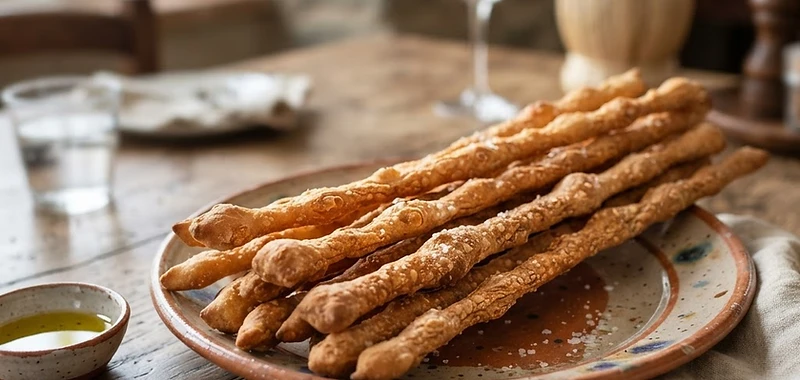
The breadstick that the world copied, and that Piedmont still does best. Long, pencil-thin, dry, and crisp, originally invented in Turin in the 17th century for a sick duke who couldn't digest bread. Eaten at every Piedmontese meal, as a starter, with prosciutto wrapped around them. The rubatà (hand-rolled) version is thicker and rougher than the industrial one. A small thing, done right.
Why go
To eat grissini at their source — hand-rolled, in Turin, where they were invented.
The Field Guide take
In Turin and across the Piedmont region, the grissino is not a snack to be ordered or a novelty to be sampled; it is a permanent fixture of the table. These long, pencil-thin breadsticks are the functional foundation of a local meal, serving as a palate cleanser before the antipasti arrive or as a structural accompaniment to cured meats. While the world has since standardized the breadstick into an industrial, vacuum-sealed commodity, the grissino torinese remains a distinct, artisanal product defined by its brittleness and its specific history of necessity.
A royal remedy
The origins of the breadstick are rooted in the health of the House of Savoy. In the 17th century, the young Duke Vittorio Amedeo II suffered from chronic digestive issues, making the consumption of standard, doughy, soft-crumb bread difficult. His physician, Teobaldo Pecchio, tasked the palace bakers with finding a solution. They developed the ghërsa, a long, thin loaf designed to maximize the ratio of crust to crumb. By removing the soft center and baking the dough until it reached a state of total desiccation, the bakers created a product that was easier to digest and significantly more shelf-stable than traditional loaves. By the 18th century, the breadstick had moved from the palace to the public, eventually earning the admiration of Napoleon Bonaparte, who reportedly kept a supply on hand.
The mechanics of the dough
Authentic Piedmontese grissini are made from a straightforward mixture of Tipo 00 flour, yeast, sea salt, and either lard or extra virgin olive oil. The defining characteristic is the method of shaping. A master baker handles the dough with minimal pressure, as over-handling compresses the internal structure and ruins the texture.
There are two primary categories of traditional grissini. The rubatà, a Piedmontese term meaning "rolled," are the thicker, more rustic variation. These are shaped entirely by hand, and one can often see the baker’s fingerprints indented into the surface of the bread. The stirà—often associated with the town of Chieri—are stretched longer and thinner than the rubatà, resulting in a glass-like snap. In either case, the baking process is the most critical stage. The bread must be baked until it is entirely bone-dry; an under-baked grissino with a soft, chewy center fails the basic requirement of the style.
Where to seek them out
To understand the grissino, you must eat it in Turin. The city’s high-end panifici (bakeries) treat the production of rubatà as a craft, often displaying them in long bundles near the point of sale. If you find yourself in the smaller towns surrounding the capital, look for bakeries that specialize in the stirà variety. Avoid the mass-produced, boxed versions found in supermarkets, which are typically dense and lack the necessary structural fragility of a freshly baked hand-rolled stick. A proper grissino should shatter clean when snapped; if it bends, it is not fresh.
Consumption and pairings
Grissini are present at every hour of the day in Piedmont, though they are most prominent during the aperitivo and at the start of a multi-course dinner. They are rarely eaten in isolation. The most common pairing is high-quality prosciutto crudo, which is wrapped around the breadstick to create a contrast between the salty, supple fat of the meat and the dry, brittle snap of the dough.
Because of their neutral, yeasty profile, they are an ideal companion to the region’s signature drinks. They are frequently served with Vermouth di Torino, where their dryness balances the botanicals of the fortified wine. During the meal, they pair naturally with the high acidity and tannins of a local Nebbiolo, serving as a reliable palate cleanser between glasses and bites of richer, meat-heavy dishes. When you sit down at a table in Turin, do not expect a bread basket; expect a bundle of grissini standing upright, waiting to be broken.
The Story
Where Grissini di Torino comes from
Grissini originated in the 17th century in Turin, Piedmont. Legend attributes their creation to the royal physician Teobaldo Pecchio, who devised a specialized, easily digestible bread for the young Duke Vittorio Amedeo II of Savoy, who suffered from poor health and digestive issues. By removing the soft crumb and focusing on the crisp crust, the palace bakers created the 'ghërsa,' a long, thin loaf that became the city's signature. The breadsticks quickly transitioned from a medical necessity to a staple of the royal court, and by the 18th century, they were a known delicacy across Europe, famously admired by Napoleon Bonaparte.
What Defines It
Signature ingredients
Tipo 00 Flour
Provides the low-protein foundation necessary for a snappy, non-chewy texture.
Lard or Extra Virgin Olive Oil
Lard is traditional for a richer flavor and flakiness; oil creates a cleaner, more modern finish.
Active Yeast
Required to provide the necessary rise and airy structure before the final drying process.
Sea Salt
Essential for seasoning the dough, often sprinkled on top for a sharp flavor contrast.
The Method
How it's made
Authentic Piedmontese grissini, particularly the 'rubatà' variety, are hand-rolled. The dough is shaped into small logs and then stretched by hand to reach their signature length, a technique that requires practice to ensure uniform thickness. A master baker avoids heavy pressure, which ruins the internal structure. The crucial stage is the bake, where the moisture is pulled out until the bread is bone-dry and brittle; a careless version is often under-baked, leaving a soft center that negates the essential crisp snap.
Across Italy
Regional variants
Turin
Home to the 'rubatà,' which are thicker, hand-rolled, and retain the fingerprints of the baker.
Chieri
Known for the 'stirà' style, which are stretched thinner and longer than the rubatà, resulting in a glass-like crispness.
Timing
When to eat it
Grissini are produced and consumed year-round, serving as a constant presence on dining tables throughout Piedmont, usually served before a meal or alongside antipasti.
Serve With
Classic pairings
Prosciutto Crudo
FoodWrapping a thin slice of aged ham around the crisp grissino provides a balance of salt and fat.
Nebbiolo
WineThe tannins in this regional Piedmontese red wine cut through the starch and fat of the bread.
Vermouth di Torino
DrinkThe herbal profile of this local fortified wine complements the simple, toasted grain notes of the breadstick.
What makes it worth going
Long, thin, crisp breadsticks from Turin — the breadstick the world copied, at its source.
Things to do
- bakery
A Turin bakery (e.g. Baratti & Milano or a forno)
The home of the grissini, in Turin. The long, thin breadsticks; the crunch is the test. Buy them warm, in the morning.
45 min
- cafe
A Turin cafè for grissini and a vermouth
The grissini with a vermouth (the Turin drink, since 1786); the breadstick and the aperitivo are the pairing.
1 hr
- experience
A grissini-making demonstration
The grissini are stretched by hand (the stirato) or rolled (the rubatà); the two styles are the Turin tradition.
1.5 hrs
- experience
A Turin food walk
Grissini, agnolotti, gianduiotto; the full Turin circuit, with the grissini as the start.
Eat
- bread
Grissini stirati
The hand-stretched version; long, thin, irregular. The artisan grissino; the crunch is the point.
- bread
Grissini rubatà
The rolled version; shorter, thicker, more uniform. The classic grissino; the older style.
- pairing
With a vermouth or a dip
The two companions: the vermouth (the Turin aperitivo) or a dip (bagna cauda, crema di tonno). The grissini are the vehicle.
Stay
- neighborhood
Turin center (Centro / Quadrilatero Romano)
Near the best bakeries and cafés. Walkable and central.
- rural
The Langhe
In the hills, where the grissini are also made and the wine is better. A car is required.
Experiences Worth Booking
Grissini-making class
2 hrsThe dough, the stretch (or the roll), the bake. The two styles are the tradition.
The grissini are stretched by hand; a class shows you the dough and the stretch (or the roll).
Suits: Bread bakers who want the Turin technique; the stretch is the secret.
Turin food day
full dayGrissini and a vermouth, agnolotti for lunch, a gianduiotto. The full Turin arc.
The grissini, the agnolotti, and the gianduiotto are the Turin trinity; a day covers all.
Suits: Food travelers with a day for Turin.
What's nearby & pairs with
More food from Piemonte
Dish
Tajarin al Tartufo
Egg-yolk-rich ribbon pasta with butter and white truffle — the signature dish of the Alba truffle season.
Dish
Bagna Càuda
A warm dip of garlic, anchovy, and butter for raw vegetables — the communal dish of Piedmont's cold months.
Dish
Vitello Tonnato
Cold sliced veal with a tuna-caper sauce — the dish of the Piedmontese summer that everyone copies.
Dish
Gianduiotto
A hazelnut-and-chocolate confection from Turin — the original hazelnut chocolate, the forefather of Nutella.
Dish
Agnolotti del Plin
Tiny pinched pasta parcels filled with roast meat, from the Langhe and Monferrato — Piedmont's most refined pasta.
Ready to plan?
Ready to turn discovery into a trip?
Italy Field Guide helps you decide where to go. When you're ready to build the actual day-by-day itinerary, take your saved places to Travel Itinerary Co — your interests go with you.
Turn your saved Italy places into a trip