The Verdict
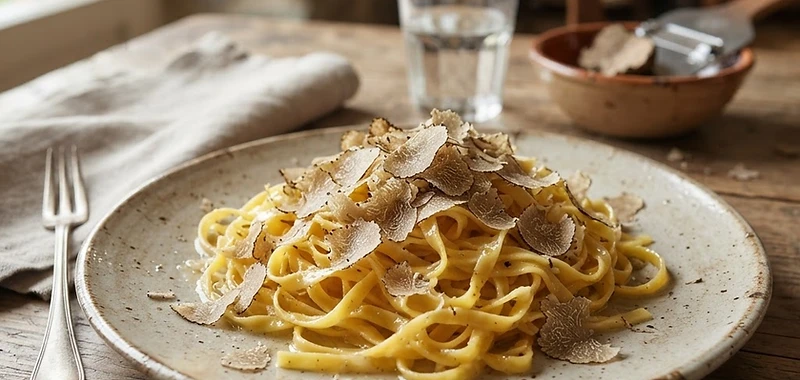
The dish that justifies the trip to Alba in October-November. Tajarin: thin, golden ribbons made with up to 40 egg yolks per kilo of flour. Tossed in butter and shaved with white truffle (tartufo bianco d'Alba), by weight, at the table. The pasta is the vehicle; the truffle is the point. Nothing else should interfere — no garlic, no cream, no tomato. When the truffle is good, this is the best pasta in Italy.
Why go
To eat white truffle shaved over the richest egg pasta in Italy, in Alba, in season.
The Field Guide take
Tajarin al tartufo is the singular culinary event of the Langhe hills. It is a dish of high-contrast minimalism: the extreme, silk-like richness of egg-yolk-heavy pasta paired with the immediate, aromatic intensity of the Tuber magnatum pico, or white truffle of Alba. In Piedmont, it is considered a seasonal necessity rather than a menu item.
The composition of tajarin
Tajarin is the Piedmontese name for a thin, hand-cut ribbon pasta. While common throughout Italy, the regional distinction here lies in the ratio of ingredients. Where standard egg pasta might use a single egg for every 100 grams of flour, traditional tajarin is defined by its excess, often incorporating 30 to 40 egg yolks per kilogram of flour. This creates a dough that is not merely firm, but intensely yellow and remarkably supple. It is rolled paper-thin—ideally by hand with a mattarello—and cut into fine ribbons. Because of the high fat content from the yolks, the pasta has a mouthfeel that is almost creamy once cooked.
Origins and the truffle culture
The dish evolved from the agricultural history of the Langhe and Monferrato. In rural households, poultry was abundant during harvest, providing the surplus of yolks required for such a decadent dough. Historically, this was peasant food elevated by the bounty of the harvest season. The pairing with white truffle—a wild, subterranean fungus that cannot be cultivated—was a natural progression of utilizing two prized local products. The rise of the Alba White Truffle Fair in the 20th century cemented the dish's status, transforming it from a domestic specialty into the standard-bearer for Piedmontese gastronomy.
The preparation
The preparation of tajarin al tartufo is an exercise in restraint. The pasta is cooked for less than two minutes in boiling salted water. It is then drained and tossed quickly in a pan with melted, high-quality local butter until the fat emulsifies into a light coating.
The dish is finished at the table. The hot, buttered pasta is plated, and the white truffle is shaved directly onto the noodles in front of the diner. Culinary purists in the Langhe maintain that nothing else belongs on the plate. Ingredients like garlic, cream, or tomato are viewed as errors that mask the volatile, musky aroma of the truffle. The pasta serves only as a delivery system for the truffle’s scent, which is the dish's primary purpose.
Where to eat it
The epicenter for this dish is the province of Alba and the surrounding villages of the Langhe, such as La Morra, Barbaresco, and Neive. Seek out traditional trattorias that specialize in cucina casalinga. A reliable indicator of quality is a kitchen that refuses to serve the dish outside of the truffle harvest window. If a restaurant offers "truffle pasta" in May or August, they are likely using oils or preserved products, both of which are poor substitutes for the fresh experience. The dish is fundamentally tied to the calendar; it is at its best during the peak harvest months of October and November.
When and how to drink it
Tajarin al tartufo demands a wine that can stand up to the fat of the butter and the weight of the yolks without overpowering the delicate, earthy aroma of the truffle. The local choice is almost always a nebbiolo-based wine from the region. A Barolo or Barbaresco is the standard recommendation, as their tannins and acidity cut through the richness of the egg pasta. For those who prefer a sparkling option, an Alta Langa—Piedmont's traditional-method sparkling wine—offers enough structure and mineral complexity to complement the dish without obscuring the truffle. When in doubt, defer to the house wine, as producers in the Langhe ensure their regional output is tailored to the local pantry.
The Story
Where Tajarin al Tartufo comes from
Tajarin, a diminutive of the Piedmontese word for tagliolini, originated as a pasta of the Langhe hills and Monferrato region. Unlike the egg-based pastas of Emilia-Romagna, which often rely on a one-egg-per-100-grams ratio, traditional tajarin dough is famous for its extreme richness, frequently utilizing 30 to 40 egg yolks per kilogram of flour. Historically, this was a celebration of the abundance of farm-raised poultry during the harvest season. The marriage of this thin, delicate egg pasta with the white truffle of Alba (Tuber magnatum pico) is a logical convergence of two of the region's most prized culinary products: the pantry staple of the household and the wild-harvested subterranean luxury of the Piedmontese forests. While tajarin has been a domestic staple for generations, its emergence as a premier restaurant dish is inextricably linked to the commercial rise of the Alba White Truffle Fair, which turned the local tradition into a global benchmark for seasonal luxury.
What Defines It
Signature ingredients
Egg Yolks
The defining component; the high yolk-to-flour ratio provides the intense yellow color and a distinctively silky, elastic mouthfeel that differentiates tajarin from standard tagliatelle.
00 Flour
Finely milled wheat flour is necessary to achieve the pasta's signature thinness without compromising structural integrity during boiling.
Alba White Truffle
The primary aromatic element. It must be fresh and shaved raw at the table to allow its volatile, garlicky, and musky compounds to hit the nose before they dissipate.
Local Butter
A high-fat, unsalted butter is the only appropriate fat; it provides a neutral, creamy base that coats the pasta ribbons without masking the delicate scent of the truffle.
The Method
How it's made
The dough is worked by hand until it achieves a firm, uniform consistency, then rolled out extremely thin—often with a rolling pin (mattarello) in traditional kitchens. The pasta is cut by hand into thin, uniform ribbons. A careless version involves machine-rolled, overly thick pasta that lacks the necessary silkiness. The cooking process is brief, often under two minutes. The final assembly must happen rapidly: the pasta is tossed gently in melted, emulsified butter, moved to the plate, and immediately topped with generous shavings of white truffle. The use of cream, garlic, or excessive salt is widely considered a failure that degrades the specific flavor profile of the truffle.
Across Italy
Regional variants
Langhe
The epicenter of the dish, where the emphasis remains strictly on the ratio of egg yolks to flour and the absence of extraneous aromatics.
Monferrato
While identical in composition to the Langhe version, it is occasionally served with a ragù of veal or rabbit, though this is distinct from the tartufo-specific preparation.
Timing
When to eat it
This is a strictly seasonal dish, tied to the truffle harvest which peaks between October and November. Outside of these months, reputable establishments will remove it from the menu rather than rely on preserved truffles.
Serve With
Classic pairings
Barbaresco
wineA Nebbiolo-based red from the region; its structure and earthy notes complement the intensity of the truffle without overpowering it.
Barolo
wineA classic pairing; the tannins and complexity of a mature Barolo align with the prestige of the dish.
Alta Langa
wineA dry, sparkling white wine from the region that serves as a palate-cleansing alternative to the heavy reds.
What makes it worth going
Egg-yolk-rich ribbon pasta with butter and white truffle — the signature dish of the Alba truffle season.
Things to do
- trattoria
La Piola (Alba)
In the Piazza del Duomo, the heart of Alba. The white truffle tajarin in season (Oct-Dec) is the reason to go. Reserve.
2 hrs
- trattoria
Trattoria della Posta (Monforte d'Alba)
In the Langhe hills. The tajarin is made with up to 40 yolks per kilo. The white truffle is shaved at the table. Reserve far ahead in season.
2 hrs
- ristorante
Guido da Costigliole (Borgo San Donato)
The refined version, in a Langhe village. The tajarin is the test, the truffle is the luxury.
2 hrs
- festival
Alba White Truffle Fair (Oct-Nov)
The world truffle market, on weekends in October and November. The truffles are weighed and sold by the gram. The atmosphere is the show.
half day
Eat
- pasta
Tajarin al tartufo bianco
The benchmark: egg-ribbon pasta, butter, and shaved white truffle by weight. No cream, no garlic, no interference. The truffle is the dish.
- pasta
Tajarin al burro e salvia
Out of truffle season: the same tajarin with butter and sage. The pasta is still the richest in Italy.
- antipasto
Vitello tonnato
The Piedmontese summer starter; the cold veal with tuna-caper sauce. The right opener before the tajarin.
Stay
- city
Alba center
The truffle capital; near La Piola and the fair. Walkable to the best restaurants in season.
- rural
A Langhe village (Monforte, Barolo, La Morra)
In the hills, among the vineyards. The most beautiful base; a car is required.
Experiences Worth Booking
White truffle hunt with a trifolau
3-4 hrsA dawn walk with a truffle hunter and his dog, in the Langhe woods. Find a white truffle; lunch after.
The dog is the secret; a real hunt shows you why a white truffle is worth its price.
Suits: Anyone in Piedmont in October-December; the most authentic truffle experience.
Barolo + Barbaresco cellar day
full dayVisits to two or three cellars in the Langhe, with tastings. Often with a long lunch.
The truffle and the wine are the Langhe's two gifts; a cellar day is the other half.
Suits: Wine lovers who want the Nebbiolo pilgrimage.
What's nearby & pairs with
More food from Piemonte
Dish
Bagna Càuda
A warm dip of garlic, anchovy, and butter for raw vegetables — the communal dish of Piedmont's cold months.
Dish
Vitello Tonnato
Cold sliced veal with a tuna-caper sauce — the dish of the Piedmontese summer that everyone copies.
Dish
Grissini di Torino
Long, thin, crisp breadsticks from Turin — the breadstick the world copied, at its source.
Dish
Gianduiotto
A hazelnut-and-chocolate confection from Turin — the original hazelnut chocolate, the forefather of Nutella.
Dish
Agnolotti del Plin
Tiny pinched pasta parcels filled with roast meat, from the Langhe and Monferrato — Piedmont's most refined pasta.
Ready to plan?
Ready to turn discovery into a trip?
Italy Field Guide helps you decide where to go. When you're ready to build the actual day-by-day itinerary, take your saved places to Travel Itinerary Co — your interests go with you.
Turn your saved Italy places into a trip