
The Verdict
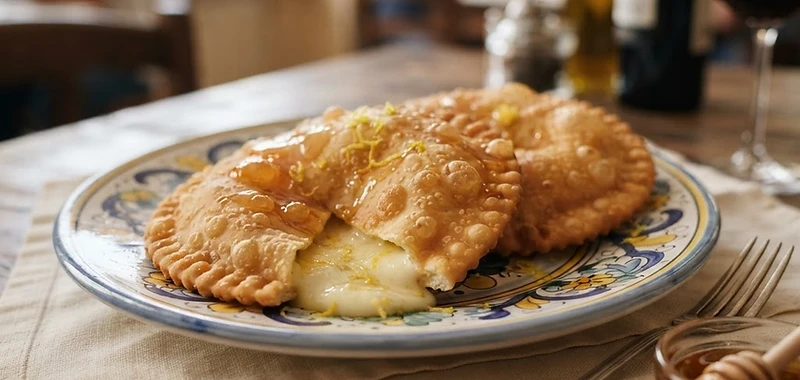
The dessert that's not really a dessert. A disk of semolina dough filled with young, melting pecorino, fried until crisp, then drenched in bitter Sardinian honey (miele amaro, often strawberry-tree honey). The cheese is savory, the honey is bitter-sweet, the contrast is what makes it. Eaten as a sweet-savory finish, or sometimes as a mid-meal palate-killer. Nowhere else does this.
Why go
To taste a dessert made of fried cheese and bitter honey — uniquely Sardinian.
The Field Guide take
In the landscape of Italian sweets, the seada stands apart. It is a dish that defies the conventional boundaries of a dessert, acting less as a sugary conclusion to a meal and more as a final, concentrated expression of Sardinian pastoral life. Comprised of nothing more than semolina dough, young sheep’s cheese, and bitter honey, it is a caloric, singular encounter that remains a cornerstone of the island’s culinary identity.
What it is
A seada (sometimes called sevada) is a large, hand-formed raviolo. The pastry is made from semolina flour, water, and lard, rolled thin and fried until it bubbles and turns a deep golden brown. Inside, the filling is strictly pecorino fresco—sheep’s milk cheese that has not been allowed to age or sharpen. When heated, the cheese becomes elastic and molten. Once lifted from the fryer, the pastry is doused in honey. The resulting flavor profile is a persistent push-and-pull between the lactic, salt-forward interior and the floral, astringent notes of the honey.
Origin and history
The seada emerged from the transhumance traditions of the Barbagia, Ogliastra, and Logudoro regions. Historically, this was not an indulgence to be eaten after a long dinner; it was a nutrient-dense, shelf-stable meal for shepherds guiding their flocks through the rugged Sardinian interior. The ingredients—semolina, lard, and sheep’s cheese—were the staples of the pastoral household.
While the dish’s exact origins are lost to time, its structure suggests the influence of Spanish culinary practices, which often combined fried doughs with savory or sweet fillings. Over time, as rural life shifted, the seada transitioned from a primary source of sustenance for shepherds into a centerpiece of village festivals and religious feast days.
How it’s made
The integrity of a seada relies on the quality of the pecorino fresco. In the canonical versions found in Barbagia, the cheese is often lightly melted or grated and mixed with a small amount of lemon zest to cut through the richness. This cheese is placed between two sheets of dough, crimped at the edges, and submerged in hot lard or oil.
A high-quality seada is defined by the contrast in texture: the crust must be crisp and light, while the interior must be uniformly molten. If the cheese is aged, it will curdle rather than melt, leading to an oily, gritty texture. The final step is the honey, traditionally miele amaro (bitter honey) derived from the strawberry tree (corbezzolo). The bitterness of this specific honey is essential; it balances the fat of the lard and the salt of the cheese, preventing the dish from becoming cloying.
Regional variations
While the preparation is consistent across the island, local nuances exist. In Barbagia, the adherence to tradition is strict, utilizing the youngest possible sheep’s cheese. In the north, within the Logudoro region, cooks occasionally adjust the dough thickness or increase the proportion of lemon zest. In Ogliastra, you may encounter larger formats, and in years where the strawberry tree harvest is thin, producers may substitute it with local citrus blossom honey. These variations are minor, but they reflect the specific environmental harvest of each district.
When and how
While you can find seadas on restaurant menus throughout the year, the dish is historically anchored to the winter and spring, reflecting the cycle of fresh sheep’s milk. It is a substantial item, often served in taverns and trattorias as a standalone course. It is rarely shared; a single seada is sufficient for one person. It must be eaten immediately while the pastry is hot and the cheese is still fluid; once it cools, the cheese loses its stretch and the pastry absorbs the honey, losing its crispness.
What to drink with it
Because the seada is as much savory as it is sweet, it pairs well with wines that offer significant body or aromatic complexity. A glass of Malvasia di Bosa, with its golden hue and notes of dried fruit and herbs, provides the necessary structure to stand up to the molten cheese. Alternatively, a robust Cannonau di Sardegna can bridge the gap between the savory dough and the floral honey. To conclude, a small glass of mirto—the local myrtle liqueur—is the traditional choice to assist with digestion after the heavy, fried pastry.
The Story
Where Seadas comes from
Seadas (or sevadas) are an ancient pastoral preparation rooted in the transhumance traditions of central Sardinia, specifically the Barbagia, Ogliastra, and Logudoro regions. Historically, this was not a dessert in the modern sense but a hearty, nutrient-dense meal for shepherds following their flocks. It evolved from a rural necessity—using sheep's milk cheese, semolina flour, and lard—to a centerpiece of festive occasions. The dish is intrinsically linked to the island's sheep-farming culture, where the lifecycle of the pecorino cheese defined the domestic calendar. While its origins predate written documentation, the practice of frying dough filled with cheese is a clear remnant of Spanish influence on the island, reflecting a cross-cultural culinary history that favors simple, shelf-stable ingredients converted into something substantial. Despite its current status as a dessert, it remains fundamentally savory in its construction, challenging the Italian classification of 'dolce.'
What Defines It
Signature ingredients
Pecorino fresco
Specifically young, non-aged sheep's milk cheese that melts into a gooey, stringy texture rather than turning oily.
Semola di grano duro
Hard durum wheat semolina is essential for creating a dough that can withstand high-heat frying while maintaining a characteristic snap.
Strutto (Lard)
Traditional frying fat that imparts a distinct depth and ensures the pastry puffs correctly during the quick fry.
Miele amaro
Specifically bitter honey derived from the arbutus (strawberry tree), providing a complex, tannic counterpoint to the saltiness of the cheese.
Lemon zest
Often incorporated into the cheese filling to provide a necessary aromatic lift and brightness to the heavy fats.
The Method
How it's made
The dough is made by kneading semolina with warm water and lard until smooth, then rolling it into thin sheets. The filling—young pecorino—is sometimes melted down slightly or grated, often mixed with a touch of lemon zest. A mound of cheese is placed on one sheet, covered by another, and cut into a perfect circle, with the edges crimped to seal the cheese inside. A well-made seada is fried in hot lard or oil until the crust bubbles and turns golden-brown; a careless version uses low-quality oil or aged, sharp pecorino, which results in a curdled, greasy interior rather than a smooth, molten center. The finish is critical: the seada must be served piping hot, doused generously with warm, liquid honey, which creates a syrupy glaze that permeates the crisp pastry.
Across Italy
Regional variants
Barbagia
Considered the canonical home of the dish, where the use of specifically unripened sheep's cheese is most strictly observed.
Logudoro
In some northern areas, the preparation may include a slightly higher proportion of lemon zest or minor variations in dough thickness.
Ogliastra
Often features slightly larger formats and sometimes incorporates a hint of local citrus blossom honey if the strawberry tree honey is unavailable.
Timing
When to eat it
Seadas are available year-round in restaurants throughout Sardinia, but they are historically linked to the winter and spring months when fresh sheep's milk is most abundant. They are standard fare for feast days and village celebrations.
Serve With
Classic pairings
Malvasia di Bosa
wineA structured, honeyed dessert wine that matches the intensity of the arbutus honey.
Cannonau di Sardegna
wineThe tannins in this robust red wine help cut through the richness of the fried pastry and molten cheese.
Mirto
digestifA myrtle-based liqueur that provides a herbal, slightly bitter finish that cleanses the palate after the heavy pastry.
What makes it worth going
Fried semolina and pecorino pastry, doused in bitter honey — Sardinia's most singular dessert.
Things to do
- farm
Agriturismo in Barbagia or Ogliastra
The home of seadas. The fresh pecorino, the dough, the honey. Book a full meal; the seadas is the finish.
half day
- trattoria
Trattoria in Cagliari
In the city, for seadas without the drive. The cheese is fresh, the honey is bitter, the fry is crisp.
2 hrs
- producer
A Sardinian honey producer
The bitter honey (miele amaro, from corbezzolo, the strawberry tree) is the classic finish. Visit a producer; the honey is the dish.
- festival
A village festival
The Sardinian interior has food festivals through the summer; the seadas is often the dessert. Check the calendar.
Eat
- dessert
Seadas
The classic: a disc of semolina dough, filled with fresh pecorino, fried, and drizzled with bitter honey (miele amaro, from corbezzolo). The sweet-savory-bitter contrast is the point.
- condiment
Miele amaro
The bitter honey, from the corbezzolo (strawberry tree). The classic finish; the bitterness cuts the cheese and the fry.
Stay
- farm-stay
An agriturismo in the interior
The only way to eat seadas at its source; the cheese is fresh, the honey is local.
- city
Cagliari or Nuoro
The city bases, with good trattorias for seadas without the interior drive.
Experiences Worth Booking
Seadas-making class
2 hrsThe dough, the fresh pecorino, the fry, the honey. The cheese must be fresh and melty.
The seadas is a pasta-pastry hybrid; a class shows you the dough, the cheese, and the fry.
Suits: Sweet-savory lovers who want the technique; the fry is the secret.
Sardinian honey and cheese day
full dayA honey producer, a cheese maker, and a seadas lunch. The sweet-savory-bitter arc.
The seadas is the honey and the cheese; a day covers both at their source.
Suits: Food travelers with a day for Sardinian sweets.
What's nearby & pairs with
More food from Sardegna
Dish
Porceddu
Whole roast suckling pig, cooked on a spit over a wood fire — Sardinia's great celebratory dish.
Dish
Culurgiones
Sardinian ravioli filled with potato, pecorino, and mint — pinched into a wheat-sheaf shape.
Dish
Malloreddus
Saffron gnocchetti with pork and tomato ragù — the everyday pasta of Sardinia.
Dish
Pane Carasau
Thin, crisp, twice-baked flatbread — the bread of Sardinian shepherds, made to last for weeks.
Dish
Bottarga di Cabras
Salt-cured mullet roe from the Cabras lagoon — Sardinia's 'gold', shaved over pasta.
Ready to plan?
Ready to turn discovery into a trip?
Italy Field Guide helps you decide where to go. When you're ready to build the actual day-by-day itinerary, take your saved places to Travel Itinerary Co — your interests go with you.
Turn your saved Italy places into a trip