Cheese · Sardegna
Fiore Sardo
The Verdict
Fiore Sardo is the cheese that explains the Sardinian interior: sheep, shepherds, and a fire. It is dense, smoky, and salty, and the aged versions are hard enough to grate over pasta. Buy it in a village shop in the Barbagia rather than a city delicatessen.
Why go
Shepherd country in the granite mountains, with dairies that sell directly and a transhumance culture still alive.
The Field Guide take
Fiore Sardo is the definitive cheese of the Sardinian interior. It is dense, smoky, and assertive, reflecting the realities of life for shepherds in the Barbagia mountains. While it is sold throughout Italy, the product found in the granite highlands of Nuoro and Sassari carries a depth that city markets rarely replicate. It is a cheese that requires travel to the source to understand fully.
What it is
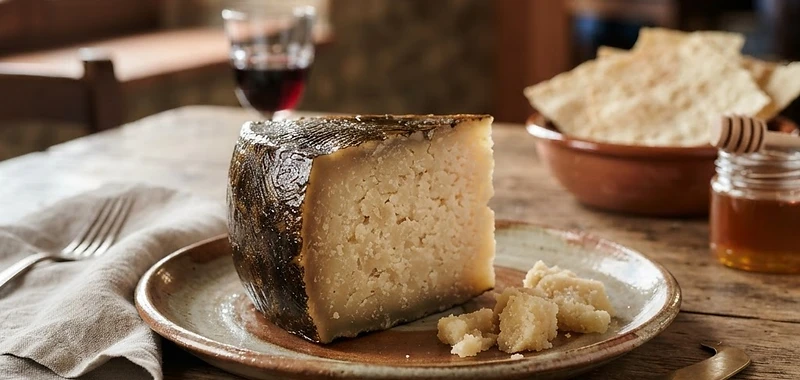
Fiore Sardo is a raw, whole sheep’s milk cheese defined by its smoke-cured rind. It is produced exclusively from the milk of the Sarda breed of sheep. The cheese undergoes a natural aging process that dictates its character: young wheels have a buttery, elastic texture, while mature versions—aged for eight months or more—become brittle, crystalline, and sharp. The smoke treatment, performed over local woods, permeates the paste, leaving a faint, savory char that anchors the flavor profile.
Origin and history
The cheese is a byproduct of transhumance. For centuries, Sardinian shepherds moved their flocks between lowland winter pastures and mountain summer grazing grounds. The production of Fiore Sardo was designed for mobility and longevity. Smoking the rind served as a pragmatic method of preservation, preventing mold and deterring parasites during the long months the cheese spent in shepherd huts. This practice shifted from a necessity to a defining sensory signature. The connection between the shepherd’s hut and the dairy remains essential to its identity; historically, the smoke came from the fires used to heat the home, integrating the cheese into the very architecture of mountain life.
How it is made
Production relies on raw milk, which is coagulated using lamb rennet. Once the curd forms, it is cooked at low temperatures, then pressed into distinct, bowl-shaped molds that give the cheese its characteristic appearance. After a period in brine, the wheels are moved to a drying room. Here, they are exposed to the smoke of a fire built from Mediterranean scrub—typically consisting of myrtle, mastic, or holm oak. The aging takes place in cool, damp cellars. The process is labor-intensive and tied to the seasonal cycle; the highest quality milk is produced during the spring, when the sheep graze on fresh grasses and wild herbs in the high pastures.
Where to eat it
Do not look for this cheese in tourist-heavy beach towns. Its home is the Barbagia region. To buy the most authentic wheels, travel to villages like Gavoi, Fonni, or Ollolai. In these mountain towns, dairies and small-scale producers often sell directly to the public. If you are staying in a city, seek out a dedicated caseificio or a salumeria that sources directly from cooperatives in Nuoro. The best way to taste it is at a local agriturismo in the mountains, where the cheese is served as part of a traditional dinner, often alongside local cured meats and honey.
When and how
While Fiore Sardo is available throughout the year, the spring harvest—produced when the flocks are on their richest pastures—is superior in complexity. When serving, remove the cheese from the refrigerator at least thirty minutes before eating. Cold temperatures mask the nuances of the smoke and the fat. Younger, semi-aged versions are excellent when eaten in thick wedges with crisp, thin pane carasau. The fully aged, hard versions should be shaved or grated. Its saltiness makes it a practical, flavorful substitute for Pecorino Romano when used to finish pasta dishes, though it is more potent and significantly more aromatic.
What to drink with it
Fiore Sardo demands a wine that can stand up to its intensity and salt content. Cannonau di Sardegna DOC is the canonical pairing. The high tannin and dark fruit profile of this Grenache-based wine balance the savory, charred notes of the smoke and the high fat content of the sheep's milk. If seeking a white, look for a Vermentino di Gallura, though ensure it is a structured, full-bodied vintage; thin or overly acidic whites will be overwhelmed by the cheese. Avoid light, delicate wines entirely.
The Story
Where Fiore Sardo comes from
The cheese goes back to the Sardinian shepherds' economy, when flocks moved between winter pastures and summer mountain grass. The smoking was a way to preserve the rind, and it became the signature.
The Method
How it's made
Raw ewes' milk is coagulated with lamb rennet, cooked, pressed into molds, salted, and then smoked over a fire of local wood — sometimes in the same hut where the shepherd sleeps. Aging runs from a few months to over a year.
Timing
When to eat it
Best made in spring when the flocks are on new grass; the cheese is available year-round.
Serve With
Classic pairings
Cannonau di Sardegna DOC
winePane carasau
breadWhat makes it worth going
Raw sheep's milk cheese smoked over a wood fire in the Barbagia, made by shepherds who still summer their flocks on the mountains.
What's nearby & pairs with
More food from Sardegna
Dish
Porceddu
Whole roast suckling pig, cooked on a spit over a wood fire — Sardinia's great celebratory dish.
Dish
Culurgiones
Sardinian ravioli filled with potato, pecorino, and mint — pinched into a wheat-sheaf shape.
Dish
Malloreddus
Saffron gnocchetti with pork and tomato ragù — the everyday pasta of Sardinia.
Dish
Pane Carasau
Thin, crisp, twice-baked flatbread — the bread of Sardinian shepherds, made to last for weeks.
Dish
Seadas
Fried semolina and pecorino pastry, doused in bitter honey — Sardinia's most singular dessert.
Dish
Bottarga di Cabras
Salt-cured mullet roe from the Cabras lagoon — Sardinia's 'gold', shaved over pasta.
Ready to plan?
Ready to turn discovery into a trip?
Italy Field Guide helps you decide where to go. When you're ready to build the actual day-by-day itinerary, take your saved places to Travel Itinerary Co — your interests go with you.
Turn your saved Italy places into a trip