
Cheese · Sicilia
Ragusano
The Verdict
Ragusano is the Sicilian cheese to seek out and the reason to detour inland from the baroque towns. Fresh it is elastic and mild; aged for a year it becomes hard, savory, and sharp enough to grate. Buy it in a caseificio, not a supermarket.
Why go
Cheese country in the dry Iblei hills, with dairies that welcome visitors and sell the aged forms direct.
The Field Guide take
The Iblei hills in southeastern Sicily are defined by dry-stone walls and the resilient Modicana cattle. Ragusano is the product of this landscape, a firm, stretched-curd cheese that stands apart from the sheep-milk tradition found elsewhere on the island. It is a destination product; travelers should prioritize a detour into the province of Ragusa specifically to locate the aged versions, which offer a depth of salt and savory intensity that rarely survives the journey to urban markets.
The character of Ragusano
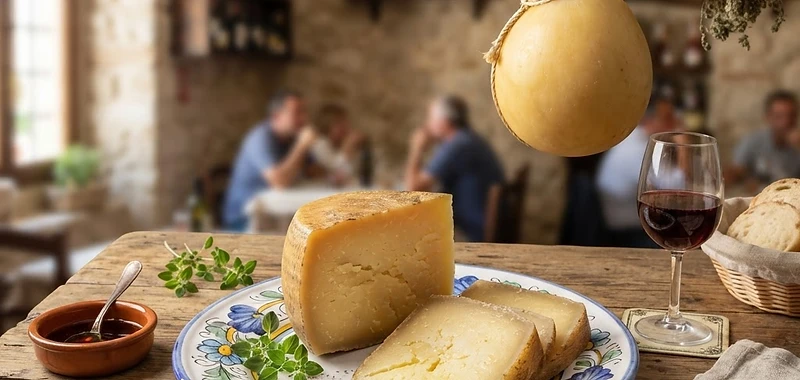
Ragusano is classified as a pasta filata cheese, meaning the curd is stretched in hot water before shaping. Its most recognizable feature is the square-blocked form, a result of the molds used during the initial stages of production. Once shaped, the blocks are tied in pairs with hemp rope and hung over wooden beams to cure.
The cheese changes significantly with time. When young, it is supple, white, and mild, with a milky finish. As it matures—often for twelve months or more—the paste darkens to a straw-yellow, the texture becomes dense and hard, and the flavor profile develops into a sharp, spicy savoriness. If you encounter Ragusano in a shop, look for the density of the paste. The aged variety is a grating cheese, while the fresh variety is sliced.
Roots in the Iblei
The production of Ragusano is tied to the Modicana cow, an ancient breed known for its dark, mahogany-colored coat. These cattle have been central to the economy of the Ragusa province for centuries. Records indicate that this style of cheese making has existed in the Iblei mountains since at least the sixteenth century. The reliance on the Modicana breed is not merely traditional; their milk is uniquely high in the specific fat and protein content required to create the structure of a long-aged pasta filata. While many modern dairies have shifted to different breeds, the most authentic examples of Ragusano still come from producers who maintain herds of Modicana.
Traditional production
The process begins with raw cow’s milk. After the curds are formed and separated from the whey, they are submerged in water heated to roughly 80 degrees Celsius. The cheesemaker stretches the mass until it becomes elastic and smooth. This pliable curd is then placed into a square mold. After the block sets, it is soaked in a brine bath for several days.
The final stage is the hanging. The cheeses are tied in pairs—the weight of the ropes leaving permanent indentations on the crust—and suspended from rafters in cool, ventilated rooms. During this maturation, producers often rub the exterior with olive oil and a touch of vinegar, a practice that encourages a specific rind development and protects the cheese from spoilage during the long wait to maturity.
Seeking it out
Avoid supermarkets when searching for quality Ragusano. The best approach is to visit a caseificio in the province of Ragusa, particularly in the vicinity of Ragusa, Modica, or Scicli. Dairies in this area are often small-scale operations that sell directly to the public. If the shop offers a taste, ask for a side-by-side comparison of a six-month and a twelve-month aged wedge.
This is not a cheese for western Sicily; its identity is inextricably linked to the geography of the southeast. If your itinerary is restricted to Palermo or Trapani, you will likely find better regional alternatives than mass-produced Ragusano.
When to visit and how to serve
Spring is the peak season for production, as the grazing conditions for the Modicana cows are optimal. Fresh Ragusano, eaten within a few days of production, is a common summer food. However, for those interested in the complex, aged cheese, the timing of your visit matters less than the ability to store it properly.
Serve the aged cheese at room temperature. It does not require elaborate accompaniment; a simple flatbread or local sourdough is sufficient. If you are ordering scaccia—the local stuffed flatbread—at a bakery in Modica or Ragusa, ask if it is prepared with Ragusano. The cheese provides the essential salt and structure to the vegetable fillings common in these traditional hand-folded pastries.
The cellar pairing
The wine of the region, Cerasuolo di Vittoria DOCG, is the standard companion. This red blend of Frappato and Nero d’Avola possesses enough acidity and fruit-forward notes to balance the salt of the aged Ragusano. The Frappato component, in particular, adds an aromatic lift that cuts through the fat of the milk, making it a predictable and reliable pairing for an afternoon meal in the Iblei hills. Confirm vintage availability with local producers, as the interplay between the sharp cheese and a younger, vibrant Cerasuolo is a regional staple.
The Story
Where Ragusano comes from
The Modicana cow is an old Sicilian breed, now rare, kept for milk that is high in fat and protein. The cheese has been made in the Iblei since at least the sixteenth century.
The Method
How it's made
The curd is stretched in hot water and pulled into a shape, then tied in pairs with rope and hung over a beam to age. The fresh form is eaten within days; the aged one is rubbed with oil and vinegar and kept for a year or more.
Timing
When to eat it
Spring milk gives the best cheese; the fresh form is a summer food.
Serve With
Classic pairings
Cerasuolo di Vittoria DOCG
wineScaccia
street foodWhat makes it worth going
A stretched-curd cheese from the Iblei hills, made from the milk of Modicana cows and hung in pairs to age.
What's nearby & pairs with
More food from Sicilia
Dish
Caponata
Sweet-sour eggplant caponata with capers, olives, and vinegar — Sicily's most famous vegetable dish.
Dish
Pasta con le Sarde
Pasta with sardines, fennel, saffron, and breadcrumbs — Palermo's most complex pasta.
Dish
Granita
Frozen, scraped ice with fruit or nuts — Sicily's breakfast, and the world's best frozen dessert.
Dish
Arancini
Fried rice balls stuffed with ragù, mozzarella, and peas — Sicily's most famous street food.
Dish
Pasta alla Norma
Pasta with tomato, fried eggplant, ricotta salata, and basil — Catania's signature dish.
Dish
Cannoli
Crisp fried pastry tubes filled with sweetened sheep's-milk ricotta — Sicily's most famous dessert.
Ready to plan?
Ready to turn discovery into a trip?
Italy Field Guide helps you decide where to go. When you're ready to build the actual day-by-day itinerary, take your saved places to Travel Itinerary Co — your interests go with you.
Turn your saved Italy places into a trip