The Verdict
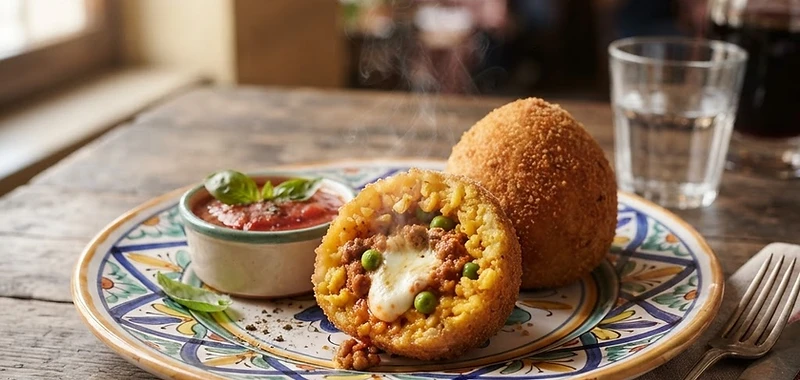
Sicily's great hand food: balls of saffron risotto, stuffed with meat ragù, mozzarella, and peas, breaded and fried. In eastern Sicily they're called arancini (masculine, the size of small oranges); in the west, arancine (feminine). The Catania version has a conical shape, said to imitate Etna. Eat them hot from a fry shop, on the street, for a euro or two.
Why go
To eat Sicily's best cheap food, hot from the fryer, for almost nothing.
The Field Guide take
The arancino (or arancina) is the foundational street food of Sicily. It is a rice croquette, breaded and deep-fried, typically stuffed with a combination of ragù, cheese, and peas. It is a dish designed for necessity: a complete, shelf-stable meal that can be held in one hand. Whether you are traveling through the markets of Palermo or the piazzas of Catania, these fried spheres are ubiquitous, serving as the default choice for a quick lunch or a late-afternoon snack.
What it is
An arancino is a ball of risotto, seasoned with saffron, that creates a golden, fragrant casing for a savory center. The traditional al ragù filling consists of a slow-cooked meat sauce, peas, and a stretchable cheese—typically caciocavallo or mozzarella. While variations exist, including fillings with ham (al burro), spinach, or pistachios, the ragù version remains the standard against which all others are measured. The texture is the primary indicator of quality: the exterior must be crisp and rigid, while the interior should be soft and steaming.
Origin and history
The history of the arancino is tied to the Arab period of Sicilian history (9th to 11th centuries). During this time, saffron and rice were introduced to the island. While the specific evolution into a fried, stuffed ball is difficult to document, food historians generally agree that it developed as a way to preserve and transport leftover risotto. By frying the rice in a breadcrumb crust, the dish became resistant to spoilage, making it ideal for laborers and travelers. It is a culinary artifact of Sicily’s position at the crossroads of the Mediterranean, borrowing techniques and ingredients from North African and Middle Eastern traditions.
Regional nomenclature and shape
Travelers in Sicily will quickly encounter a long-standing linguistic and geometric debate: the name and shape of the snack.
In Palermo and the western part of the island, the dish is referred to as arancina (feminine, singular). These are typically round, intended to mimic the appearance of a small orange. In Catania and the eastern provinces, the dish is called arancino (masculine, singular). In the east, the form is frequently conical, a design said to replicate the silhouette of Mount Etna. There is no culinary consensus on which shape or name is correct; they are simply distinct regional traditions. Locals take the distinction seriously, so it is best to mirror the terminology of the city you are visiting.
How it’s made
The preparation is labor-intensive. First, arborio or carnaroli rice is cooked with saffron to create a vibrant yellow risotto, which must be cooled completely so that it is firm enough to shape. A cook takes a handful of rice, creates a depression in the center, adds a spoonful of ragù, peas, and cheese, and then seals it with more rice. The sphere or cone is then dipped into a pastella (a thin flour-and-water batter), rolled in breadcrumbs, and deep-fried in high-heat oil. The goal is to reach a deep, golden-brown crust without the interior cheese burning or the rice becoming greasy.
Where to eat it
The best arancini are found in dedicated friggitorie (fry shops) or rosticcerie. These are not formal restaurants; they are shops with glass counters where the food is prepared in batches throughout the day. You should prioritize shops that have a high turnover of customers, as an arancino is only acceptable when it is fresh from the fryer. If you see a tray that has been sitting for several hours, look elsewhere.
When and how
Arancini are available year-round. They are traditionally eaten as a takeaway meal. In Sicily, it is common to order one or two, pay at the counter, and walk out the door to eat them on the sidewalk or while walking through a market. They are best consumed hot. If you find yourself holding a cold one, it is a sign of a poor-quality shop or an end-of-day remainder. Do not look for a fork or knife; this is food meant to be eaten by hand.
What to drink with it
Because the arancino is fried and savory, it requires a beverage that can cut through the fat of the breading. A cold, light lager is the most common accompaniment at a street kiosk. If you are sitting down for a more relaxed version of the meal, a glass of Etna Rosso—a structured, mineral-forward red wine from the volcanic soil of the island—balances the richness of the ragù and the earthiness of the saffron.
The Story
Where Arancini comes from
Arancini are the pride of Sicilian street food, reflecting the island's complex history of Arab influence, where rice and saffron were introduced. They are essentially portable, fried feasts, designed for snacking on the go. The shape varies by city, indicating whether you are in the east or west of Sicily.
What Defines It
Signature ingredients
Saffron-infused rice
The yellow rice provides a fragrant, earthy base.
Ragù
The meaty center that makes the dish hearty and rich.
Caciocavallo cheese
A sharp, local sheep's cheese that melts into the center.
The Method
How it's made
Rice balls are stuffed, coated in breadcrumbs, and deep-fried until golden. The defining feature of a good arancino is a thin, crunchy shell and a warm, molten interior.
Across Italy
Regional variants
Palermo
Often round and filled with meat, whereas eastern versions are conical.
Timing
When to eat it
Year-round
Serve With
Classic pairings
Etna Rosso
wineA high-altitude red that handles the fat of the deep-fried snack.
Peroni
beerA cold, crisp beer is the standard drink for street food.
What makes it worth going
Fried rice balls stuffed with ragù, mozzarella, and peas — Sicily's most famous street food.
Things to do
- pasticceria
Savia (Catania)
The Catania benchmark, on Via Etnea. The conical arancino (Etna shape) is the local pride. Eat at the counter.
20 min
- bar
Cannoli e Arancine at Bar de Spada (Palermo)
In the Vucciria. The round Palermo arancina, with the sweet-and-sour meat filling. The east-west difference in one stop.
20 min
- pasticceria
Pasticceria Costarelli (Catania)
A local favorite, less famous than Savia, often better. The pistachio arancino is the surprise.
20 min
- experience
Street food tour of Palermo
Arancine, panelle, sfincione, cannoli — the full Palermo circuit, with a guide who knows the stands.
3 hrs
Eat
- street food
Arancino al ragù
The classic: saffron risotto, meat ragù, peas, mozzarella, breaded, fried. The Catania cone or the Palermo round.
- street food
Arancino al pistacchio
The Catania specialty: pistachio cream and mortadella, or pistachio ragù. The nut is from Bronte.
- drink
Seltz
The Catania summer drink: sparkling water, salt, lemon, sometimes a splash of syrup. The fry-cutting refreshment.
Stay
- neighborhood
Catania center (Via Etnea)
Near Savia and the best arancini. The most authentic Catania base.
- island
Ortigia (Siracusa)
Siracusa's old island, with fry shops and the best street-food walk in Sicily.
Experiences Worth Booking
Sicilian street food tour (Palermo or Catania)
3-4 hrsArancini, panelle, sfincione, cannoli, granita — five stops, with a guide.
The best Sicilian food is eaten standing; a guide knows which stands.
Suits: Eaters who want the full circuit in a day, without guessing.
Arancino-making class
3 hrsThe saffron rice, the filling, the breading, the fry. Make all three classic fillings.
The rice is the structure; the class shows you the temperature that makes it hold.
Suits: Home cooks who want the technique; the breading is the secret.
What's nearby & pairs with
More food from Sicilia
Dish
Caponata
Sweet-sour eggplant caponata with capers, olives, and vinegar — Sicily's most famous vegetable dish.
Dish
Pasta con le Sarde
Pasta with sardines, fennel, saffron, and breadcrumbs — Palermo's most complex pasta.
Dish
Granita
Frozen, scraped ice with fruit or nuts — Sicily's breakfast, and the world's best frozen dessert.
Dish
Pasta alla Norma
Pasta with tomato, fried eggplant, ricotta salata, and basil — Catania's signature dish.
Dish
Cannoli
Crisp fried pastry tubes filled with sweetened sheep's-milk ricotta — Sicily's most famous dessert.
Ready to plan?
Ready to turn discovery into a trip?
Italy Field Guide helps you decide where to go. When you're ready to build the actual day-by-day itinerary, take your saved places to Travel Itinerary Co — your interests go with you.
Turn your saved Italy places into a trip