
The Verdict
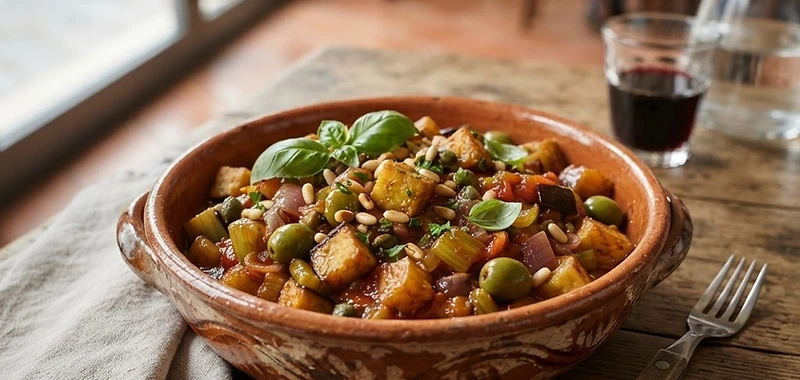
The dish that is Sicily on a plate: agrodolce (sweet-sour) at its most complex. Fried eggplant, capers, olives, celery, onion, tomato, and vinegar and sugar, simmered into a relish. Eaten cold, as an antipasto or a side. Every Sicilian town has its version — Palermo with octopus, Catania with peppers — and all of them are the same idea: sweet, sour, savory, and unmistakably island.
Why go
To taste Sicily's agrodolce — sweet, sour, and unmistakably island.
The Field Guide take
Caponata is the defining vegetable dish of Sicily. It is a dense, cooked-down relish built on the foundational Sicilian principle of agrodolce—the marriage of vinegar and sugar. While versions exist across the island, the core components are consistent: fried eggplant, celery, capers, olives, and a tomato-based sauce balanced by the sharp tang of vinegar. It is served cold or at room temperature, acting as a centerpiece of the Sicilian antipasto table.
The mechanics of the dish
Caponata relies on the careful management of textures. The eggplant is cubed and typically fried in olive oil until golden; it should remain firm enough to hold its shape. Separately, a soffritto of onion and celery is softened in olive oil. Once these are combined with tomatoes, capers, and olives, the agrodolce element—usually a mixture of vinegar and sugar—is introduced. The mixture is then simmered long enough for the flavors to fuse but not so long that the ingredients turn into a puree. A successful caponata is glossy and deeply flavored, with the crispness of the celery providing a necessary contrast to the melting softness of the eggplant.
Origins and terminology
The history of caponata reflects the layers of influence that define Sicilian food. Its roots are often traced to the Arab occupation of the island in the 9th century, which introduced the techniques and produce—particularly eggplant—that form the backbone of the dish.
The origin of the name remains a point of scholarly debate. Some linguists connect it to the Latin caupona, suggesting it was originally food served in roadside taverns for travelers. Others point to capone, the Sicilian word for the dolphinfish (mahi-mahi). It is believed that in previous centuries, the dish was an aristocratic preparation featuring fish in a sweet-sour sauce, which evolved into a more affordable, vegetable-heavy staple by the 18th century as it moved from the tables of the elite into the kitchens of the general population.
Regional variations
While the central identity of caponata is constant, regional iterations highlight local preferences and historical circumstances. In Palermo, it is not uncommon to find versions that include octopus, a testament to the city’s status as a major port and its maritime history. In Catania, the addition of bell peppers is standard, introducing a brighter, sweeter profile. In the province of Agrigento, some versions incorporate toasted almonds, adding an earthy crunch to the otherwise soft composition of the dish.
How to eat it
Caponata is a summer dish by design. It requires the high-quality, sun-ripened eggplants and tomatoes that appear in Sicilian markets during the warmer months. Because it is a cold-service dish, it is ideally suited for hot weather. It is almost always accompanied by thick slices of pane di casa—crusty, local hearth bread—which is essential for clearing the plate and balancing the acidity of the sauce.
When searching for authentic caponata, look for kitchens that prioritize local, seasonal produce. Avoid versions that appear overly processed or uniform; the best caponata will show distinct, identifiable pieces of vegetable rather than a homogenized paste.
What to drink
The flavor profile of caponata is challenging for many wines due to the high acidity of the vinegar and the sweetness of the sugar. To pair effectively, look for wines with sufficient structure and minerality. An Etna Bianco, with its volcanic acidity and mineral backbone, can stand up to the vinegar without being overwhelmed. Alternatively, a Cerasuolo di Vittoria, a red wine from southeastern Sicily, offers enough fruit and tannins to complement the savory, concentrated flavors of the eggplant and capers without clashing with the agrodolce sauce.
The Story
Where Caponata comes from
Caponata represents the complex culinary intersection of Sicily's history. The dish likely traces its roots to the Arab occupation of Sicily in the 9th century, drawing inspiration from the North African influence on the island's produce. The term itself is debated; some linguists point to the Latin 'caupona,' implying it was a dish served in taverns for travelers, while others argue it relates to 'capone,' the Sicilian name for the dolphinfish, which was allegedly once served in a similar sweet-sour sauce for the island's elite. By the 18th century, it had firmly established itself in the cookbooks of Sicilian households, evolving from an aristocratic fish dish into the vegetable-forward staple recognized today. It serves as a culinary encapsulation of the 'agrodolce' philosophy, a technique perfected in the region to preserve and balance flavors using vinegar and sugar.
What Defines It
Signature ingredients
Eggplant
Provides the essential fleshy, absorptive base that acts as a sponge for the agrodolce sauce.
Celery
Adds a necessary structural crunch that prevents the texture from becoming too mushy.
Capers
Provides the sharp, salty punch required to balance the sweetness of the sugar.
Vinegar
The core of the agrodolce profile, providing the acidity that cuts through the oil of the fried eggplant.
Olives
Typically green, these contribute a briny, fatty complexity that rounds out the savory profile.
The Method
How it's made
A high-quality caponata relies on the meticulous preparation of the eggplant. The vegetable should be cubed and either fried until golden or roasted before being introduced to the base. The base begins with a 'soffritto' of onions and celery, softened slowly in olive oil. Once the tomato sauce and agrodolce components—vinegar and sugar—are added, the mixture must simmer gently to meld the flavors without disintegrating the vegetables. A careless version involves boiling the vegetables into a jam-like paste; a successful version maintains the integrity of each ingredient, allowing the distinct textures of the celery and eggplant to remain perceptible under the glossy sauce.
Across Italy
Regional variants
Palermo
Often includes octopus, reflecting the city's historical connection to its bustling port and maritime traditions.
Catania
Frequently incorporates bell peppers, which add a distinctive sweetness and color to the finished dish.
Agrigento
Known to occasionally add peppers or even toasted almonds, providing an earthy, crunchy counterpoint to the soft vegetables.
Timing
When to eat it
While the availability of global trade allows for year-round production, caponata is fundamentally a summer dish. It relies on the peak harvest of eggplants and tomatoes, making it most authentic when prepared during the warmer months. It is traditionally served at room temperature, making it a reliable fixture of summer antipasti boards.
Serve With
Classic pairings
Etna Bianco
wineThe high minerality and crisp acidity of this volcanic wine cut cleanly through the oil of the fried eggplant.
Cerasuolo di Vittoria
wineA chilled red from Southeastern Sicily whose bright fruit notes complement the sweet-sour profile of the sauce.
Pane di Casa
foodCrusty, rustic sourdough bread is essential to soak up the residual agrodolce sauce left on the plate.
What makes it worth going
Sweet-sour eggplant caponata with capers, olives, and vinegar — Sicily's most famous vegetable dish.
Things to do
- trattoria
Trattoria La Bersagliera (Palermo)
In the Vucciria. The caponata is the benchmark; the agrodolce (sweet-sour) is the test. Eat it with bread, as an antipasto.
1.5 hrs
- trattoria
Trattoria da Calogero (Catania)
On the fish market. The caponata is made with the market's eggplant; the seafood is the rival. Eat both.
1.5 hrs
- experience
A Sicilian home or agriturismo
The best caponata is made at home, by a Sicilian grandmother. The recipe varies by family; the capers and the vinegar are the constants.
- market
Ballarò or Vucciria market
The markets of Palermo, where the eggplant, the capers, and the olives are sold. The ingredients are the dish.
Eat
- antipasto
Caponata
The classic: fried eggplant, celery, capers, olives, onions, tomato, vinegar, sugar, pine nuts, raisins. The agrodolce is the point; the eggplant is the base.
- side
With bread
The correct way; the caponata is scooped with bread, not eaten with a fork alone.
- wine
A glass of Nero d'Avola
The Sicilian red; the correct pairing, or a white Grillo.
Stay
- neighborhood
Palermo center (Kalsa / Ballarò)
Near the markets and the best caponata. The most authentic Palermo base.
- neighborhood
Catania center
Near the fish market and the caponata. The east-Sicily base.
Experiences Worth Booking
Sicilian cooking class
3 hrsCaponata, pasta alla norma, arancini. The agrodolce technique is the lesson.
The caponata is the agrodolce; a class shows you the vinegar-to-sugar ratio and the eggplant fry.
Suits: Anyone who wants the Sicilian sweet-sour at home.
Palermo market walk
3 hrsThe Ballarò and Vucciria markets, with tastings of caponata, panelle, and sfincione.
The caponata is made from the market; a walk shows you the ingredients in their context.
Suits: Eaters who want the markets at their loudest.
What's nearby & pairs with
More food from Sicilia
Dish
Pasta con le Sarde
Pasta with sardines, fennel, saffron, and breadcrumbs — Palermo's most complex pasta.
Dish
Granita
Frozen, scraped ice with fruit or nuts — Sicily's breakfast, and the world's best frozen dessert.
Dish
Arancini
Fried rice balls stuffed with ragù, mozzarella, and peas — Sicily's most famous street food.
Dish
Pasta alla Norma
Pasta with tomato, fried eggplant, ricotta salata, and basil — Catania's signature dish.
Dish
Cannoli
Crisp fried pastry tubes filled with sweetened sheep's-milk ricotta — Sicily's most famous dessert.
Ready to plan?
Ready to turn discovery into a trip?
Italy Field Guide helps you decide where to go. When you're ready to build the actual day-by-day itinerary, take your saved places to Travel Itinerary Co — your interests go with you.
Turn your saved Italy places into a trip