
The Verdict
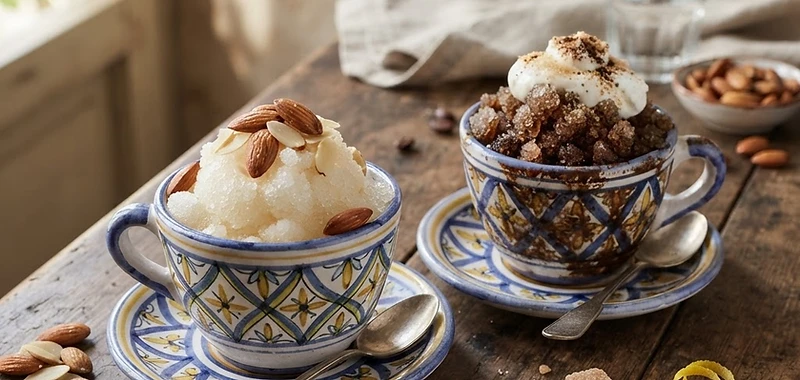
The dessert that Sicilians eat for breakfast. A semi-frozen, hand-scraped ice of fruit, coffee, or almond — coarser than gelato, finer than a slushie. Eaten with a brioche (a sweet, soft bun) for dunking, in the morning, in summer. The almond and the coffee versions are the classics. The Messina and Catania versions are the most famous; the Syracusan lemon one is the purest.
Why go
To eat granita and brioche for breakfast, in Sicily, in summer — the correct way.
The Field Guide take
In Sicily, the day often begins with a frozen, hand-scraped treat served alongside a warm, soft bun. This is granita. It is not a sorbet, nor is it a snow cone; it is a semi-frozen mixture of water, sugar, and raw ingredients—most commonly coffee, almond, or citrus—that serves as the island’s definitive morning meal.
What it is
Granita is a frozen dessert with a distinct, crystalline structure. Its texture should be coarse enough to feel granular on the tongue, yet soft enough to yield easily to a spoon. Unlike gelato, which relies on milk fats and air to create a smooth, emulsified creaminess, granita is primarily water-based. It is meant to be eaten fresh, usually before noon, and traditionally paired with brioche col tuppo—a rounded, brioche-style bun topped with a small "knot" of dough that serves as the perfect utensil for scooping and dipping.
Origin and history
The roots of the dish lie in the 9th-century Arab occupation of Sicily. The occupiers introduced the practice of harvesting snow from the upper reaches of Mount Etna and the Hyblaean Mountains. This ice was stored in specialized ice houses and later flavored with fruit syrups, herbs, and flowers to create a precursor to modern sorbet, known as sherbet.
By the 17th century, the trade had become formalized through the nevaroli, workers dedicated to managing the island's ice supply. As freezing technology evolved, the reliance on mountain snow shifted to water-based mixtures frozen in salt-and-ice barrels. While mechanical freezing is now the norm, the fundamental chemistry remains the same: a precise ratio of sugar to water, which prevents the liquid from becoming a solid block of ice while maintaining the signature crystal consistency.
How it's made
The quality of a granita is defined by its crystals. In the traditional method, the mixture is churned in a pozzetto, a cylindrical container kept in a bath of salt and ice. Constant manual scraping is required to ensure the mixture does not solidify and to break up the ice into uniform, small particles.
Commercial shortcuts often involve blast chillers or soft-serve machines, which tend to aerate the mixture, producing a texture closer to a slushie than an authentic granita. An authentic version relies on the sugar content to keep the texture supple. If the sugar ratio is incorrect, the dessert will either be too icy or fail to hold its structure.
Regional variations
Sicily’s geography dictates the local style of the dish. In Messina, the granita is generally creamier and denser, with coffee and chocolate versions often finished with a dollop of panna (whipped cream).
Catania is recognized for its intense almond granita, which often incorporates toasted almonds, resulting in a deep, roasted flavor profile that is distinct from the sweeter, blander versions found elsewhere. In the Noto valley, producers emphasize the purity of local ingredients. Here, you will find delicate, crystalline versions made with the famous Noto almond or fresh strawberries sourced from the surrounding hills. In Siracusa, the lemon granita is the standard, made with local IGP-certified fruit for a sharp, clean acidity.
When and how
Though tourists often order granita as an afternoon snack, the local practice is to consume it in the morning, typically before 11:00 AM. It is a seasonal food, most abundant from late spring through early autumn. When ordering, it is expected that you will pair your choice of flavor with a brioche col tuppo. The practice is to tear off the "tuppo" (the top knot) and use it to scoop the granita, followed by the rest of the bun.
What to drink with it
If you are eating breakfast like a local, the granita is the meal. However, it is common to accompany a coffee-based granita with a short espresso on the side. For a more indulgent, late-morning experience, some pair a fruit-based granita with a glass of Zibibbo, a sweet Sicilian dessert wine that complements the aromatics of the fruit or almond. If you are looking for a dessert that feels like a light, sugary confection or a standard scoop of ice cream, this may be a surprise; the experience is intentionally austere, refreshing, and deeply tied to the island's agricultural identity.
The Story
Where Granita comes from
Granita traces its roots to the Arab occupation of Sicily, which began in the 9th century. The occupiers brought the technique of snow harvesting from the slopes of Mount Etna and the Hyblaean Mountains, mixing it with fruit syrups, herbs, and flowers to create a primitive sorbet known as 'sherbet.' Over centuries, this evolved from snow-based mixtures into a sophisticated freezing technique using sugar, water, and local agricultural products. By the 17th century, the 'nevaroli'—specialized workers who managed the ice supply—played a critical role in the growth of this trade across the island. The transformation into the modern granita saw the replacement of packed snow with water-based slush, solidified by salt and ice barrels, eventually leading to the mechanical freezing processes used today in cities like Messina, Catania, and Noto.
What Defines It
Signature ingredients
Sweet Almonds
Specifically Pizzuta di Avola almonds, which provide a rich, creamy mouthfeel and distinct nuttiness when blended into almond milk for the granita base.
Espresso Coffee
Provides a robust, bitter backbone that contrasts with the sweetness of the ice crystals, essential for the classic breakfast version.
Siracusa Lemon (IGP)
High acidity and intense citrus oils make this the gold standard for the lemon variety, preventing the flavor from becoming overly sugary or flat.
Raw Cane Sugar
Essential for controlling the freezing point and achieving the precise texture; high-quality sugar ensures the granita is refreshing rather than syrupy.
The Method
How it's made
A high-quality granita relies on the size of the ice crystals; they must be distinct and uniform, neither melted into a liquid nor frozen into a solid block. Traditionally, the mixture was churned by hand in a 'pozzetto' (a cylindrical container surrounded by salt and ice), requiring frequent scraping to break up large crystals. A careless version is often made with modern blast chillers or commercial slushie machines, which often introduce too much air or produce overly fine, slush-like textures. The authentic method requires precise sugar-to-water ratios, as the sugar prevents the water from freezing into a rock-hard mass.
Across Italy
Regional variants
Messina
Known for a creamier, denser texture, particularly the coffee and chocolate versions which are often topped with whipped cream.
Catania
Famous for its almond granita, which often utilizes toasted almonds, resulting in a darker, more intense flavor profile.
Noto
Renowned for utilizing local ingredients like Noto almonds or fresh strawberries from the surrounding hills in a more delicate, crystalline structure.
Timing
When to eat it
While available year-round in many parts of Sicily, it is traditionally consumed during the warmer months, specifically between late spring and early autumn. It remains the canonical Sicilian breakfast, typically consumed before noon.
Serve With
Classic pairings
Brioche col tuppo
foodA soft, buttery, egg-enriched sweet bun with a top knot, designed to be torn into pieces and used to scoop up the granita.
Zibibbo
wineA sweet passito wine from Pantelleria that, while not typically served alongside the granita for breakfast, shares the same Mediterranean flavor profile.
Espresso
drinkOften consumed alongside, though usually distinct from the granita itself, to provide a hot contrast to the frozen dessert.
What makes it worth going
Frozen, scraped ice with fruit or nuts — Sicily's breakfast, and the world's best frozen dessert.
Things to do
- caffè
Caffè Sicilia (Noto)
The benchmark granita in Sicily, since 1892. The almond is the classic; the coffee is the rival. Eat with a brioche, for breakfast. Reserve in summer.
45 min
- pasticceria
Pasticceria Savia (Catania)
On the Via Etnea. The granita and brioche breakfast is the Catania ritual. The almond and the coffee are the test.
45 min
- bar
Bar del Duomo (Siracusa)
In Ortigia. The lemon granita is the purest; the almond is the most complex. With a brioche.
30 min
- experience
The Messina granita
Messina claims the most coffee-forward granita in Sicily; the caffè there serve it with a warm brioche and a splash of cream.
Eat
- dessert
Granita di mandorla
The classic: almond, water, sugar, frozen and scraped. Coarser than gelato, finer than a slushie. The almond is the Sicilian base.
- dessert
Granita di caffè
The other classic: strong espresso, frozen and scraped. With a brioche, for breakfast, in summer.
- dessert
Granita di limone
The purest: Syracuse lemon, water, sugar. The cleanest, most acidic version. The summer palate cleanser.
Stay
- baroque town
Noto
The base for Caffè Sicilia; the baroque town is the other reason. Stay overnight for the early granita.
- neighborhood
Catania center
Near Savia and the best caffè. The most convenient base for the granita breakfast.
- island
Ortigia (Siracusa)
The old island, with Bar del Duomo and the lemon granita. The most beautiful base.
Experiences Worth Booking
Granita and brioche breakfast tour
3 hrsThree caffè in one morning, in Noto or Catania. The almond, the coffee, the lemon.
Granita is a breakfast food in Sicily; the tour shows you the correct hour and the correct brioche.
Suits: Sweet breakfast lovers; anyone who thinks granita is a dessert.
Sicilian gelato and granita workshop
3 hrsThe making of both, in a pasticceria. The scraping technique, the sugar, the fruit.
The texture is the scrape; a class shows you the machine and the temperature.
Suits: Sweet tooths who want the technique; the scrape is the secret.
What's nearby & pairs with
More food from Sicilia
Dish
Caponata
Sweet-sour eggplant caponata with capers, olives, and vinegar — Sicily's most famous vegetable dish.
Dish
Pasta con le Sarde
Pasta with sardines, fennel, saffron, and breadcrumbs — Palermo's most complex pasta.
Dish
Arancini
Fried rice balls stuffed with ragù, mozzarella, and peas — Sicily's most famous street food.
Dish
Pasta alla Norma
Pasta with tomato, fried eggplant, ricotta salata, and basil — Catania's signature dish.
Dish
Cannoli
Crisp fried pastry tubes filled with sweetened sheep's-milk ricotta — Sicily's most famous dessert.
Ready to plan?
Ready to turn discovery into a trip?
Italy Field Guide helps you decide where to go. When you're ready to build the actual day-by-day itinerary, take your saved places to Travel Itinerary Co — your interests go with you.
Turn your saved Italy places into a trip