The Verdict
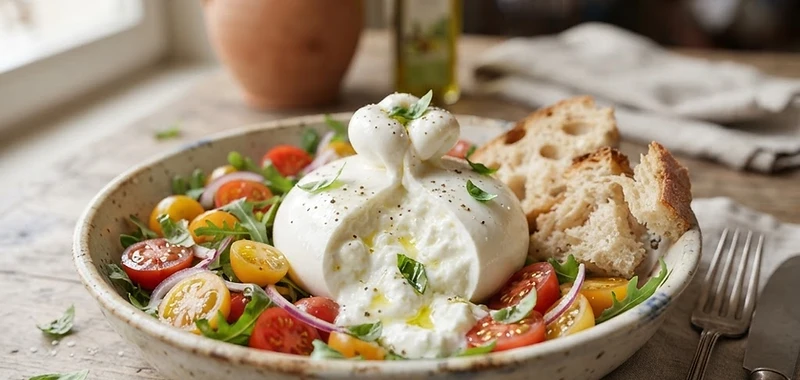
The cheese that became a restaurant trend everywhere, and is still best in Puglia. A pouch of mozzarella filled with stracciatella (shredded mozzarella and cream). Eat it the day it's made, at room temperature, with good bread and a tomato. In Puglia, it's breakfast food, not a dinner-party starter. The version that travels is never the same.
Why go
To eat burrata the day it's made, in Puglia, where it was invented.
The Field Guide take
The reputation of burrata has traveled far beyond the borders of Puglia, becoming a menu staple in cities from New York to Tokyo. Yet, the version found in industrial kitchens or shipped across oceans bears little resemblance to the product found in the province of Bari. When eaten in its home region within hours of production, burrata is a different product entirely: the shell is supple and elastic, and the interior, known as stracciatella, possesses a clean, milky sweetness that disappears once the cheese sits for more than a day. In Puglia, it is an accessible, everyday food rather than a curated luxury.
What it is
Burrata is a fresh, unaged cow’s milk cheese. Structurally, it consists of a thin, flexible outer shell of pasta filata—stretched curd mozzarella—that acts as a pouch. Inside this pouch is a mixture of fresh cream and stracciatella, which refers to "rags" or shreds of mozzarella curd. When the cheese is sliced, the filling spills outward. Because it is highly perishable and lacks a rind or preservatives, its flavor is defined by its freshness. Once the temperature drops or the days pass, the delicate cream begins to sour and the mozzarella shell toughens, losing its defining texture.
Origin and history
The history of burrata is relatively short by Italian standards. It originated in the early 20th century in the town of Andria, in the Puglia region. The invention is often attributed to local cheesemakers looking for a practical solution to manage production waste. Rather than discarding the irregular scraps of mozzarella created during the stretching process, they mixed these shreds with fresh cream and encased the mixture within a fresh mozzarella skin. What began as a resourceful way to preserve dairy leftovers evolved into a refined, intentional product. Today, Andria remains the center of burrata production, and the cheese is recognized as a staple of the local economy.
How it’s made
The production process requires manual precision. Cheesemakers prepare a batch of mozzarella, stretching the curd in hot water until it is malleable. A portion is flattened into a thin, circular sheet. This sheet is gathered at the edges to form a cup or pouch. The center is then filled with a mixture of heavy cream and finely shredded mozzarella. The top of the pouch is gathered and tied shut, creating a characteristic knot. The final seal must be tight enough to contain the liquid interior while remaining thin enough to be sliced through easily with a knife.
Where to eat it
The most reliable place to consume burrata is within the province of Bari, specifically in or near Andria. While it is served in restaurants throughout Puglia, the quality is highest when sourced directly from local caseifici (dairies). In these shops, the cheese is often pulled from the cooling vat on the morning of purchase. If you are eating it in a restaurant, look for establishments that explicitly state they source their dairy from local producers daily. Avoid burrata that has been refrigerated for an extended period; if the shell feels firm or rubbery, the quality has likely degraded.
When and how
Burrata is available year-round, as it is a product of technical process rather than seasonal milk cycles. Unlike international interpretations that position burrata as a dinner-party starter or a decorative salad topping, in Puglia, it is frequently eaten as a meal in itself. It is best served at room temperature; if it is too cold, the cream thickens and the nuances of the milk are muted. It requires little accompaniment. A fresh, crusty loaf of bread and ripe, seasonal tomatoes are sufficient. If adding produce, grilled peaches are a standard local pairing that balances the richness of the cream with fruit acidity.
What to drink with it
Because burrata is high in fat and remarkably creamy, it requires a beverage that can cut through the richness on the palate. A crisp, dry sparkling wine such as a Prosecco Superiore is the standard recommendation. The carbonation and high acidity of the wine clear the palate between bites, preventing the meal from feeling heavy. If you prefer a still wine, select a dry, high-acid white wine from Puglia, such as one made from the Fiano or Bombino Bianco grapes, which will mirror the saline and milky notes of the cheese without being overwhelmed by its texture.
The Story
Where Burrata comes from
Burrata was invented in the early 20th century in Andria as a clever way to preserve leftover mozzarella scraps. By filling a pouch of mozzarella with cream and stracciatella, the makers created a luxury product that essentially re-envisions the cheese-making process. It remains one of Italy's most popular exports due to its decadent, oozing interior.
What Defines It
Signature ingredients
Mozzarella shell
A thin, stretched-curd exterior that holds the rich filling.
Stracciatella
Shredded mozzarella curds mixed with thick cream for an indulgent, flowing texture.
The Method
How it's made
A warm, thin shell of stretched mozzarella is filled with the cream mixture and gathered at the top. The knot must be sealed tightly enough to keep the filling from spilling out before the diner cuts into it.
Timing
When to eat it
Year-round.
Serve With
Classic pairings
Prosecco Superiore
wineThe fine, dry bubbles cleanse the palate of the heavy, lingering cream.
Grilled peaches
foodThe slight char and natural sweetness of the fruit provide a modern, balanced contrast.
What makes it worth going
A mozzarella pouch filled with cream and curd — Puglia's most beloved dairy export.
Things to do
- dairy
Caseificio in Andria
The home of burrata, in the Murgia. Book a morning visit; the burrata is made at dawn, and the stracciatella inside is the point.
2 hrs
- meal
Eat burrata at the caseificio
The only correct way: within hours of make, at room temperature, with bread, a tomato, and olive oil. The cream should be visible when you cut it.
- experience
Bari Vecchia street food walk
Barese women making orecchiette in the street, focaccia from the ovens, and burrata from the caseifici. The full Bari food walk.
3 hrs
- dairy
Caseificio on the Murgia plateau
The high plateau above Bari, where the caseifici are. The pasture is the reason the milk is different; visit one with a tasting.
Eat
- cheese
Burrata, plain
The classic: a mozzarella pouch filled with stracciatella (shredded mozzarella and cream). Cut it and the cream runs. Eat at room temperature, the day of make.
- dish
Burrata with bread and tomato
The Puglian way: burrata, a slice of bread, a ripe tomato, olive oil. The simple plate that is the point.
- cheese
Stracciatella
The filling, on its own. If you can't finish a burrata, buy stracciatella and eat it with a spoon.
Stay
- neighborhood
Bari Vecchia
The old town, with the orecchiette women and the caseifici. The most authentic Bari base.
- rural
Andria / Murgia
The home of burrata; a rural base for the caseifici and the Castel del Monte. A car is required.
Experiences Worth Booking
Caseificio visit with burrata-making
2 hrsThe morning make, the stretching, the filling with stracciatella, the tying. Tasting at the end.
Burrata is a pouch — you see the moment it's filled and tied, and the cream inside.
Suits: Cheese lovers who want the technique; the filling is the secret.
Bari food walk
3 hrsOrecchiette in the street, focaccia, burrata, sgagliozze (fried polenta). The full Bari Vecchia circuit.
The best Bari food is in the street, made by grandmothers; a walk finds them.
Suits: Eaters who want the old town at its loudest.
What's nearby & pairs with
More food from Puglia
Dish
Orecchiette con le Cime di Rapa
'Little ear' pasta with bitter turnip greens, garlic, and anchovy — the dish that defines Puglia.
Dish
Tiella Barese
Rice, potatoes, and mussels baked in a pan — Puglia's one-pan meal, from the fishermen of Bari.
Dish
Bombette
Small rolls of pork stuffed with cheese and capocollo, grilled — the great meat snack of the Puglian butcher.
Dish
Taralli Pugliesi
Baked, boiled-then-baked bread rings — the crunchy snack of Puglia, eaten with everything.
Ready to plan?
Ready to turn discovery into a trip?
Italy Field Guide helps you decide where to go. When you're ready to build the actual day-by-day itinerary, take your saved places to Travel Itinerary Co — your interests go with you.
Turn your saved Italy places into a trip