
The Verdict
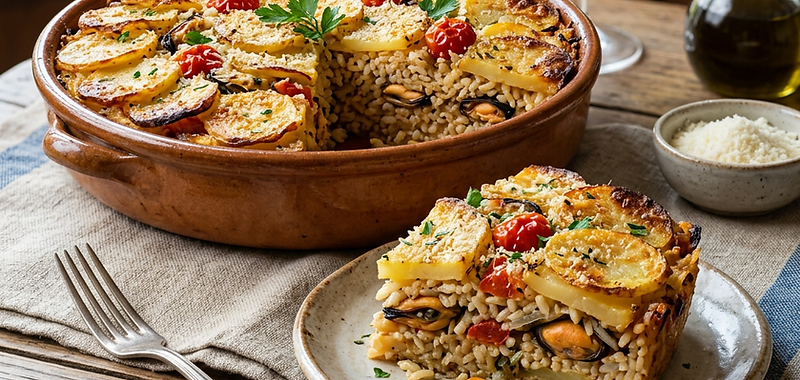
The dish that's Puglia's answer to paella: rice, sliced potatoes, and mussels, layered in a pan with onion, tomato, and olive oil, and baked until the bottom is a golden crust. From the Bari fishermen, made to carry to the boats. Eaten hot or cold, in a slice, like a cake. The mussel-and-potato combination is unlikely and works. A street and home dish, not a restaurant one — seek it in a market.
Why go
To eat Puglia's one-pan classic — rice, potatoes, and mussels, in a slice.
The Field Guide take
Tiella Barese is a dish of necessity and geography. At its most basic, it is a layering of rice, sliced potatoes, and mussels baked in a shallow pan. In Bari, this preparation is a culinary institution that defines the relationship between the city’s working class and the Adriatic Sea. It is not a dish that arrives with flourish at a white-tablecloth restaurant; it is a compact, nutrient-dense meal designed to be transported, sliced, and eaten with the hands.
The utility of the tiella
The name tiella refers to the circular, shallow pan—traditionally made of terracotta or thin metal—used to bake the dish. This vessel is not merely a container; its shape dictates the heat distribution and the final texture of the meal. Historically, the dish emerged from cucina povera, using humble staples like potatoes and rice to stretch the flavor of local mussels. For fishermen and laborers in the Bari province, it offered a self-contained lunch that remained functional whether eaten hot at home, warm at the docks, or at room temperature in the fields. It is a dish of proportions, requiring a balance of starches and proteins that yields a firm, cake-like slice.
The mechanics of construction
The preparation of a tiella is an act of assembly rather than mixing. Everything is placed into the pan raw. A base of Puglian extra virgin olive oil, sliced onions, and potatoes forms the foundation. Over this, a layer of rice is added, followed by mussels—often kept in one half of their shell—and tomatoes. A final layer of potatoes seals the top, often finished with a light dusting of Pecorino or breadcrumbs.
The difficulty lies in moisture management. Because the ingredients are layered raw, the cook must add precisely enough water to hydrate the rice and soften the potatoes without turning the mixture into a porridge. If there is too much liquid, the components lose their integrity; if too little, the rice remains hard. A properly baked tiella requires a steady oven—initially hot enough to encourage the bottom layer of potatoes to caramelize and form a crust, and then lower to allow the flavors to meld. The final product should be firm enough to be sliced into wedges that hold their shape.
Where and how to find it
Tiella Barese is fundamentally a home-cooked dish or a specialty of local bakeries. Travelers looking for it on the menus of formal restaurants are likely to be disappointed. In Bari, the dish is an early-day staple; bakeries that prepare focaccia often have the oven capacity and the morning demand for a fresh tiella. It is best sourced from small, neighborhood panifici or rosticcerie where the ovens are constantly cycled. If you are in the city, look for vendors who sell it by the weight or by the slice. It is a street-side snack meant for a midday break, not an evening sit-down meal.
Regional variations
While the Bari city version is the canonical standard—strictly rice, potatoes, and mussels—geography dictates small shifts in the recipe. As one moves inland away from the coast, the availability of fresh mussels decreases, and it is common to see them swapped for seasonal vegetables such as zucchini or artichokes. In the northern reaches of the Bari province, some versions lean more heavily on a breadcrumb topping, which adds a distinct crunch to the crust that contrasts with the soft, starchy interior.
When to eat and what to drink
While the ingredients for a tiella are available year-round, the dish is at its best during the warmer months. This aligns with the seasonal peak of mussels and the sweetness of sun-ripened tomatoes. It is a traditional fixture of Sunday lunches and coastal picnics. When pairing, avoid heavy reds. Because the dish is salty, oily, and brine-forward, it benefits from a crisp, high-acid white wine such as a Bombino Bianco. For a more casual approach, it is traditionally served with a cold local lager, such as a Peroni, which cuts through the density of the potato and rice starch. It is often accompanied by a piece of Focaccia Barese, though for most, the tiella itself provides more than enough sustenance.
The Story
Where Tiella Barese comes from
Tiella Barese is a defining dish of the Bari region in Puglia, born from the necessity of the working class and the abundance of the Adriatic Sea. Its name, tiella, refers specifically to the round, shallow terracotta or metal pan in which it is cooked, a vessel that dictates the proportions and heat distribution of the meal. Historically, it served as a practical solution for fishermen and laborers: a self-contained, nutrient-dense lunch that could be prepared at home and taken to the docks or the fields, remaining palatable whether hot, warm, or at room temperature. It reflects the cucina povera tradition, utilizing humble, caloric staples—rice and potatoes—as the backbone to extend the flavor of the more expensive, seasonally harvested mussels. While often associated with the city of Bari, its roots are shared across the coastal towns of the Bari province, where it remains a household staple rather than a restaurant specialty. It is rarely found in formal dining settings, as it is fundamentally a dish meant for home kitchens or local bakeries, where the ovens are primed for the long, slow bake required to crisp the bottom layer of potatoes.
What Defines It
Signature ingredients
Mussels
They are the dish's soul, releasing their briny, iodine-rich liquor during baking, which seasons the rice and potatoes.
Potatoes
Sliced thinly, they form the base and top layers; they absorb the mussel juice and provide the necessary starch to bind the dish together.
Arborio or Carnaroli rice
A semi-starchy rice that softens as it absorbs the liquids from the tomato and mussel, but retains enough structure to be sliced.
Puglian extra virgin olive oil
Essential for the bottom crust; a generous coating prevents sticking and ensures the potatoes fry slightly rather than just steam.
Tomatoes
Usually fresh cherry tomatoes, which provide acidity to balance the richness of the starch and the saltiness of the shellfish.
The Method
How it's made
The construction of a tiella is an exercise in layering rather than mixing. Raw ingredients are stacked in the pan: a base of olive oil and sliced onions and potatoes, followed by the rice, raw mussels (often kept in one half of their shell), tomatoes, and herbs, topped by a final layer of potatoes and a dusting of Pecorino or breadcrumbs. The key to a superior tiella is the moisture management; the cook must add just enough water to cook the rice without turning it into a porridge. A careless version often suffers from mushy potatoes or undercooked rice. A well-executed version requires an oven temperature that starts high enough to begin the crusting process on the bottom potatoes and finishes low enough to ensure the rice is tender and the flavors have fully melded, resulting in a firm slice that holds its shape on a plate.
Across Italy
Regional variants
Bari City
The canonical version, strictly adhering to the rice, potato, and mussel combination with little deviation.
Inland Puglia
In towns further from the coast, versions may substitute or augment mussels with vegetables like zucchini or artichokes, reflecting local agricultural availability.
Northern Bari Province
Some variations incorporate a more pronounced layer of breadcrumbs on top to provide a crunchier contrast to the soft interior.
Timing
When to eat it
While available year-round, tiella is best enjoyed during the warmer months when mussels are plump and tomatoes are at their peak sweetness. It is a traditional Sunday lunch staple and a fixture of coastal picnics.
Serve With
Classic pairings
Bombino Bianco
wineA crisp, high-acidity white wine from Puglia that cuts through the starch and oil of the dish.
Focaccia Barese
other foodOften served alongside or as part of a spread of local bakery goods; the saltiness of the focaccia complements the maritime notes of the mussels.
Peroni
beerA common local pairing, the bitterness and carbonation of a standard lager serve as a functional palate cleanser.
What makes it worth going
Rice, potatoes, and mussels baked in a pan — Puglia's one-pan meal, from the fishermen of Bari.
Things to do
- trattoria
A trattoria in Bari Vecchia
The home of the tiella, in the old town of Bari. The rice, the potato, the mussels, the bake. Reserve; the trattorias are small.
2 hrs
- experience
A Bari street food walk
Tiella, focaccia barese, panzerotto. The full Bari circuit, in the old town.
2 hrs
- experience
A Puglian cooking class
The tiella is the lesson; the rice, the potato, the mussels, the bake. The technique is the layering.
3 hrs
- market
A Bari fish market
The source of the mussels; the market is where the freshest are sold. The tiella is only as good as the mussels.
1 hr
Eat
- dish
Tiella barese
The classic: a baked rice and potato dish, with mussels, onions, tomatoes, and olive oil. The rice and the potato on the same plate; the mussels are the sea. The Puglian answer to the risotto and the paella.
- bread
With focaccia barese
The companion; the focaccia of Bari, with tomatoes and olives. The bread and the tiella are the table.
- wine
A glass of Primitivo or Verdeca
The Puglian red or white; the correct pairing for the mussels and the rice.
Stay
- neighborhood
Bari Vecchia (old town)
At the source, in the old town. Walkable; the trattorias are in the alleys.
- coastal town
Polignano a Mare or Monopoli
The nearby coast, with good trattorias and a beautiful setting. A car is useful.
Experiences Worth Booking
Tiella-making class
3 hrsThe rice, the potato, the mussels, the bake. The layering is the technique.
The tiella is a bake; a class shows you the layers, the rice, and the mussels.
Suits: Home cooks who want the Bari classic; the rice-potato-mussel is the secret.
Bari food day
full dayA tiella lunch, a focaccia tasting, a Primitivo cellar. The full Bari arc.
The tiella, the focaccia, and the Primitivo are the Bari trinity; a day covers all.
Suits: Food travelers with a day for Bari.
What's nearby & pairs with
More food from Puglia
Dish
Orecchiette con le Cime di Rapa
'Little ear' pasta with bitter turnip greens, garlic, and anchovy — the dish that defines Puglia.
Dish
Bombette
Small rolls of pork stuffed with cheese and capocollo, grilled — the great meat snack of the Puglian butcher.
Dish
Taralli Pugliesi
Baked, boiled-then-baked bread rings — the crunchy snack of Puglia, eaten with everything.
Cheese
Burrata
A mozzarella pouch filled with cream and curd — Puglia's most beloved dairy export.
Ready to plan?
Ready to turn discovery into a trip?
Italy Field Guide helps you decide where to go. When you're ready to build the actual day-by-day itinerary, take your saved places to Travel Itinerary Co — your interests go with you.
Turn your saved Italy places into a trip