The Verdict
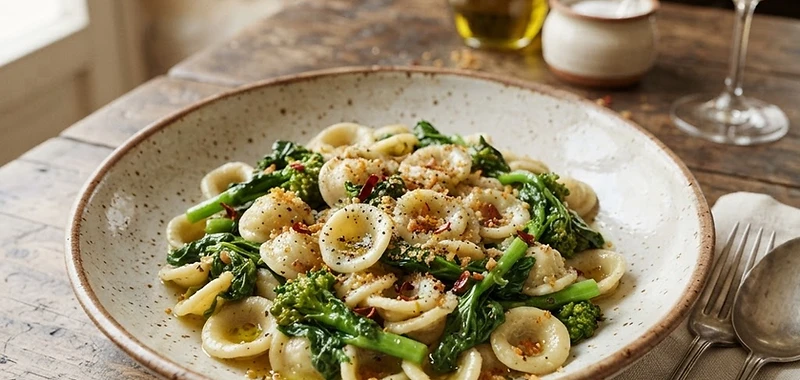
The dish that is Puglia in a bowl. Orecchiette — hand-shaped 'little ear' pasta — with bitter turnip tops (cime di rapa), garlic, anchovy, chili, and olive oil. The bitterness of the greens, the salt of the anchovy, and the heat of the chili are the whole point. It's peasant food from Bari, made from things that grow in the garden. Eat it in Bari, or in any Puglian town, and you understand the region.
Why go
To taste the dish that explains Puglia — bitter greens, salt, and pasta, in one bowl.
The Field Guide take
Orecchiette con le cime di rapa is the culinary baseline of Puglia. It is a dish that relies on the interaction between a specific shape of pasta, a bitter brassica, and the savory intensity of cured fish. While it is served throughout the region, its heart lies in the province of Bari, where the dish functions not as a delicacy, but as a standard of daily sustenance.
The composition of the dish
The dish consists of three primary components: fresh orecchiette, cime di rapa (broccoli rabe), and a base of olive oil infused with garlic, anchovy, and chili. The orecchiette, meaning "little ears," are small, concave disks of pasta made from nothing more than durum wheat semolina and water. Their shape provides a distinct texture—thicker and chewier at the base, and thinner at the edges. The cime di rapa provides the necessary bitterness, which is moderated by the salt of the anchovy and the heat of the chili flakes. A well-prepared bowl relies on the emulsion created by the starchy pasta water and the olive oil to bind these elements together.
Origin and history
The history of orecchiette in Puglia dates back to at least the 12th century, with the town of Sannicandro di Bari often cited as a historic focal point for its production. Whether the shape originated as a local innovation or was influenced by the French culinary traditions introduced during the Angevin period is a subject of debate among food historians. Regardless of its provenance, the pasta became a staple of the region’s cucina povera. It was designed to withstand the heat of the southern Italian climate, utilizing non-perishable semolina as its primary ingredient. The pairing with cime di rapa is an extension of this agricultural reality—a dish built on what grew in the local soil and what could be easily preserved.
The method of preparation
In an authentic preparation, the cime di rapa are boiled in the same pot as the orecchiette. This is critical: the pasta must cook in the water seasoned by the greens, allowing the dough to absorb the vegetable’s flavor. The aromatics—garlic, anchovies, and chili—are gently heated in extra virgin olive oil until the anchovies have fully dissolved into a paste. Once the pasta and greens are drained, they are tossed in this oil. A skilled cook will ensure the result is glossy and light. If the dish is greasy or the pasta lacks the porous surface to hold the sauce, it is usually because the cook used low-quality, machine-made pasta rather than the traditional hand-shaped variety.
Where and when to eat it
The dish is strictly seasonal. You will find it at its best from late autumn through the winter months, when the cime di rapa are harvested. Because the flavor of the greens is dependent on the cold weather to develop their characteristic balance of sweetness and bitterness, the dish often disappears from menus in the summer.
While Bari is the canonical home of this dish, variations exist as you travel across the region. In the Salento peninsula, you will often find the addition of mollica—toasted breadcrumbs—scattered on top for texture. In Foggia, toward the north, the preparation sometimes incorporates pork fat or local sausage, a departure from the strictly vegetable-forward focus found in Bari.
Pairing and tradition
To drink, look for regional wines that can stand up to the bitterness of the greens and the saltiness of the anchovies. A Primitivo di Manduria, with its bold fruit and structure, or a Castel del Monte Bombino Nero, which offers high acidity and elegance, are the traditional choices. If you are eating in a casual setting in Bari, it is common to start the meal with a piece of focaccia barese, though the orecchiette is sufficiently hearty to serve as the centerpiece of the meal.
This is not a dish for those seeking mild flavors. If you are sensitive to strong aromatics, garlic, or the pungent profile of cured fish, the dish may prove overwhelming. However, if you want to understand the agricultural and cultural history of the Puglian countryside, there is no more direct way to do so than through this bowl of greens and pasta.
The Story
Where Orecchiette con le Cime di Rapa comes from
Orecchiette, named for their resemblance to small ears, have been a staple of the Puglia region since at least the 12th century, with historical roots often traced to the town of Sannicandro di Bari. While some historians debate whether the shape was inspired by French influences introduced by the Angevins or earlier local traditions, the pasta became deeply embedded in the peasant culture of the Bari province. It is traditionally crafted from durum wheat semolina and water, a testament to the region's historical reliance on accessible, non-perishable ingredients grown in the sun-drenched landscape of southern Italy.
The pairing of orecchiette with cime di rapa—the flowering tops of broccoli rabe—reflects the agricultural reality of the Puglian countryside. This dish is the definitive expression of 'cucina povera,' where humble, seasonal garden vegetables are elevated by the savory punch of preserved fish and the local abundance of high-quality olive oil. It is not a celebratory banquet dish in its origin, but rather the daily sustenance that came to define the culinary identity of the Bari region.
What Defines It
Signature ingredients
Semolina flour
Provides the signature firm, chewy texture that resists turning mushy during boiling.
Cime di rapa
Broccoli rabe greens that offer a necessary sharp bitterness to balance the density of the pasta.
Anchovies
Dissolved in hot oil, they provide the essential umami saltiness that binds the ingredients together.
Extra virgin olive oil
Puglian oil is the foundation of the emulsion, carrying the flavor of the garlic and chili throughout.
Dried chili flakes
Introduces a subtle heat that cuts through the bitterness of the greens.
The Method
How it's made
The authentic method requires boiling the cime di rapa in the same pot as the orecchiette, allowing the pasta to absorb the flavor of the greens while they soften. A careless version often uses poor-quality, dried machine-made pasta that lacks the porous surface needed to hold the sauce, or fails to properly dissolve the anchovies into the oil. The mark of a skilled cook is the creation of a light, glossy emulsion—formed by the starchy pasta water and the olive oil—which coats the pasta without making the dish heavy or greasy.
Across Italy
Regional variants
Bari
The canonical version, strictly focused on the balance between bitterness and the salt of the anchovy.
Salento
Often features the addition of toasted breadcrumbs (mollica) on top to provide a contrasting crunch.
Foggia
Occasionally incorporates pork fat or local sausage, veering slightly from the lean, vegetable-forward Bari preparation.
Timing
When to eat it
This is a seasonal dish, best eaten from late autumn through winter when cime di rapa are at their peak and naturally sweet despite their inherent bitterness.
Serve With
Classic pairings
Primitivo di Manduria
wineA robust, full-bodied red from Puglia that stands up well to the intensity of the garlic and anchovy.
Castel del Monte Bombino Nero
wineA structured rosé that provides enough acidity to refresh the palate between bites of oily pasta.
Focaccia Barese
foodA common starter in Bari that shares the same high-quality olive oil profile.
What makes it worth going
'Little ear' pasta with bitter turnip greens, garlic, and anchovy — the dish that defines Puglia.
Things to do
- trattoria
Osteria Le Armonie (Bari Vecchia)
In the old town, near the orecchiette women. The orecchiette with cime di rapa is the benchmark. Reserve.
2 hrs
- trattoria
Trattoria al Sorso Preferito (Bari)
The most deliberate version in Bari. The orecchiette is hand-shaped, the greens are bitter, the anchovy is salt.
2 hrs
- experience
Watch the orecchiette women of Bari Vecchia
In the streets of the old town, women sit at tables and shape orecchiette by hand, with a knife, on a board. Watch, buy, eat. The most authentic pasta in Italy is made in the street.
1 hr
- market
A market day in Bari or Bitonto
Where the cime di rapa (turnip tops) are sold. The greens are the dish; the market is where they're freshest.
Eat
- pasta
Orecchiette con cime di rapa
The classic: hand-shaped 'little ear' pasta, bitter turnip tops, garlic, anchovy, chili, olive oil. The bitterness, the salt, and the heat are the whole point.
- pasta
Orecchiette al ragù di carne
The alternative, with a slow meat ragù. The other Puglian orecchiette.
- cheese
Burrata
The starter or the side; Puglia's other gift. Eat it with the orecchiette, or before.
Stay
- neighborhood
Bari Vecchia
The old town, with the orecchiette women and the best trattorias. The most authentic base.
- coastal town
Polignano a Mare
A cliff town, 30 min from Bari. A more scenic base; the orecchiette is as good.
Experiences Worth Booking
Orecchiette-making class with a nonna
3 hrsLearn to shape orecchiette by hand, with a knife and a board, with a local woman. Make the cime di rapa too.
The shape is only made by hand; a class with a nonna is the only way to learn the gesture.
Suits: Anyone who wants the technique; the shaping is the secret.
Bari Vecchia food walk
3 hrsOrecchiette in the street, focaccia, burrata, sgagliozze (fried polenta). The full Bari old town circuit.
The best Bari food is in the street; a walk finds the grandmothers and the ovens.
Suits: Eaters who want the old town at its loudest.
What's nearby & pairs with
More food from Puglia
Dish
Tiella Barese
Rice, potatoes, and mussels baked in a pan — Puglia's one-pan meal, from the fishermen of Bari.
Dish
Bombette
Small rolls of pork stuffed with cheese and capocollo, grilled — the great meat snack of the Puglian butcher.
Dish
Taralli Pugliesi
Baked, boiled-then-baked bread rings — the crunchy snack of Puglia, eaten with everything.
Cheese
Burrata
A mozzarella pouch filled with cream and curd — Puglia's most beloved dairy export.
Ready to plan?
Ready to turn discovery into a trip?
Italy Field Guide helps you decide where to go. When you're ready to build the actual day-by-day itinerary, take your saved places to Travel Itinerary Co — your interests go with you.
Turn your saved Italy places into a trip