
The Verdict
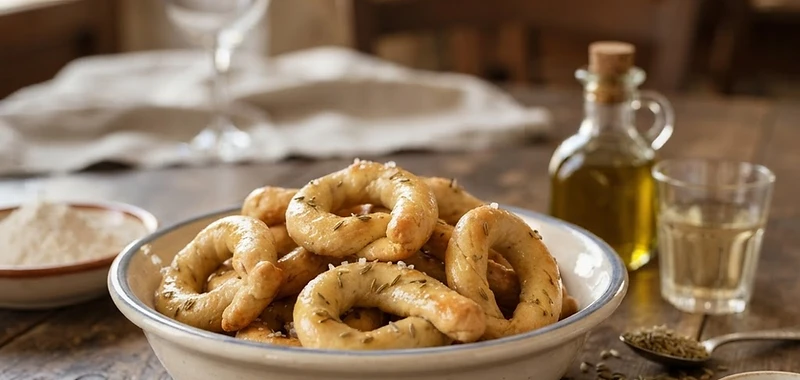
The breadstick of the south, and the snack of every Puglian table. Small rings of dough, boiled like bagels, then baked until hard, with olive oil, white wine, and fennel seeds or chili. Crack them open and eat with salumi, cheese, or just a glass of wine. The plain ones are good; the fennel ones are better. A peasant food that became a national snack.
Why go
To taste the southern breadstick — fennel-crusted, crunchy, and eaten with everything.
The Field Guide take
In Puglia, the tarallo is as foundational as the olive tree. These small, ring-shaped bread snacks are the constant companion of the Puglian table, serving as a functional, shelf-stable staple that bridges the gap between a simple snack and a necessary accompaniment to every glass of wine or slice of cured meat. They are not intended to be eaten as a soft bread; they are designed to shatter.
What they are
Taralli are baked, twice-processed dough rings that prioritize crunch and shelf life. While the dough is made from standard pantry staples—flour, olive oil, and white wine—the result is a rigid, golden snack that serves as the southern Italian answer to the breadstick. They are savory, oily, and aromatic, often flecked with fennel seeds, black pepper, or chili. A quality tarallo is defined by its texture: it must snap cleanly when bitten, with a light sheen from the olive oil, never a dusty or gummy finish.
Origin and history
The history of the tarallo is rooted in cucina povera. Emerging from 8th-century rural Puglia, these rings were a practical solution to the problem of food waste. Peasants utilized leftover bread dough scraps, enriched with oil and wine, to create a portable food source for field workers. Because bread was the primary source of calories for the rural population, losing any dough was unacceptable. Over centuries, the tarallo transitioned from a survival ration into a symbol of regional hospitality. In the provinces of Bari and Salento, offering a guest a bowl of taralli and a glass of wine remains the standard, modest gesture of welcome. While production has been partially industrialized to meet national demand, the tarallo retains its identity as an emblem of frugal, resourceful agriculture.
The production process
The making of a tarallo is a two-stage process. First, a stiff dough is kneaded from 00 flour, olive oil, white wine, and sea salt, along with regional aromatics. The dough is rolled into thin logs and joined into closed loops. Before they see an oven, the rings are boiled in water. Much like a bagel, the boiling step is crucial; it sets the exterior of the dough, ensuring that when the rings are eventually baked at high temperatures, they develop a rigid, glass-like crust rather than a bready interior. Once boiled, the rings are dried and then baked until they reach a uniform golden brown.
Regional variations
While the core concept remains consistent, the local flavor profile shifts as you travel through Puglia:
- Bari: This is the most canonical territory for the snack. Bari-style taralli are typically small, bite-sized, and prominently flavored with fennel seeds.
- Salento: As you move south toward the heel of the boot, the flavor profile turns toward heat. You will frequently encounter versions made with black pepper or dried hot chili flakes.
- Foggia: In the northern part of the region, traditions occasionally diverge. Foggia-style taralli are sometimes larger in size, and some traditional family recipes incorporate lard rather than olive oil for a richer, more savory bite.
When and how to eat them
Taralli are non-seasonal and are available year-round. They are served at almost every hour, functioning as a mid-morning snack, a standard aperitivo fixture, or a table-side substitute for fresh bread during lunch and dinner. Because they are designed to be shelf-stable, they are also a common sight at harvest festivals and communal gatherings. When eating them, pair them with the local larder: they are best alongside Capocollo di Martina Franca, fresh burrata, or simply a bowl of olives.
What to drink with them
The high fat content from the olive oil and the salinity of the dough require a wine with enough character to stand up to the crunch. A Primitivo di Manduria, with its robust structure and dark fruit notes, provides a classic, balanced pairing. If you prefer white, a dry, crisp local white wine is the standard choice, as the acidity helps cut through the richness of the oil. Avoid overly delicate wines, which the assertive crunch and aromatics of the fennel or pepper will easily overwhelm.
The Story
Where Taralli Pugliesi comes from
Taralli trace their origins to the rural kitchens of 8th-century Puglia, created as a resourceful solution to use up leftover bread dough scraps. In an era when bread was the primary caloric intake for peasants, waste was not tolerated, and by combining residual flour, olive oil, and wine into ring-shaped snacks, families could store a shelf-stable, portable food source for workers in the fields. It remains a staple of the 'cucina povera' tradition, reflecting the frugal ingenuity of the southern Italian agricultural landscape.
Historically, the tarallo served as a symbol of hospitality. Known in regional dialect as the 'bread of the poor,' it was traditionally offered to guests with a glass of wine, a custom that persists in homes across the Salento and Bari provinces today. While once strictly a homemade necessity, the production of taralli became industrialized in the 20th century, cementing their status as Puglia's definitive contribution to the Italian snack market while maintaining their cultural identity as a symbol of regional frugality.
What Defines It
Signature ingredients
Extra virgin olive oil
Provides the essential fat content required for the signature brittle, crumbly texture; regional Puglian oil adds a distinct grassy profile.
Dry white wine
Acts as the liquid base for the dough, contributing acidity that aids in gluten development and adds a subtle depth of flavor to the otherwise plain flour.
00 Flour
Finely milled wheat flour is required to achieve the necessary snap rather than a chewy or bread-like consistency.
Fennel seeds
The most traditional aromatic inclusion; the seeds provide a sharp, anise-like contrast to the rich, fatty dough.
Sea salt
Essential for seasoning the dough, as the structural integrity of the tarallo relies on the precise balance of salinity.
The Method
How it's made
The process begins by kneading flour, oil, wine, and aromatics into a smooth, stiff dough that must rest before shaping. The dough is rolled into thin logs and joined into rings, which are briefly boiled in water—a step analogous to bagel preparation—until they float, signaling they are ready to be removed. After drying, they are baked at a high temperature until golden and rigid. A well-made tarallo is defined by its 'fracture'; it should shatter cleanly between the teeth without being excessively hard or gummy, and the surface should show a delicate sheen from the olive oil rather than a dull, floury finish.
Across Italy
Regional variants
Bari
Often produced in smaller sizes and frequently flavored with fennel, maintaining the most canonical definition of the snack.
Salento
Frequently incorporates black pepper or hot chili flakes into the dough, reflecting the region's preference for spice.
Foggia
Taralli from the northern part of the region can occasionally be larger and sometimes feature additional fats like lard, depending on specific local family recipes.
Timing
When to eat it
Taralli are a year-round staple, consumed daily as a snack, an aperitivo accompaniment, or a substitute for bread during meals. They have no specific seasonal window but are ubiquitous at communal events and harvest festivals throughout the autumn.
Serve With
Classic pairings
Primitivo di Manduria
wineThe high tannins and dark fruit notes of this local Puglian red provide the necessary structural weight to balance the oily, fatty nature of the tarallo.
Capocollo di Martina Franca
foodThe smoked, artisanal cured pork from the Itria Valley offers a savory contrast to the crunch of the taralli, creating a classic antipasto pairing.
Burrata
foodThe creaminess of fresh burrata acts as a textural foil to the dry, brittle snap of the tarallo.
What makes it worth going
Baked, boiled-then-baked bread rings — the crunchy snack of Puglia, eaten with everything.
Things to do
- bakery
A bakery in Bari or any Puglian town
The home of the taralli, in Puglia. The bread, the oil, the wine, the boil-bake. Buy them warm, in the morning.
45 min
- enoteca
A Puglian enoteca for taralli and wine
The taralli with a Primitivo or a Negroamaro; the bread and the wine are the aperitivo.
1 hr
- experience
A taralli-making demonstration
The taralli are boiled (like bagels) then baked; the boil-bake is the technique. The oil and the wine in the dough are the flavor.
1.5 hrs
- experience
A Puglian food walk
Taralli, focaccia, orecchiette. The full Puglian circuit, with the taralli as the start.
Eat
- bread
Taralli pugliesi (plain or fennel)
The classic: a ring-shaped bread, made with flour, oil, and white wine, boiled then baked. The crunch is the point; the wine is the flavor. The plain or the fennel seed version.
- bread
Taralli al peperoncino
The spicy version, with chili. The heat-seeker's tarallo.
- dessert
Taralli with sugar (dolci)
The sweet version, with sugar or icing. The dessert tarallo.
Stay
- city
Bari or any Puglian town
The bases, with good bakeries. Walkable in the centers.
- farm-stay
A masseria in the interior
In the countryside, where the taralli are made on the farm. A car is required.
Experiences Worth Booking
Taralli-making class
2 hrsThe dough, the boil, the bake, the oil and wine. The boil-bake is the technique.
The taralli are boiled then baked; a class shows you the dough, the boil, and the bake.
Suits: Bread bakers who want the Puglian technique; the boil is the secret.
Puglian food day
full dayA taralli tasting, a tiella lunch, a Primitivo cellar. The full Puglian arc.
The taralli, the tiella, and the Primitivo are the Puglian trinity; a day covers all.
Suits: Food travelers with a day for Puglia.
What's nearby & pairs with
More food from Puglia
Dish
Orecchiette con le Cime di Rapa
'Little ear' pasta with bitter turnip greens, garlic, and anchovy — the dish that defines Puglia.
Dish
Tiella Barese
Rice, potatoes, and mussels baked in a pan — Puglia's one-pan meal, from the fishermen of Bari.
Dish
Bombette
Small rolls of pork stuffed with cheese and capocollo, grilled — the great meat snack of the Puglian butcher.
Cheese
Burrata
A mozzarella pouch filled with cream and curd — Puglia's most beloved dairy export.
Ready to plan?
Ready to turn discovery into a trip?
Italy Field Guide helps you decide where to go. When you're ready to build the actual day-by-day itinerary, take your saved places to Travel Itinerary Co — your interests go with you.
Turn your saved Italy places into a trip