
The Verdict
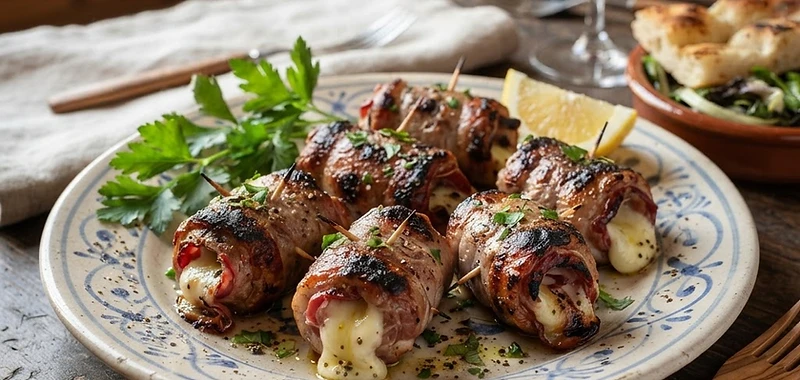
The great meat snack of Puglia, and the reason to find a butcher with a grill. Small rolls of thin pork, stuffed with caciocavallo or stracciatella, capocollo, and a little black pepper, grilled until the cheese melts out. Eaten hot, with bread and a Primitivo, in the back of a butcher shop in the Valle d'Itria. Puglia's answer to porchetta, and arguably better.
Why go
To eat the best pork-and-cheese snack in Italy — from a butcher's grill, in the Valle d'Itria.
The Field Guide take
In the Valle d’Itria, a central Puglian basin that bridges the provinces of Bari, Brindisi, and Taranto, the local butcher shop is not merely a place to buy raw ingredients. It is a social hub and a kitchen. The bombetta is the primary product of this arrangement: a small, tightly wrapped roll of pork neck, stuffed with cheese and cured meat, and grilled over open wood fire. It is a pragmatic, high-protein snack that has become the definitive meat preparation of the region.
What it is
A bombetta is a meat roll, roughly the size of a large walnut or a small apricot. It consists of a thin slice of pork neck (the capocollo cut) that is hammered flat, filled with a mixture of grated cheese—usually caciocavallo—and seasonings, then rolled and skewered. When cooked, the heat causes the interior cheese to melt into the pork fats, creating a self-basting effect. They are sold by weight or by the piece, eaten hot off the grill, and are almost always consumed in the immediate vicinity of the butcher’s counter.
Origin and history
The dish is rooted in the tradition of fornello pronto—literally "ready stove." Historically, farmers and residents would bring their own meat to the neighborhood butcher, who utilized the large, wood-fired ovens originally designed for baking bread to roast the customers' cuts. Over time, this evolved into a system where the butcher prepares the raw cuts themselves. The bombetta emerged as a way to utilize the thinner, less uniform slices of pork neck that were not suitable for long roasting. It was a rapid, efficient meal for laborers that eventually became a staple of the local diet in towns like Cisternino, Martina Franca, and Locorotondo.
How it’s made
The quality of a bombetta relies entirely on the butcher’s technique. The pork must be sliced thin enough to cook in minutes, but sturdy enough to hold the stuffing. The center typically contains a mix of parsley, black pepper, and caciocavallo cheese, often bolstered by a small sliver of Capocollo di Martina Franca, a slow-cured local pork specialty.
The cooking process is the final arbiter of quality. The rolls are placed on skewers and grilled over high, indirect heat. Authentic preparations use dried olive or oak wood, which imparts a specific scent to the fat as it renders. A properly cooked bombetta should have a charred, crisp exterior and a molten, savory center. If the meat is too thick or the cheese is of poor quality, the interior will separate or remain tough, but a well-made version will have a distinct, singular flavor profile where the cheese has essentially marinated the pork from the inside out.
Where to eat it
The Valle d'Itria is the only place to experience this tradition as intended. Cisternino is widely regarded as the gold standard; the butchers there prioritize the purity of the pork and the quality of the local caciocavallo. In Martina Franca, the versions are slightly more complex, often incorporating the town's namesake capocollo for a deeper, saltier intensity. Seek out shops that display a fornello (the wood-fired oven) clearly visible to the street. You are looking for a butcher shop that functions as a casual eatery; do not expect a standard dining room with table service. You order at the counter, choose your meats, and wait for them to be grilled.
When and how
Bombette are a year-round staple of Puglian life. They are particularly popular during the summer months, when the practice of outdoor grilling moves from the butcher's back room to the town square or the veranda. They are meant to be eaten immediately, usually while standing or sitting on simple stools, accompanied by thick slices of Pane di Altamura to soak up the dripping fats.
What to drink with it
Because bombette are high in fat and salt, they require a beverage with enough structure to cut through the richness. The local choice is Primitivo di Manduria, a red wine with enough body and fruit-forward intensity to stand up to the charred pork. If you prefer a white, a dry, crisp Verdeca from the surrounding hills provides a clean, acidic counterpoint to the molten cheese. Avoid complex or delicate vintages; the food is direct and rustic, and the wine should be as well.
The Story
Where Bombette comes from
Bombette originate from the Valle d'Itria, a central Puglian valley spanning the provinces of Bari, Brindisi, and Taranto. They are historically linked to the tradition of 'fornello pronto,' where local butcher shops double as kitchens. Farmers and residents would bring meat to the butcher to be roasted in the large, wood-fired ovens used to bake bread, eventually evolving into a system where the butcher prepares and cooks the meat on-site for immediate consumption. Cisternino, Martina Franca, and Locorotondo are considered the spiritual homes of this dish. It emerged as a practical way for butchers to utilize thin slices of pork neck, providing a quick, high-protein meal for laborers and locals. Unlike slow-roasted meats, bombette were designed to be prepared rapidly, reflecting the pragmatic culture of the Puglian countryside.
What Defines It
Signature ingredients
Pork neck (capocollo portion)
The marbling in this cut ensures the meat remains succulent during the quick, high-heat grilling process.
Caciocavallo podolico
A semi-hard, stretched-curd cheese that provides a sharp, savory bite and melts without turning into an oily liquid.
Capocollo di Martina Franca
This cured meat, flavored with cooked wine and herbs, adds a distinctive depth and slight smokiness to the center of the roll.
Fresh parsley and black pepper
Used minimally to cut through the fat of the pork and balance the richness of the cheese.
The Method
How it's made
The process begins by slicing pork neck into very thin, wide pieces, which are lightly pounded to ensure an even thickness. A small mixture of grated cheese, herbs, and occasionally a slice of cured pork is placed in the center, and the meat is tightly rolled and secured with a toothpick or skewer. The crucial step is the grilling: it must be done over high, indirect wood heat—ideally using oak or olive wood—to achieve a charred, crispy exterior while keeping the center molten. A careless version often uses meat that is too thick or low-quality cheese that separates, whereas a quality bombetta relies on the precise balance of a hot sear to seal the juices inside.
Across Italy
Regional variants
Cisternino
Considered the gold standard; the focus here is strictly on the purity of the pork and the local caciocavallo.
Martina Franca
These versions often emphasize the use of high-quality local Capocollo di Martina Franca, a slow-cured meat specific to the town.
Timing
When to eat it
Available year-round, as the butcher shop culture is a permanent fixture of Puglian daily life. They are particularly popular during summer evenings when outdoor grilling is a social standard.
Serve With
Classic pairings
Primitivo di Manduria
wineA bold, tannic red wine that stands up to the fatty, charred profile of the pork.
Pane di Altamura
foodCrusty, dense bread used to mop up the rendered fat and cheese that drips onto the tray.
Puglian white wine (Verdeca)
wineAn acidic, crisp white that cleanses the palate from the saltiness of the cheese and cured meat.
What makes it worth going
Small rolls of pork stuffed with cheese and capocollo, grilled — the great meat snack of the Puglian butcher.
Things to do
- butcher
A butcher in the Itria Valley (e.g. Cisternino)
The home of the bombette, in the Itria Valley of Puglia. The bombetta is the roll; the butcher grills it for you. Order at the counter, eat at the table outside.
1.5 hrs
- butcher
A Cisternino butcher's grill
The Cisternino model: the butcher rolls the bombette, you take them to the back, the grill is wood-fired, you eat at the table. The most authentic Puglian food experience.
2 hrs
- farm
A Puglian agriturismo
The bombette are made on the farm; the meat is local, the grill is wood. The agriturismo is the context.
half day
- experience
A Valle d'Itria food day
Bombette in Cisternino, orecchiette in a trattoria, a Primitivo cellar. The full Puglian arc.
Eat
- dish
Bombette pugliesi
The classic: small rolls of thin pork, stuffed with caciocavallo, salt, and pepper, grilled over wood. The caciocavallo melts inside the pork; the wood smoke is the flavor.
- pairing
With pane and 'nduja
The Puglian combo; the bombette with bread, and sometimes 'nduja or ricotta forte on the side.
- wine
A glass of Primitivo or Negroamaro
The Puglian red; the correct pairing for the pork and the grill.
Stay
- town
Cisternino or Locorotondo
The Itria Valley towns, near the butchers and the bombette. A car is required.
- farm-stay
An agriturismo or masseria
In the valley, where the bombette are made on the farm. A car is required.
Experiences Worth Booking
Bombette at a Cisternino butcher
2 hrsThe butcher, the roll, the wood grill, the table outside. The most authentic Puglian food experience.
The Cisternino butcher's grill is the bombette; the experience is the butcher, the grill, and the table.
Suits: Meat lovers who want the bombette at its source.
Valle d'Itria food day
full dayBombette in Cisternino, orecchiette in a trattoria, a Primitivo cellar. The full Puglian arc.
The bombette, the orecchiette, and the Primitivo are the Puglian trinity; a day covers all.
Suits: Food and wine travelers with a day for the Itria Valley.
What's nearby & pairs with
More food from Puglia
Dish
Orecchiette con le Cime di Rapa
'Little ear' pasta with bitter turnip greens, garlic, and anchovy — the dish that defines Puglia.
Dish
Tiella Barese
Rice, potatoes, and mussels baked in a pan — Puglia's one-pan meal, from the fishermen of Bari.
Dish
Taralli Pugliesi
Baked, boiled-then-baked bread rings — the crunchy snack of Puglia, eaten with everything.
Cheese
Burrata
A mozzarella pouch filled with cream and curd — Puglia's most beloved dairy export.
Ready to plan?
Ready to turn discovery into a trip?
Italy Field Guide helps you decide where to go. When you're ready to build the actual day-by-day itinerary, take your saved places to Travel Itinerary Co — your interests go with you.
Turn your saved Italy places into a trip