
The Verdict
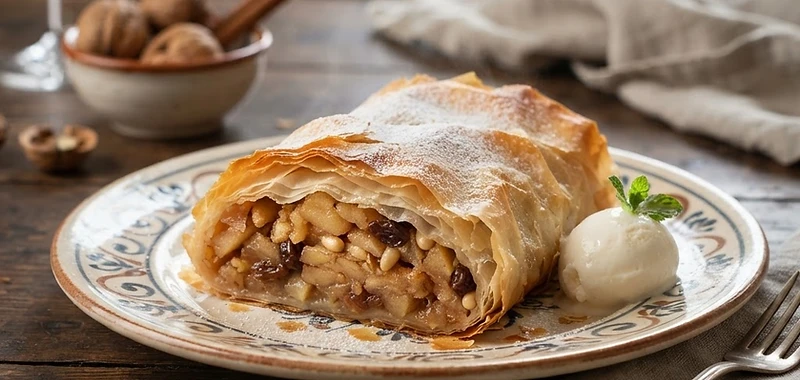
The Austrian dessert that the Italians kept. A strudel of paper-thin, hand-stretched pastry, wrapped around apples, raisins, pine nuts, cinnamon, and breadcrumbs, baked until the pastry is glass. From Alto Adige, where the Germanic pastry tradition stayed. Eaten warm, with vanilla sauce or crema, in a South Tyrolean café. The pastry, if it's right, is so thin you can read a newspaper through it.
Why go
To taste the Alpine apple strudel, with pastry thin enough to read through.
The Field Guide take
In the high-altitude valleys of South Tyrol, the strudel di mele is not a foreign import but a reflection of a landscape that shares more with the geography of the Austrian Alps than the Mediterranean coast. It is a defining piece of the region’s cultural identity, serving as a reminder that for centuries, these mountains belonged to the Austro-Hungarian Empire. Today, the strudel remains a staple of the local diet, particularly in the orchards of the Adige Valley and the mountain towns of the north.
What it is
At its most fundamental, strudel di mele is a thin, crisp pastry wrapped around a spiced apple filling. Unlike many French or Italian pastries that rely on layers of butter and flour, the traditional Tyrolean strudel is defined by its structure. When prepared correctly, the pastry is rolled and stretched until it is nearly transparent, providing a delicate shell for the fruit within. It is a study in texture: the contrast between the brittle, glass-like exterior and the soft, cinnamon-scented interior.
Origin and history
The history of the strudel is a lineage of cultural exchange. Its culinary ancestors can be traced back to the layered doughs of the Ottoman Empire, which moved through Central Europe and eventually became the Apfelstrudel of the Austro-Hungarian Empire. When the borders shifted following the end of World War I, the traditions of the region remained tied to its northern roots. In towns like Bolzano, Merano, and Bressanone, the dish persisted as a daily necessity rather than a special-occasion dessert. It is a culinary artifact of the region’s resilience, maintaining a distinct character that sets the cooking of the Italian Alps apart from the rest of the country.
How it's made
The defining technical challenge of the strudel is the dough. Authentic preparation requires hand-stretching the dough on a floured cloth until it is thin enough to read newsprint through. Store-bought puff pastry, which is common in mass-produced versions, is a poor substitute; it lacks the necessary crispness and overwhelms the filling.
The filling typically centers on Renetta apples, which provide a firm texture and a balance of acidity. These are combined with breadcrumbs browned in butter—which serve to absorb the moisture from the fruit during baking—along with raisins soaked in rum, pine nuts, and a touch of cinnamon. The dough is brushed with melted butter, rolled into a tight cylinder, and baked until the crust is golden and shattered. A successful strudel should be firm enough to hold its shape on a plate but soft enough to yield to a fork without requiring a knife.
Where to eat it
The best places to find authentic strudel are the traditional cafés and mountain rifugi (refuges) throughout Alto Adige. While variations exist—such as in the Val di Non, where the pastry is often slightly more rustic and dense, or in Cortina d'Ampezzo, where the portions of cream served alongside are more generous—the South Tyrolean standard remains the benchmark. Look for smaller, independent establishments where the smell of baked apples and butter is present from the kitchen. If a bakery or café appears to be using a thick, commercial crust, it is an indicator that the preparation is not the hand-stretched variety.
When and how
While available throughout the year, the dish is tied to the harvest. The autumn months, when local apples are gathered, are the optimal time to seek out the freshest versions. During the winter, a warm slice served in a heated mountain café is a regional fixture. It is traditional to serve the strudel warm, accompanied by a pouring of vanilla crema or crème anglaise.
What to drink with it
Because of the richness of the pastry and the sweetness of the spiced apples, the drink pairing is important. A glass of regional Gewürztraminer, which grows well in the local climate, provides a floral and slightly spicy aromatic match. For a more casual setting, a simple, hot filter coffee is the standard accompaniment in most Tyrolean households and cafés, providing a clean bitterness that cuts through the buttery pastry and the sugar of the filling.
The Story
Where Strudel di Mele comes from
Apple strudel, or Apfelstrudel, is the signature pastry of the Trentino-Alto Adige region, a testament to the area's complex history as part of the Austro-Hungarian Empire until the end of World War I. While the dish is rooted in Central European culinary traditions—with roots tracing back to the Baklava brought to the region via Ottoman influence—it evolved in the Alpine valleys of South Tyrol into a distinct, localized staple. It represents the cultural synthesis of Germanic baking techniques and the abundant apple orchards that define the landscape of the Adige Valley. In towns like Bolzano, Merano, and Bressanone, the strudel is not merely an imported treat but a domestic foundation of the local diet. The preservation of this dish in Northern Italy highlights the resilience of Tyrolean identity, which maintains a clear culinary distance from the Mediterranean styles of central and southern Italy. It remains a primary example of how regional borders have historically mattered less than geographical and cultural continuity.
What Defines It
Signature ingredients
Renetta Apples
These firm, tart, and fragrant apples hold their structure during baking and provide the necessary acidity to balance the sugar.
Buttered Breadcrumbs
Toasted in butter, they are placed between layers of fruit to absorb excess moisture, preventing the pastry from becoming soggy.
Raisins soaked in Rum
Adds a necessary depth and slight boozy sweetness that cuts through the starch of the dough.
Pine nuts
Provides a essential textural contrast and a subtle, nutty richness typical of Alpine pantry staples.
Cinnamon
The defining aromatic profile that ties the fruit and pastry together in the traditional Central European style.
The Method
How it's made
The true test of an authentic strudel is the dough, which must be hand-stretched until it is translucent enough to read text through. A careless version often uses thick, store-bought puff pastry, which lacks the structural integrity and delicacy of the traditional pulled strudel dough. The dough is rolled out on a floured cloth, stretched thinly, brushed with melted butter, and layered with the apple-crumb mixture. It is rolled tightly into a cylinder and baked until the exterior is golden and glass-like, creating a sharp contrast with the soft, spiced interior. The pastry should be crisp and shatter upon contact, while the filling should remain moist but not liquid.
Across Italy
Regional variants
Trentino (Val di Non)
Often features a slightly denser, more rustic pastry compared to the gossamer-thin dough preferred in the neighboring Alto Adige.
Veneto (Cortina d'Ampezzo)
Adopts the South Tyrolean style closely, though it is frequently served with more generous portions of local cream as a nod to the luxury mountain resort culture.
Timing
When to eat it
Available year-round, though it is most characteristic of the autumn harvest season when local Renetta apples are at their peak. It is a standard fixture in mountain refuges and cafes throughout the winter months.
Serve With
Classic pairings
Gewürztraminer
wineA local white wine from Alto Adige that provides the necessary aromatics and body to complement the spiced fruit.
Vanilla Crème Anglaise
sauceServed warm alongside the strudel to add a creamy, cooling element to the crisp pastry.
Filter Coffee
drinkOften consumed in the Austrian-influenced fashion of the region, providing a clean bitterness that balances the sugar of the dessert.
What makes it worth going
Apple strudel from Alto Adige — the Italian version of the Austrian classic, with a paper-thin pastry.
Things to do
- pasticceria
A pasticceria in Bolzano or Merano
The strudel di mele is the benchmark; the thin dough, the apples, the pine nuts, the raisins. Eat it warm, with a coffee.
45 min
- trattoria
A trattoria or rifugio
The strudel is the dessert after the canederli; the alpine lunch is the canederli and the strudel.
1 hr
- farm
A South Tyrolean agriturismo
The apples are from the valley (the Val Venosta is the apple capital); the strudel is made on the farm.
half day
- experience
A strudel-making class
The dough is stretched thin enough to read a newspaper through; the apples are the filling. The technique is the stretch.
Eat
- dessert
Strudel di mele
The classic: a thin dough, stretched by hand, filled with apples, pine nuts, raisins, cinnamon, and breadcrumbs. The dough is the test; the apples are the filling.
- accompaniment
With vanilla sauce or gelato
The traditional companion; the warm strudel with the cold cream or gelato.
- drink
A coffee or a Schiava
The alpine companion; a coffee or the local red.
Stay
- city
Bolzano or Merano center
Near the best pasticcerias. Walkable and central.
- rural
The Val Venosta or the Sciliar plateau
The apple country; the strudel is made at its source. A car is required.
Experiences Worth Booking
Strudel-making class
3 hrsThe dough, the stretch (thin enough to read through), the apple filling, the bake. The stretch is the technique.
The strudel dough is stretched by hand until it's transparent; a class shows you the stretch and the roll.
Suits: Bakers who want the alpine dessert; the dough is the test.
Alpine food and orchard day
full dayAn apple orchard in the Val Venosta, a strudel tasting, a canederli lunch. The full South Tyrolean arc.
The strudel is the apple and the dough; a day covers the orchard and the dessert.
Suits: Food travelers with a day for the Alps.
What's nearby & pairs with
More food from Trentino-Alto Adige
Ready to plan?
Ready to turn discovery into a trip?
Italy Field Guide helps you decide where to go. When you're ready to build the actual day-by-day itinerary, take your saved places to Travel Itinerary Co — your interests go with you.
Turn your saved Italy places into a trip