The Verdict
The ham of the Alps. Pork leg, dry-cured like prosciutto, then lightly cold-smoked over juniper, laurel, and other woods, and aged. The result is somewhere between prosciutto and smoked ham — savory, smoky, and leaner than Parma. From Alto Adige, where the Germanic and Italian food cultures meet. Eat it with dark bread, mustard, and a beer, or in a canederlo (bread dumpling).
Why go
To taste the Alpine ham that's neither Italian nor Austrian — but both.
The Field Guide take
Speck Alto Adige is the product of an environment defined by the convergence of Mediterranean and Alpine influences. Produced in the autonomous province of Bolzano, it functions as a bridge between the salt-cured traditions of the Italian south and the wood-smoked preservation techniques common in the Germanic north. It is a ham that defies simple categorization, providing a profile that is leaner, spicier, and more aromatic than the hams of the Po Valley, yet distinctly cured in the Italian style.
What it is
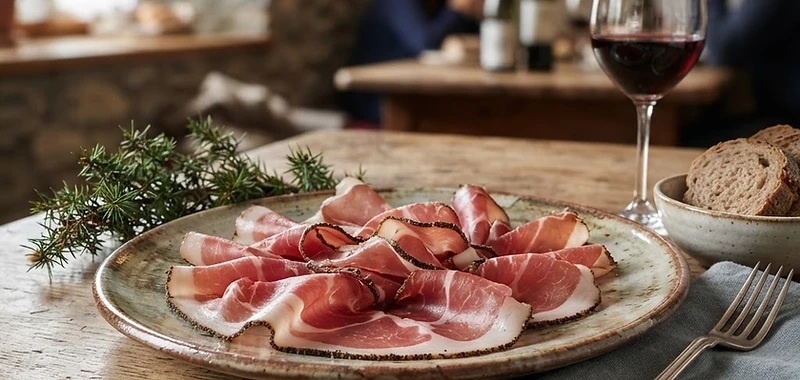
Speck is a dry-cured, lightly smoked pork leg. To the uninitiated, it occupies a middle ground: it possesses the structure and silky, tender mouthfeel of a classic prosciutto crudo, but incorporates a subtle, savory smoke. The exterior of a slice often shows a darker, reddish hue compared to the uniform pink of unsmoked hams, a result of the curing process and the specific environment in which it ages. It is characterized by the scent of wood smoke, typically beech, and a complex spice rub that frequently includes juniper berries.
Origin and history
The history of speck is rooted in the practical necessities of the Alpine farmer. In the remote valleys of Alto Adige, the annual slaughter of the family pig was a vital event; the meat needed to be preserved to sustain the household through long, isolated winters. Farmers combined the two dominant regional preservation methods: they used salt and Mediterranean curing techniques to prevent decay, and they employed the cold-smoking methods common in the nearby Austrian and German territories to protect the meat from mold and improve shelf life. Over centuries, this process moved from farmstead practice to professional production, eventually securing the Indicazione Geografica Protetta (IGP) status that protects its name and methods today.
How it’s made
The production of Speck Alto Adige follows a strictly regulated sequence. First, the pork leg is deboned and trimmed into a classic shape. The producer then applies a dry cure consisting of salt, pepper, and a proprietary spice blend—juniper is the most recognized aromatic, though bay leaves, rosemary, and garlic are also used.
The meat cures for several weeks, during which it is rotated to ensure even absorption. The defining step is the cold-smoking process. The ham is exposed to a cool, light smoke from beechwood logs; it is not a "cooked" ham in the sense of heat-processing, but rather a preservation technique that imparts a delicate fragrance. Finally, the speck undergoes a maturation period in the crisp, high-altitude air of the Dolomites. The combination of cool, dry mountain air and controlled humidity is essential to achieving its signature firm, dense texture.
Where to eat it
While speck is available throughout Italy, it is best experienced in its home province of Bolzano. The most authentic settings are the Buschenschank—traditional farm taverns that serve the products of their own land. Throughout the valleys of the Val Pusteria or the Val Venosta, look for menus that feature Marende, a traditional afternoon snack plate. These plates are the standard vehicle for speck, served alongside local mountain cheeses, pickles, and horseradish. You will also find it incorporated into cooked dishes, most notably in canederli (also known as knödel), large bread dumplings that rely on the fat and salt of the speck to provide depth to the dish.
When and how
Speck is available year-round, as the curing process is designed to endure all seasons. It is rarely served as a centerpiece protein; rather, it is consumed as an appetizer or a light meal. When eating it raw, it should be sliced thinly, but not as paper-thin as a translucent prosciutto; its texture is slightly more robust. If you are served speck on a board, pair it with dense, dark rye bread—the acidity and slight bitterness of the bread cut through the fat of the ham.
What to drink with it
Because of the smokiness and the spice rub, speck pairs best with the local wines of Alto Adige rather than the lighter, fruit-forward wines often served with southern Italian hams. Lagrein, a bold, dark, and slightly earthy red wine native to the Bolzano basin, provides the necessary structure to stand up to the cured meat. If you prefer white wine, look for an Alto Adige Gewürztraminer, which shares the same spice profile as the ham’s cure. For a more traditional, casual approach, a glass of cold, crisp, local lager is a standard and reliable choice.
The Story
Where Speck comes from
Speck is a product of Trentino-Alto Adige, representing the intersection of Northern European smoking techniques and Italian dry-curing. Historically, it was created by farmers looking to preserve the family pig for the long Alpine winter. It carries the distinct smokiness of the North but maintains the elegant, silken texture of a prosciutto.
What Defines It
Signature ingredients
Juniper berries
Used in the cure to provide a piney, balsamic note that characterizes the meat.
Beechwood smoke
Used for a cold-smoking process that adds flavor without over-cooking the meat.
The Method
How it's made
The ham is deboned, dry-cured with spices, and lightly smoked before a long aging period in clean Alpine air. This multi-step process results in a ham that is simultaneously savory, spicy, and smoky.
Timing
When to eat it
Year-round.
Serve With
Classic pairings
Lagrein
wineA dark, local red that mirrors the earthy and spicy qualities of the ham.
Rye bread
foodThe dense, dark crust and malty crumb complement the smoke.
What makes it worth going
Smoked, dry-cured ham from Alto Adige — the Alpine answer to prosciutto, lightly smoked over juniper.
Things to do
- producer
A speck producer in Alto Adige
The home of speck, the alpine cured ham. The cure is salt, the smoke is light (juniper and pine), the age is the mountain air. Visit a producer; book ahead.
1.5 hrs
- osteria
A speck tasting in a Bolzano osteria
The speck is sliced thin, served with bread and a Schiava wine. The smoke is the test; the cure is the flavor.
1 hr
- rifugio
A rifugio on the high pastures
The speck is the companion to the canederli; at a rifugio, after a hike, the two are the alpine lunch.
half day
- festival
The Speckfest (e.g. San Maddalena, October)
The village festival, with the speck in the square. The smoke is the smell; the cure is the show.
full day
Eat
- cured_meat
Speck altoatesino
The classic: a cured, lightly smoked ham from Alto Adige, with juniper and pine. The IGP version; the light smoke is the difference from prosciutto. Sliced thin, with bread.
- dish
With canederli
The speck is the filling of the canederli; the dumpling and the cure are the alpine pairing.
- wine
A glass of Schiava or Lagrein
The alpine red; the correct pairing for the speck and the smoke.
Stay
- city
Bolzano or Merano
The urban bases, with good producers and osterias. Walkable.
- rifugio
A rifugio on the high pastures
The alpine hut, for speck at altitude. A hike is required.
Experiences Worth Booking
Speck cellar and smoking visit
2 hrsA visit to a speck cellar, the cure, the light smoke, the tasting. The juniper is the context.
The speck is a light-smoke cure; a cellar visit shows you the juniper, the mountain air, and the age.
Suits: Cured-meat lovers who want the alpine cure at its source.
Alpine food day
full dayA speck tasting, a canederli lunch, a strudel dessert. The full South Tyrolean arc.
The speck, the canederli, and the strudel are the alpine trinity; a day covers all three.
Suits: Food travelers with a day for the Alps.
What's nearby & pairs with
More food from Trentino-Alto Adige
Ready to plan?
Ready to turn discovery into a trip?
Italy Field Guide helps you decide where to go. When you're ready to build the actual day-by-day itinerary, take your saved places to Travel Itinerary Co — your interests go with you.
Turn your saved Italy places into a trip