The Verdict
The dish that proves Italian seafood pasta doesn't need tomato. Spaghetti with fresh vongole (clams), garlic, white wine, olive oil, parsley, and a little chili. No cream, no tomato, no complication — the clams are the sauce. The Neapolitan and Venetian versions both claim it; the Campania version, with the sweet local clams, is the benchmark. Eat it on the coast, looking at the sea.
Why go
To taste the cleanest seafood pasta in Italy — clams, wine, and nothing else.
The Field Guide take
Spaghetti alle vongole is the definitive seafood pasta of the Italian coast. It is a dish that relies on the interaction between three elements: the salinity of the mollusks, the sharpness of the garlic, and the starch of the pasta. In Campania, this dish is not treated as a luxury, but as a standard of kitchen competence. If a restaurant cannot execute this dish correctly, it is a reliable indicator that the rest of their seafood menu should be approached with caution.
What it is
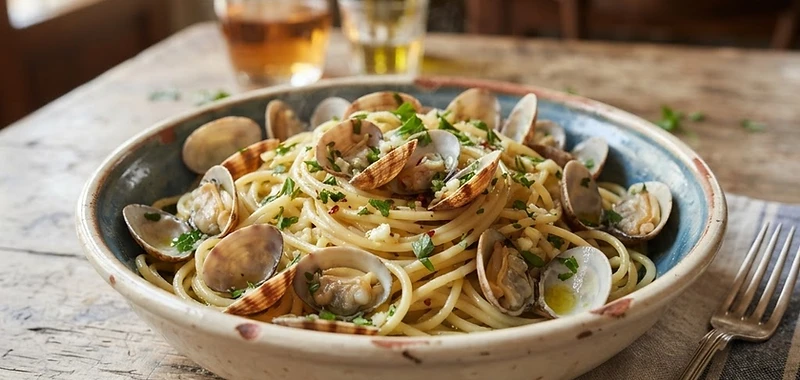
At its core, spaghetti alle vongole is a study in subtraction. It consists of spaghetti, vongole veraci (carpet shell clams), garlic, extra virgin olive oil, parsley, and sometimes a dried chili pepper. There is no tomato, no cream, and no cheese. The sauce is formed by the briny liquid released by the clams as they open, emulsified with high-quality olive oil and the starchy water from the pasta pot. The result is a translucent, golden coating on the pasta that carries the scent of the sea.
Origin and history
The dish reflects the maritime culture of the Tyrrhenian coast, specifically the Neapolitan tradition. Historically, this was a working-class meal, prepared by fishermen using the day’s harvest alongside the simplest pantry staples—garlic and olive oil. Because it requires no preservation or complicated processing, it could be cooked quickly over a flame on a dock or a small boat. While other regions of Italy have their own interpretations, the Campanian version is considered the benchmark, defined by the proximity to the sandy, nutrient-rich sea beds of the Gulf of Naples.
How it's made
The success of the dish depends on timing and heat management. The clams are cleaned thoroughly to remove sand, then placed in a wide pan with heated oil and garlic. As the clams hit the heat, they open and release a concentrated liquid. The pasta is boiled separately until it is very firm—significantly undercooked—then transferred to the pan with the clams.
By finishing the cooking process in the pan, the pasta absorbs the clam liquor, and the starch released by the noodles helps bind the oil and water into a smooth, cohesive emulsion. The heat is kept high to ensure the clams do not overcook and become rubbery, and the parsley is added at the final moment to maintain its bright, herbal aroma.
Where to eat it
The most authentic experience is found in the coastal towns of Campania. Seek out trattorie or ristoranti in Naples, particularly in the waterfront districts like Mergellina, or in the smaller fishing villages along the Phlegraean Fields. Look for establishments that focus on local seafood rather than those with broad, tourist-oriented menus. If you see a menu where the clams are described as veraci (the preferred variety for their flavor and size), you are in the right place. In these settings, the dish is prepared to order; if you are served a dish that appears to have been sitting under a heat lamp, the emulsion will have broken and the flavor profile will be lost.
When and how
While available throughout the year, the dish is best enjoyed when the water is cool. In the heat of mid-summer, clams can be less active and, occasionally, less flavorful. The dish is served as a primo piatto. It is customary to use a fork and spoon to twirl the spaghetti, though in informal coastal spots, the focus is entirely on the speed of consumption; the pasta should be eaten while it is steaming, before the oil cools and the clams firm up.
What to drink with it
Because the dish is saline and delicate, it requires a wine with high acidity and mineral structure to act as a counterweight. The white wines of the region are built for this. A Falanghina from the Campi Flegrei—grown in the volcanic soils near the sea—provides the necessary crispness. Alternatively, a Greco di Tufo offers a more structured, mineral-heavy profile that stands up well to the intensity of the garlic and the brine of the clams. Avoid heavy, oaked reds, which will overpower the subtle flavors of the seafood.
The Story
Where Spaghetti alle Vongole comes from
This dish represents the maritime tradition of coastal Campania, where simplicity is the highest form of sophistication. It emerged from the needs of local fishermen who cooked their daily catch directly on the docks. The recipe relies entirely on the quality of the mollusks and the timing of the pasta.
What Defines It
Signature ingredients
Vongole veraci
Small, sweet clams that provide the essential saline liquor for the sauce.
Garlic
Should be used with restraint to aromatize the oil without overwhelming the delicate brine.
Parsley
Flat-leaf variety provides a necessary grassy brightness to balance the seafood.
The Method
How it's made
The clams are sautéed until they snap open, releasing their juices into a base of garlic and oil. The pasta is finished directly in the pan with this liquid to ensure every strand is coated in a light, emulsified emulsion.
Timing
When to eat it
Year-round, though best when clams are fresh and active in cooler water.
Serve With
Classic pairings
Falanghina
wineA bright, mineral-forward white from Campania that mirrors the salinity of the dish.
Greco di Tufo
wineProvides enough body and structural acidity to handle the garlic and ocean notes.
What makes it worth going
Spaghetti with clams, garlic, white wine, and parsley — the cleanest seafood pasta in Italy.
Things to do
- trattoria
Trattoria da Cicciotto (Cetara)
On the Amalfi Coast, in the anchovy town. The spaghetti alle vongole is the benchmark; the clams are fresh, the oil is the finish. Reserve.
2 hrs
- trattoria
A trattoria on the Naples coast
In Pozzuoli or Bacoli, where the clams are caught. The spaghetti alle vongole is the local dish; the clams are the point.
2 hrs
- experience
A clam bed on the Naples coast
The vongole veraci (the true clams) are harvested from the beds off the Campania coast. The freshness is the dish.
- experience
A Campania coastal day
Spaghetti alle vongole in a fishing town, a granita, a swim. The full Amalfi or Naples coast arc.
Eat
- pasta
Spaghetti alle vongole
The classic: spaghetti, fresh clams (vongole veraci), garlic, oil, white wine, parsley, chili. No tomato (or a little cherry tomato). The clams are the dish; the oil and the wine are the sauce.
- variation
In bianco or con pomodoro
The two versions: in bianco (white, no tomato) is the purist's; con pomodoro (with a little tomato) is the Neapolitan. Ask for either.
Stay
- coastal town
Cetara or Amalfi
On the Amalfi Coast, near the best vongole and the anchovies. A beautiful, if crowded, base.
- coastal town
Pozzuoli or Bacoli
On the Naples coast, near the clam beds. A more authentic, less touristy base.
Experiences Worth Booking
Vongole and clam bed visit
half dayA visit to a clam bed, a spaghetti alle vongole lunch. The freshness is the dish.
The vongole is only as good as the clams; a visit shows you the beds and the harvest.
Suits: Fish lovers who want the source.
Campania coast cooking class
3 hrsSpaghetti alle vongole, a Neapolitan ragù, a sfogliatella. The Campania classics in one class.
The vongole is a quick cook; a class shows you the clams, the garlic, the oil, and the timing.
Suits: Anyone who wants the Campania coast at home.
What's nearby & pairs with
More food from Campania
Ready to plan?
Ready to turn discovery into a trip?
Italy Field Guide helps you decide where to go. When you're ready to build the actual day-by-day itinerary, take your saved places to Travel Itinerary Co — your interests go with you.
Turn your saved Italy places into a trip