
The Verdict
The most famous food in Italy, and the one that genuinely lives up to the hype. Neapolitan pizza is a DOC-regulated product with rules: a wet dough, San Marzano tomatoes from Vesuvius, fior di latte or bufala mozzarella, and an oven that cooks it in under 90 seconds. The crust is the point — soft, foldable, and slightly charred. Go to Naples, stand in line, eat it with your hands.
Why go
To eat pizza at its source, where the dough, the oven, and the tradition were invented.
The Field Guide take
Pizza Napoletana is the foundational dish of Neapolitan cuisine. It is a soft, blistered disc of dough topped with simple, high-quality ingredients and fired at extreme heat. In Naples, it is not merely a food, but a technical discipline governed by centuries of practice and, more recently, specific international regulations. For a traveler, understanding this dish means shifting expectations: this is not a firm, crunchy flatbread, but a tender, foldable meal that relies on the interaction between a wet, fermented dough and a intense blast of wood-fired heat.
What it is
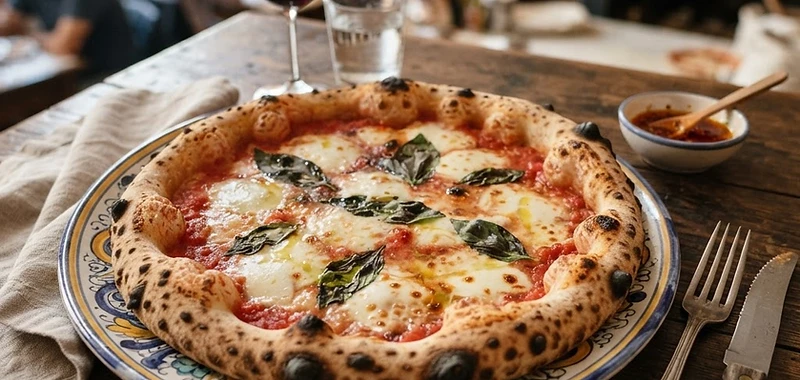
A true Pizza Napoletana is defined by its texture. It is a thin-crust pizza, but "thin" does not mean crisp. The center of the pizza is deliberately soft and moist, often requiring a knife and fork for the first few bites before it can be folded and eaten by hand. The defining feature is the cornicione, or the raised rim of the crust. When properly executed, this rim is airy, light, and marked with "leopard spotting"—small, charred blisters that indicate the dough has been subjected to high heat for a very short duration. The flavor profile is dominated by the acidity of the tomatoes and the lactic creaminess of the cheese, balanced by the toasted, slightly fermented taste of the bread.
Origin and history
The history of the dish is tied to the arrival of the tomato in Europe from the Americas and the specific economic conditions of 18th- and 19th-century Naples. Originally, pizza was street food for the city’s working class, sold by vendors who carried the product in metal containers. It was designed to be inexpensive, portable, and consumed immediately. Over time, these street-side preparations migrated into dedicated pizzerias. Today, the dish is protected by the Associazione Verace Pizza Napoletana (AVPN), an organization that sets strict standards for ingredients, preparation, and oven temperature to ensure the product remains consistent with its historical roots.
How it’s made
The production of Pizza Napoletana is a precise process. The dough consists of four fundamental ingredients: wheat flour (usually refined "00" flour), water, salt, and yeast. The dough is fermented for at least eight hours to develop its structure and flavor. When ready, the pizzaiolo stretches the ball of dough by hand, moving the air from the center into the rim to create the signature cornicione.
The toppings—San Marzano tomatoes, grown in the volcanic soil near Vesuvius, and either fior di latte (cow's milk mozzarella) or mozzarella di bufala (water buffalo mozzarella)—are applied sparingly. The pizza is then slid into a wood-fired oven that must reach temperatures between 430°C and 480°C (800°F–900°F). It cooks in 60 to 90 seconds. This brief, intense contact with the heat allows the crust to puff and char without drying out, keeping the interior soft and supple.
Where to eat it
Naples is the only place to experience the dish in its canonical form. The city contains hundreds of pizzerias, ranging from historic, century-old establishments to contemporary shops run by younger, experimental chefs. Look for the AVPN certification seal in the window or on menus; while not every excellent pizzeria is a member, the association’s guidelines provide a reliable baseline for what a Napoletana should be. Expect long queues, particularly in the city center and in the neighborhood of Spaccanapoli. Do not seek this dish in restaurants that prioritize extensive, complex menus; the best pizzerias focus almost exclusively on a limited list of traditional pies.
When and how
Pizza Napoletana is available year-round and is typically served as a dinner item, though many shops open for lunch. In Naples, it is customary to order one pizza per person. To eat it like a local, start by using a knife and fork to manage the center, then fold the pizza into a "wallet" (or a libretto) once it becomes easier to handle. Do not expect to find elaborate, heavy toppings like chicken, pineapple, or heavy cream; traditional pizzerias stick to the classics—the Margherita (tomato, mozzarella, basil, olive oil) and the Marinara (tomato, garlic, oregano, olive oil).
What to drink with it
The pairing for Pizza Napoletana is straightforward and designed not to compete with the simplicity of the dough and tomatoes. A light, local lager is the most common accompaniment in the city, providing a clean, carbonated contrast to the soft dough. For wine, a classic choice is a dry red from the nearby town of Gragnano, which is located in the hills above the Sorrento Peninsula. The wine is typically frizzante (slightly sparkling) and light-bodied, which cuts through the richness of the buffalo mozzarella and the acidity of the tomatoes effectively.
The Story
Where Pizza Napoletana comes from
Pizza Napoletana is the result of the convergence of New World tomatoes and local Neapolitan ingenuity. It was originally street food for the city’s working class, intended to be eaten quickly. It remains regulated by the AVPN to ensure it adheres to the specific, centuries-old Neapolitan standards.
What Defines It
Signature ingredients
San Marzano tomatoes
Low acidity and high sweetness are vital for the sauce.
Fior di latte
Cow's milk mozzarella that provides a balanced, creamy melt.
00 Flour
The ultra-fine grind is essential for the soft, extensible dough.
The Method
How it's made
The dough is fermented for at least 8 hours, then hand-stretched to leave an airy rim (cornicione). It is fired in a wood oven at extreme temperatures for under 90 seconds, creating a soft, tender interior with slightly charred, leopard-spotted bubbles.
Across Italy
Regional variants
Naples
Strictly adhered to by local associations to maintain the traditional texture.
Timing
When to eat it
Year-round
Serve With
Classic pairings
Gragnano
wineA local, slightly sparkling red that pairs perfectly with the char.
Lager
beerA clean, cold beer is the standard accompaniment in pizzerias.
What makes it worth going
The original pizza — soft, blistered crust, San Marzano tomato, fior di latte mozzarella, basil, cooked in 60-90 seconds in a wood-fired oven.
Things to do
- pizzeria
L'Antica Pizzeria da Michele
The legendary no-menu pizzeria (made famous by 'Eat Pray Love'). Two pizzas only: margherita and marinara. Queue at off-peak or you'll wait an hour.
45 min
- pizzeria
Pizzeria Gino Sorbillo
On the waterfront at Via dei Partenope. The largest, lightest crust in Naples. Long line at dinner; go at lunch.
45 min
- pizzeria
50 Kalo by Ciro Salvo
Modern high-hydration dough, in Chiaia. The crust is the softest and most custardy in the city. Reserve.
1 hr
- pizzeria
Pizzeria Di Matteo
In the historic center. The classic folded-street-pizza experience. The marinara here is the test.
30 min
Eat
- pizza
Margherita
The benchmark: San Marzano tomato, fior di latte, basil, olive oil. If a pizzeria gets this right, get everything.
- pizza
Marinara
Tomato, garlic, oregano, olive oil. No cheese. The test of the dough and the sauce.
- pastry
Sfogliatella
The Neapolitan finish: a crisp, ridged shell of pastry filled with ricotta and semolina. Eat it warm, from a pasticceria, not a café.
Stay
- neighborhood
Spaccanapoli / Decumani
In the historic center, walking distance to the oldest pizzerias. Loud, real, and the point of going.
- neighborhood
Chiaia
Quieter, seafront, near 50 Kalo and the modern pizzerias. More refined, less authentic.
Experiences Worth Booking
Pizza-making class in a working pizzeria
3 hrsDough, stretching, oven, and your own pizza. 2-3 hours.
You learn why a home oven can't do this — and the technique that can, with a stone.
Suits: Everyone; the dough technique is the secret.
Street food walk of Spaccanapoli
3 hrsPizza, cuoppo (fried seafood cone), sfogliatella, taralli, coffee.
The best cheap food in Naples is eaten standing; a guide knows the stands.
Suits: Eaters who want the historic center at its loudest.
What's nearby & pairs with
More food from Campania
Ready to plan?
Ready to turn discovery into a trip?
Italy Field Guide helps you decide where to go. When you're ready to build the actual day-by-day itinerary, take your saved places to Travel Itinerary Co — your interests go with you.
Turn your saved Italy places into a trip