Cheese · Campania
Provolone del Monaco
The Verdict
The best cheese on the Amalfi coast and the one food experience worth arranging around. It is firm, savory, and slightly piquant when aged, and the dairies on the peninsula still make it in small quantities for local restaurants.
Why go
Cheese made and aged on the peninsula above the Amalfi coast, where the milk comes from herds on the same slopes.
The Field Guide take
Provolone del Monaco remains the most significant cheese produced on the Sorrento peninsula. It is a firm, semi-hard pasta filata (stretched-curd) cheese that gains complexity through a minimum aging period of six months. Unlike the mild, rubbery provolone found in supermarkets, this is a distinct, savory product that reflects the specific topography and animal husbandry of the Lattari Mountains. It is the cheese to prioritize when traveling through the province of Naples.
What it is
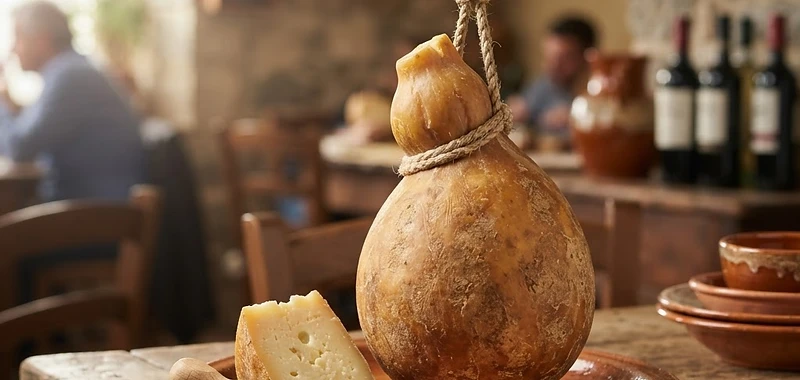
Provolone del Monaco is a cured cow’s milk cheese with a small percentage of goat or sheep milk added for depth. It is easily recognized by its gourd-like, pear shape and the characteristic impressions left by the rope used to suspend it during the aging process. The rind is thin, smooth, and yellowish, protecting an interior that ranges from ivory to a straw-colored yellow depending on the duration of the cave aging. Texture-wise, it is dense and firm; at the six-month mark, it is supple enough to slice, but it grows increasingly granular and spicy as it reaches twelve or eighteen months.
Origin and History
The history of this cheese is tied to the transit of goods from the mountain villages down to the city of Naples. Local shepherds and small-scale farmers in the Vico Equense and Sorrento hinterlands created the cheese to preserve the milk of the Agerolese cattle breed. The name derives from the early traders—often monks from the surrounding hills—who wore heavy, sack-like cloaks to protect themselves from the elements while transporting the cheese to the Naples markets by sea. The term del Monaco refers to these figures, whose traditional cloaks resembled those worn by the friars.
Production
Production begins with the acidification of raw milk, which is then curdled. The curd is stretched in hot water or whey, a process that gives the cheese its elastic structure. The cheesemaker then shapes the warm mass into a rounded, pear-like form by hand. Once shaped, the cheese is bathed in brine to provide flavor and preserve the exterior. Finally, the ropes are secured, and the cheeses are hung in specialized aging rooms. The humidity and temperature of the Sorrento peninsula’s hill country are essential to the development of the cheese’s aroma, which often includes notes of dried hay and toasted nuts.
Where to find it
To consume Provolone del Monaco in its proper context, head to the towns of Vico Equense, Meta, or Agerola. These villages act as the primary distribution points for the local dairies. While high-end food shops in Sorrento carry it, the quality is highest when sourced from the producers located on the upper slopes of the peninsula. Look for retail shops that sell the cheese in vacuum-sealed wedges; check the label for the DOP designation, which guarantees that the milk originated from herds grazing on the Lattari slopes.
When and how to eat it
Late summer and autumn are the optimal times to seek out the cheese, as the grazing herds are feeding on the dry, mountain grasses that produce richer, more flavorful milk. Provolone del Monaco is rarely used for cooking in the traditional sense; it is a table cheese intended for raw consumption. Slice it thinly or break off shards to serve alongside a rustic pane cafone—the thick-crusted, sourdough-style bread common to the region. If the cheese is aged more than a year, it can be shaved over a plate of pasta, though this is secondary to eating it as an antipasto.
What to drink with it
Because the cheese carries a sharp, salty, and slightly piquant profile, it requires a wine with sufficient acidity and body to provide contrast. A white Falanghina from the Campania region is the standard pairing. The citrus notes and mineral character of a well-made Falanghina cut through the fat content of the milk, refreshing the palate between bites. Avoid heavy, tannic reds, which clash with the cheese’s salinity. If preferring a red, look for a young, light-bodied Piedirosso, which will complement rather than overwhelm the flavor. Always serve the cheese at room temperature; chilling it masks the nuanced, earthy aromatics that define its quality.
The Story
Where Provolone del Monaco comes from
The name comes from the monks who wore heavy cloaks and carried the cheese down from the peninsula to Naples. Production is concentrated in the villages above Sorrento and Vico Equense.
The Method
How it's made
Cow's milk with a little sheep's or goat's milk is curdled, stretched in hot whey, and shaped into a gourd form with a rope around it. It is brined and then hung to age for at least six months.
Timing
When to eat it
Best in late summer and autumn, when the herds are on the dry slopes.
Serve With
Classic pairings
Falanghina
winePane cafone
breadWhat makes it worth going
A stretched-curd cheese aged for months on the Sorrento peninsula, named for the monks who once traded it down the hill.
What's nearby & pairs with
More food from Campania
Dish
Pizza Napoletana
The original pizza — soft, blistered crust, San Marzano tomato, fior di latte mozzarella, basil, cooked in 60-90 seconds in a wood-fired oven.
Dish
Spaghetti alle Vongole
Spaghetti with clams, garlic, white wine, and parsley — the cleanest seafood pasta in Italy.
Cheese
Mozzarella di Bufala Campana
Mozzarella from water buffalo milk — softer, richer, and more lactic than cow's-milk mozzarella. DOP.
Ready to plan?
Ready to turn discovery into a trip?
Italy Field Guide helps you decide where to go. When you're ready to build the actual day-by-day itinerary, take your saved places to Travel Itinerary Co — your interests go with you.
Turn your saved Italy places into a trip