Cheese · Basilicata
Canestrato di Moliterno
The Verdict
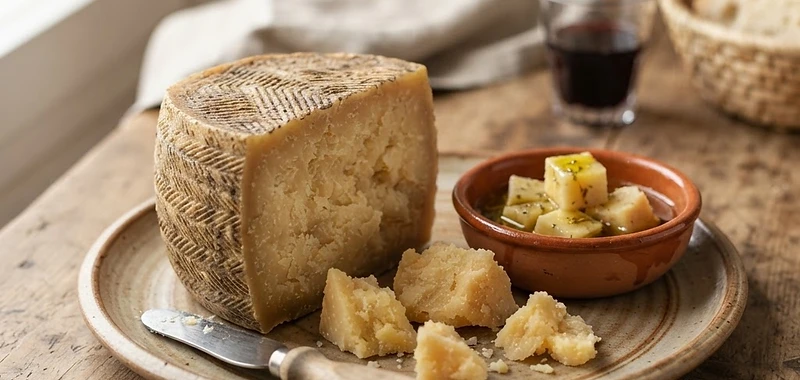
Canestrato is the best cheese in Basilicata and the reason to stop in Moliterno, a town that has aged cheese in its cellars for centuries. It is sharp and crumbly when old, mild and springy when young, and the basket pattern on the rind is genuine rather than decorative.
Why go
A hill town whose economy is still cheese, with cellars under the houses and a festival in spring.
The Field Guide take
Moliterno, a town perched in the mountains of the Val d'Agri, functions as a living maturation chamber for one of Southern Italy’s most distinct products. Canestrato di Moliterno is not merely a regional commodity; it is a specific outcome of the town’s subterranean architecture and the tradition of transhumance in Basilicata. Travelers seeking this cheese should prioritize a dedicated detour into the Potenza province, as the product is inextricably linked to the climate of these specific hills.
The character of the cheese
Canestrato is defined by the vessel that shapes it. The name derives from canestro, the traditional reed basket into which the fresh curds are pressed. This process leaves a distinct geometric pattern on the rind, which remains visible throughout the aging process. The cheese is a blend of ewe’s and goat’s milk, resulting in a firm, straw-colored paste. When young—aged for perhaps three or four months—the texture remains pliable and the flavor carries a grassy, lactic sweetness. As the cheese matures toward the one-year mark, it becomes brittle, sharp, and intensely savory. Some wheels are treated with olive oil during aging, which softens the rind and adds a slight fruitiness to the profile of the final paste.
Historical context
The production of Canestrato di Moliterno is rooted in centuries of shepherding practices, but the formalization of the industry occurred in the 1950s. At that time, a local cooperative established standardized methods for managing the maturation process. Historically, and still today, the quality of the cheese depends on the rùgghi, the cellars located beneath the private homes of Moliterno. These limestone chambers provide a consistent temperature and humidity level that defines the cheese’s evolution. While large-scale distribution exists, the practice of families aging individual forms in their own basements remains a standard part of the town's domestic life.
The production cycle
Cheesemakers typically begin the process using milk sourced from sheep and goats that graze on the high-altitude pastures of the Val d'Agri. The milk is curdled, hand-pressed into the reed baskets, and salted by hand. The defining stage is the transfer to the rùgghi. Because these cellars are integrated into the foundations of the town, they possess a unique microflora that influences the development of the rind and the concentration of the interior flavors. The cheese is turned and cleaned throughout its residency in the cellar. In some instances, producers apply a coating of olive oil to protect the rind from drying out excessively during the long winter or summer months.
Locating and consuming the product
Moliterno is the only place to experience the full spectrum of Canestrato. Visitors should visit local affineurs, where the age of the cheese can be sampled side-by-side. Expect to find wheels at various stages of maturity; request a tasting of a "primus" (young) versus a "stagionato" (aged) wheel to understand the transformation of the fats and proteins. The town hosts a dedicated festival each April, which marks the arrival of the spring milk. Outside of the festival, the cheese is sold in the town's small alimentari and directly from the producers’ storefronts. Note that hours for these establishments change seasonally; confirm before visiting.
Serving and pairing
Canestrato di Moliterno is best served at room temperature to allow the fats to soften and release their aroma. Avoid serving it cold, as the complexity of the ewe’s milk is suppressed. For a classic pairing, serve it with Pane di Matera, the dense, crusty sourdough bread from the neighboring province. The acidity of the cheese requires a robust partner in the glass. Aglianico del Vulture, a deep, tannic red wine from the volcanic slopes of northern Basilicata, balances the saltiness of the aged wheels. A drizzle of chestnut honey or a spoonful of bitter fig preserves can also provide a necessary contrast to the sharper, older forms of the cheese.
Travel logistics
Moliterno sits deep in the Val d'Agri, approximately an hour's drive west of the main tourist routes leading to Matera. It is not a stopover on a quick transit between regions, but a destination for those interested in the specific agricultural output of Basilicata. The town is elevated, and the cellars are often located on steep, winding streets. Wear comfortable footwear and prepare for cool temperatures, even in the summer, when descending into the aging cellars. If you are traveling through the region primarily to visit the Sassi of Matera, ensure you allocate a separate day for the trip to Moliterno, as the geography makes a quick visit difficult.
The Story
Where Canestrato di Moliterno comes from
The town's cheesemaking goes back centuries and was formalized in the 1950s by a cooperative that still ages the cheese in the same cellars. Families keep forms in their own basements.
The Method
How it's made
Ewe's milk with some goat is curdled, pressed into woven reed baskets that leave the rind patterned, salted, and aged for months in cool cellars. Some forms are preserved under oil.
Timing
When to eat it
Spring milk is the best; the festival is in April.
Serve With
Classic pairings
Aglianico del Vulture DOC
winePane di Matera
breadWhat makes it worth going
A sheep and goat cheese pressed into reed baskets and aged in the old houses of a hill town above the Val d'Agri.
What's nearby & pairs with
More food from Basilicata
Cheese
Caciocavallo Podolico
Cheese made from the milk of a rare long-horned breed that grazes wild in the southern Apennines.
Dish
Lagane e Ceci
Wide pasta ribbons with chickpeas, garlic, and rosemary — Lucania's ancient peasant dish.
Cheese
Caciocavallo
Stretched-curd cow's milk cheese, hung in pairs over a beam — southern Italy's great table cheese.
Ready to plan?
Ready to turn discovery into a trip?
Italy Field Guide helps you decide where to go. When you're ready to build the actual day-by-day itinerary, take your saved places to Travel Itinerary Co — your interests go with you.
Turn your saved Italy places into a trip