Cheese · Basilicata
Caciocavallo Podolico
The Verdict
Podolico is the most unusual cheese in southern Italy: made from the milk of a breed that lives outdoors year-round, it tastes of the herbs and scrub the animals eat. Production is small and the cheese is expensive for a reason.
Why go
Wild-grazed cattle country in the Lucanian Apennines, with dairies selling directly and almost no visitors.
The Field Guide take
Caciocavallo Podolico is the most unusual cheese in southern Italy. It is produced from the milk of a rare, long-horned breed that lives outdoors in the southern Apennines year-round. Because these cattle graze on wild herbs and mountain scrub, the cheese carries a distinct flavor profile reflective of the landscape. Production is small and the cost is high, but it remains a singular example of traditional pastoralism. If you are traveling through the interior of Basilicata, specifically the province of Potenza, seek this out at the source. If you are not driving through the remote mountain roads of the Lucanian Apennines, you are unlikely to find genuine, aged Podolico.
What it is
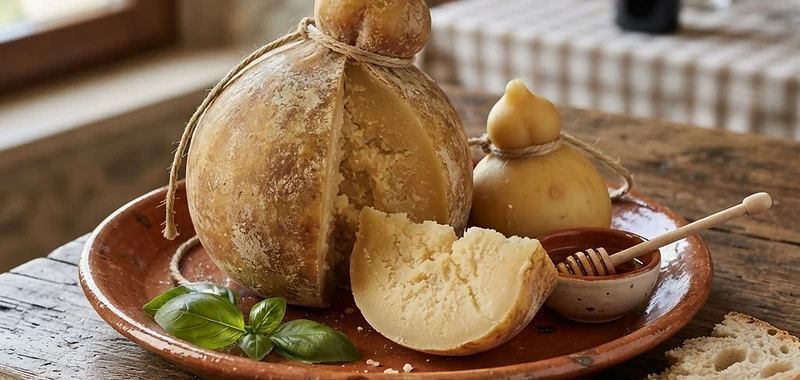
Caciocavallo Podolico is a firm, stretched-curd cheese. It is named for the podolica breed of cattle, which are hardy, long-horned animals that thrive on forage that would starve more common dairy breeds. The cheese is dense and straw-colored, with a rind that hardens and darkens significantly as it ages. Younger wheels are mild and buttery, while those aged for 18 to 24 months develop a sharp, complex salinity and an aroma reminiscent of dry hay and wild fennel. It is a slow-food product by necessity; the cows produce very little milk, and the cheese requires months of patient maturation.
Origin and history
The Podolica breed traces its presence in Italy to the movement of northern tribes, specifically the Goths, who brought the cattle into the peninsula centuries ago. The breed adapted to the rugged conditions of the southern Apennines, where herds move between different altitudes throughout the year. This cheese is a byproduct of that seasonal migration rather than an industrial enterprise. It is a survival strategy for farmers in high-altitude Basilicata, allowing them to preserve milk produced in difficult terrain. The history of the cheese is synonymous with the history of transhumance in the region.
The production process
The process begins with the raw milk of the Podolica cow. Because the cattle graze on wild, diverse vegetation, the milk composition changes by season. The cheesemaker adds calf rennet to the raw milk, which is then curdled and heated. Once the curd reaches the correct consistency, it is stretched by hand—a physical process that creates the characteristic fibrous, layered texture. The cheese is then molded into a gourd-like shape, complete with a small "head" or knob at the top. The forms are tied in pairs with twine and hung over wooden beams in ventilated rooms to age. They remain there for a minimum of six months, though superior wheels are kept for up to two years.
Where to find it
The production of authentic Caciocavallo Podolico is confined to the remote dairies of the Potenza province. You will not find this in standard supermarkets or large-scale retail shops. Locate the small agricultural estates and caseifici (dairies) in the higher elevations of the Lucanian Apennines. These producers often sell directly from the farm. Because these locations are inaccessible by public transport, you must have a vehicle to reach them. Call ahead to confirm that the dairies are open, as seasonal farming duties often dictate their availability.
When and how to eat it
The best milk for Podolico comes in late spring, when the mountain pastures are at their most lush and diverse. However, because the cheese is aged, you can purchase and consume it throughout the year. When serving, cut the cheese into thick wedges. Do not serve it chilled; let it reach room temperature for at least 30 minutes before eating to allow the fats to soften and the aromatics to release. If the rind is thick, it is best removed, though the cheese immediately beneath it is often the most concentrated in flavor.
Wine and food pairings
To balance the sharp, pungent saltiness of an aged Podolico, look for a wine with sufficient structure and body. Aglianico del Vulture, produced in the volcanic soils of northern Basilicata, is the classic regional match. Its high tannins and dark fruit notes cut through the richness of the cheese. For a snack, pair the cheese with Soppressata di Calabria or similar dry-cured sausages from the region. The combination of the herbal, sharp cheese and the fatty, spiced meat provides the most accurate sense of the Lucanian palate.
The Story
Where Caciocavallo Podolico comes from
The Podolica breed was brought by the Goths and adapted to the Apennines, living outdoors in herds that move with the seasons. The cheese is a byproduct of that way of farming rather than an industrial product.
The Method
How it's made
Milk from animals on wild pasture is curdled with calf rennet, stretched, and shaped into the gourd form. Forms are tied in pairs and hung to age for six months to two years.
Timing
When to eat it
Best made in late spring when the pasture is richest.
Serve With
Classic pairings
Aglianico del Vulture DOC
wineSoppressata di Calabria
cured meatWhat makes it worth going
Cheese made from the milk of a rare long-horned breed that grazes wild in the southern Apennines.
What's nearby & pairs with
More food from Basilicata
Cheese
Canestrato di Moliterno
A sheep and goat cheese pressed into reed baskets and aged in the old houses of a hill town above the Val d'Agri.
Dish
Lagane e Ceci
Wide pasta ribbons with chickpeas, garlic, and rosemary — Lucania's ancient peasant dish.
Cheese
Caciocavallo
Stretched-curd cow's milk cheese, hung in pairs over a beam — southern Italy's great table cheese.
Ready to plan?
Ready to turn discovery into a trip?
Italy Field Guide helps you decide where to go. When you're ready to build the actual day-by-day itinerary, take your saved places to Travel Itinerary Co — your interests go with you.
Turn your saved Italy places into a trip