
The Verdict
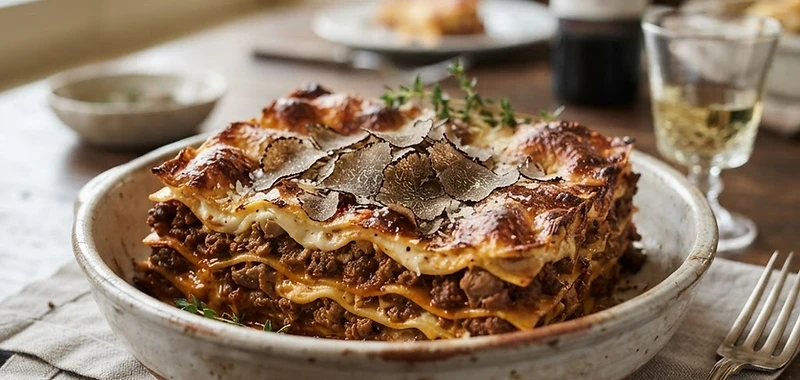
The baked pasta of Marche, and the lasagna you've never heard of. Layers of fresh egg pasta, béchamel, and a ragù of beef, pork, and chicken giblets (livers and gizzards), sometimes with a shave of truffle, baked until golden. Richer and more old-fashioned than Bolognese lasagna; the giblets are the Marche touch. A festive, Sunday, or wedding dish, and a genuine alternative to the lasagna everyone knows.
Why go
To taste Marche's richer, more old-fashioned lasagna — with chicken giblets and truffle.
The Field Guide take
Vincisgrassi is the definitive baked pasta of the Marche region. While it shares the structural logic of a standard lasagna—layers of egg pasta, ragù, and béchamel—it is a distinct culinary entity. Where Bolognese lasagna is defined by its uniformity and reliance on ground meat and tomato, Vincisgrassi is a product of Marche’s rural resourcefulness, characterized by the inclusion of chicken giblets and a depth of flavor that feels noticeably more old-fashioned and rustic.
The Architecture of the Dish
Vincisgrassi is a baked dish comprised of fresh egg pasta sheets layered with a complex, slow-cooked ragù and a rich béchamel sauce. The defining feature is the ragù, which must include chicken giblets—typically livers and gizzards. These are finely chopped to ensure they melt into the sauce rather than standing out as distinct pieces. The pasta itself is usually rolled slightly thicker than that used for other regional lasagnas, providing the necessary structural integrity to hold the heavy, dense ragù. A well-executed version relies on the careful reduction of the sauce; the goal is a cohesive, harmonious strata where the béchamel binds the meat and pasta into a unified whole, topped with a crisp, dark-golden crust.
Etymology and Origins
The origins of the name are widely attributed to the Austrian General Alfred von Windisch-Graetz, who was stationed in Ancona during the siege of 1799. Local tradition suggests that the dish was created by local cooks to honor the general, with the name "Vincisgrassi" emerging as an Italianized phonetic adaptation of his surname. Whether the story is historical fact or regional folklore, the name has stuck. Regardless of the specific military connection, the dish is rooted in the farmhouse traditions of the Marche. It historically functioned as an aristocratic influence applied to peasant-style proteins, serving as a centerpiece for weddings, religious feast days, and significant family gatherings.
Regional Variations
The composition of Vincisgrassi is not static; it shifts significantly across the provinces of Marche. In Macerata, the ragù often incorporates warm spices like cloves and cinnamon, a lingering influence of the historical spice trade. Moving south to Fermo, one may encounter versions that omit the chicken giblets entirely, opting for a concentrated reduction of beef and pork for a milder profile. Conversely, in the mountain town of Fabriano, cooks may add locally produced Salame di Fabriano to the ragù, which introduces a distinct smoky, cured character that separates it from the coastal versions found around Ancona. In some iterations, particularly those associated with festive occasions, a shave of black truffle is added to underscore the earthy, savory notes of the giblets.
Where and When to Seek It
Vincisgrassi is a labor-intensive dish, rarely encountered as a casual weeknight offering. It is an occasional, seasonal food—predominantly found on Sunday lunch menus or during winter months when the kitchen demands long-burning fires and slow, steady heat. Travelers looking to experience the dish should target trattorias in the Ancona province or the interior hills of Macerata. If a menu describes it simply as "lasagna," look for the inclusion of rigaglie (giblets) in the description to confirm it is the genuine regional article rather than a generic substitute.
Drinking with Vincisgrassi
The weight and intensity of the dish require a wine with structural acidity and, ideally, a bit of earthiness. A Rosso Conero, made from the Montepulciano grape grown on the slopes near the Adriatic coast, provides the necessary tannin to cut through the richness of the béchamel and offal. If a white wine is preferred, look for a Verdicchio di Matelica Riserva. The aging process of the Riserva provides enough body to stand up to the complex ragù, while the characteristic acidity of the Verdicchio cleanses the palate between bites. When accompanying the dish at home or in a rural setting, simple side dishes such as roasted wild mushrooms help bridge the gap between the savory sauce and the wine.
The Story
Where Vincisgrassi comes from
Vincisgrassi originated in the Marche region, specifically centered around the province of Ancona. Its name is widely attributed by local tradition to the Austrian General Alfred von Windisch-Graetz, who commanded troops in Ancona during the siege of 1799. As the legend goes, the local cooks created a refined version of lasagna to honor the general, with the name eventually evolving from his surname into the Italianized 'Vincisgrassi'. While the etymology is largely accepted in the region, the dish itself draws from a long history of Marche's rural culinary traditions, utilizing ingredients common to the region's farmhouse kitchens. It was historically a celebratory dish, prepared for weddings, religious feast days, and significant family gatherings, serving as a display of resourcefulness and hospitality in the face of local scarcity. Unlike many other regional pasta dishes that rely on simple tomato-based sauces, Vincisgrassi represents a more complex, aristocratic influence applied to peasant-style proteins, particularly the use of offal.
What Defines It
Signature ingredients
Chicken Giblets
Includes livers, hearts, and gizzards. These provide the characteristic earthy depth and distinct metallic richness that separates this ragù from standard beef sauces.
Fresh Egg Pasta
Specifically, thin sheets made with high-quality flour and a high ratio of yolks to create a firm, resilient texture that can hold up to the dense sauce during baking.
Pork and Beef
A mixture of ground beef and fatty pork shoulder or pancetta is essential to balance the texture and provide a savory foundation for the offal.
Béchamel (Besciamella)
A thick, velvety white sauce that, when layered with the ragù, creates a luxurious, creamy binding that defines the dish's structure.
Black Truffle
Though optional depending on the household, local truffles provide a deep, aromatic earthiness that cuts through the intense fat of the poultry organs.
The Method
How it's made
A superior Vincisgrassi requires a meticulous approach to the ragù, which must be cooked slowly over several hours to allow the flavors of the chopped giblets, pork, and beef to meld completely. A careless version often chops the giblets too large or utilizes commercial-grade, thin béchamel that makes the pasta soggy. The authentic method involves layering the pasta sheets—which are slightly thicker than those used in standard lasagna—alternating with the ragù and béchamel. A professional touch involves ensuring the pasta sheets are blanched and shocked before assembly to ensure they reach the perfect 'al dente' state once baked. Finally, it is baked until the edges are crispy and the top develops a deep, golden-brown crust, a hallmark of a properly finished dish.
Across Italy
Regional variants
Macerata
The dish is often prepared with a slightly more prominent use of cloves and cinnamon in the ragù, reflecting historical spice trade influences.
Fermo
Versions here occasionally omit the giblets, focusing instead on a more intense reduction of pork and beef, resulting in a lighter flavor profile.
Fabriano
Local variations may feature the inclusion of Salame di Fabriano in the ragù, adding a smoky, cured depth that is distinct to that mountainous area.
Timing
When to eat it
Vincisgrassi is primarily a winter or festive dish, served for Sunday lunches or formal events. It is rarely consumed as a casual weeknight meal due to the labor-intensive nature of the preparation.
Serve With
Classic pairings
Rosso Conero
wineA bold, structured red wine made from the Montepulciano grape, produced in the coastal hills near Ancona; it has the tannins necessary to stand up to the rich giblets.
Verdicchio di Matelica Riserva
wineWhile red is traditional, an aged, full-bodied white wine with good acidity can cut through the heavy creaminess of the béchamel.
Roasted Wild Mushrooms
other foodServing a simple side of forest mushrooms complements the earthy notes found in both the giblets and the truffle garnish.
What makes it worth going
Marche's baked pasta — richer than lasagna, with chicken giblets and truffle, from Ancona.
Things to do
- trattoria
A trattoria in Macerata
The home of the vincisgrassi, in the Marche city. The lasagna, the offal, the béchamel. Reserve; the trattorias are small.
2 hrs
- trattoria
A Marche trattoria in Ancona
The other Marche city, with a version of the vincisgrassi. The offal is the test; the béchamel is the layer.
2 hrs
- festival
A Sagra del Vincisgrassi
The village festivals in summer, where the vincisgrassi are baked in the square. The layering is the show.
full day
- experience
A vincisgrassi-making class
The vincisgrassi are the Marche lasagna, with offal (or sweetbreads) in the ragù. The technique is the layer.
Eat
- pasta
Vincisgrassi
The classic: a Marche baked pasta, like lasagna, but with a richer ragù (chicken livers, giblets, or sweetbreads, plus beef and pork) and a béchamel. The offal is the depth; the béchamel is the layer.
- wine
With a glass of Verdicchio
The Marche white; the correct pairing for the rich ragù and the béchamel.
Stay
- town
Macerata center
At the source, in the Marche hills. Walkable; a car is useful from Ancona.
- city
Ancona or the Conero
The coastal base, with good trattorias and a beautiful setting. A car is required.
Experiences Worth Booking
Vincisgrassi-making class
3 hrsThe pasta, the offal ragù, the béchamel, the layering. The offal is the secret.
The vincisgrassi is a richer lasagna; a class shows you the offal, the béchamel, and the layer.
Suits: Home cooks who want the Marche lasagna; the offal is the depth.
Marche food day
full dayA vincisgrassi lunch, a brodetto dinner, a Verdicchio cellar. The full Marche arc.
The vincisgrassi, the brodetto, and the Verdicchio are the Marche trinity; a day covers all.
Suits: Food and wine travelers with a day for the Marche.
What's nearby & pairs with
More food from Marche
Ready to plan?
Ready to turn discovery into a trip?
Italy Field Guide helps you decide where to go. When you're ready to build the actual day-by-day itinerary, take your saved places to Travel Itinerary Co — your interests go with you.
Turn your saved Italy places into a trip