The Verdict
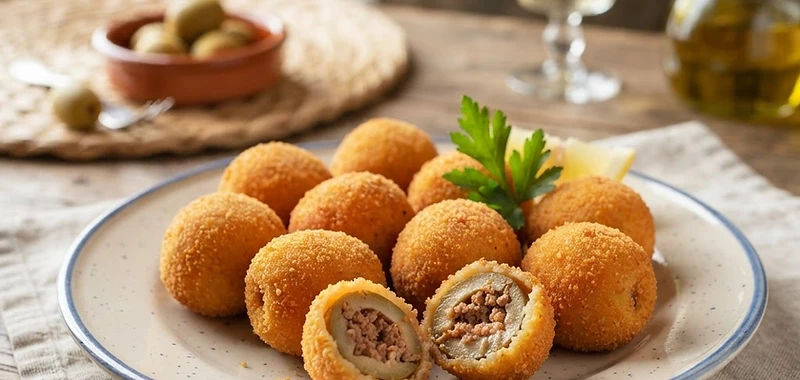
The fried snack of Ascoli Piceno, and the best fried olive in Italy. Large, green Ascolana olives, pitted, stuffed with a mix of beef, pork, and Parmigiano, breaded, and fried. Crisp outside, olive-salty, meat-rich inside. Eaten as a fritto misto, with a glass of Verdicchio, in a bar in Ascoli. Three or four is a meal; one is impossible.
Why go
To eat the stuffed, fried olive — Marche's most addictive snack, in Ascoli Piceno.
The Field Guide take
In the city of Ascoli Piceno, in the southern reaches of the Marche region, the oliva ascolana is more than a snack; it is a point of local identity. These large, green olives, meticulously pitted and stuffed with a rich meat mixture before being breaded and fried, serve as the definitive culinary marker of the city. While fried snacks are common throughout Italy, the Ascolana olive maintains a specific, rigorous standard of preparation that sets it apart from the heavy, uniform fritters found elsewhere.
What it is
The oliva ascolana is a singular item: a plump, green Tenera Ascolana olive, which is prized for its size and tender flesh. It is pitted in a continuous, spiral motion—a technique that leaves the fruit whole—and filled with a savory mixture of beef, pork, and sometimes chicken or turkey. This filling is seasoned with Parmigiano Reggiano, nutmeg, and aromatic vegetables, then bound with egg, breaded, and deep-fried. The result is a contrast between a rigid, crisp breadcrumb exterior and a warm, salty, and savory interior. In Ascoli, a serving is rarely just one; they are typically sold in paper cones or platters as part of a fritto misto.
Origin and history
The history of the dish is rooted in the 19th century, when wealthy families in Ascoli Piceno tasked their private chefs with utilizing the abundance of high-quality local olives. Culinary historians note that the dish emerged from a need to make use of roasted meats and slow-cooked stews. By combining these leftovers with the olives, the chefs created a dish that was simultaneously resourceful and indulgent. While the precise origins—and the question of which family’s chef developed the original recipe—remain subjects of local debate, the dish successfully migrated from the tables of the aristocracy to the city’s public squares and taverns, where it became the standard food for festivals and holidays.
How it's made
The labor required to produce an authentic oliva ascolana is significant. The olives must be peeled in a continuous spiral, which requires a steady hand and specific experience. The filling begins with a soffritto of onion, carrot, and celery, in which the meats are sautéed before being ground finely. The meat is then combined with Parmigiano, eggs, and spices. Once stuffed, the olive is reshaped, rolled in flour, dipped in egg wash, and coated in fine breadcrumbs.
Quality control is centered on the fry. A superior ascolana is fried in a high-smoke-point oil—typically peanut or sunflower—at a temperature high enough to form a glass-like shell instantly. If the oil is not hot enough, the olive flesh becomes soft and the breading turns oily. Industrial or careless versions often use canned olives or pre-ground meat, which results in a dense, mushy texture. Authentic shops in Ascoli avoid this, ensuring the meat maintains a distinct, pleasant bite.
Where to eat it
The dish is found throughout the Marche region, but it is most reliably produced in the province of Ascoli Piceno. In the city of Ascoli itself, you will find them in traditional friggitorie (fry shops) and bars, often served as part of a fritto misto all’ascolana. This larger platter often includes fried zucchini flowers, artichoke hearts, or sweet cream cubes, which balance the saltiness of the olives. While they are available year-round, they are ubiquitous during public holidays, local festivals, and Sunday gatherings. Travelers should avoid establishments that rely on mass-produced, frozen variants, which lack the essential textural contrast of the fresh product.
When and how
Eat them hot. The oliva ascolana is designed to be consumed shortly after leaving the fryer, while the coating is at peak crispness. They are frequently eaten as a stand-alone snack in a bar or as the starting point for a lunch or dinner. Three or four olives are sufficient as an appetizer; a larger portion serves as a substantial snack. They are rarely eaten with cutlery; they are finger food, meant to be held by the end of the olive.
What to drink with it
Because the filling is rich and the preparation involves deep frying, the dish requires a wine with high acidity to cut through the fat. A crisp, mineral-forward Verdicchio dei Castelli di Jesi is the local standard, providing the necessary sharpness to cleanse the palate. Alternatively, an Offida Pecorino, which offers structure and saline notes, works well with the inherent saltiness of the olive. Avoid heavy, tannic red wines, which clash with the intensity of the fried coating and the meat filling.
The Story
Where Olive Ascolane comes from
Olive Ascolane originate from the city of Ascoli Piceno in the Marche region. Their history is often traced back to the 19th century, when local wealthy families commissioned their personal chefs to create elaborate dishes using the local Tenera Ascolana olives. These olives, characterized by their large size and delicate, tender flesh, were stuffed with a rich filling of various meats, reflecting the prosperity of the area's culinary tradition at the time. Over time, the recipe migrated from aristocratic kitchens to the tables of ordinary citizens, becoming the quintessential festive food of the city. While the exact origins are debated by local culinary historians, it is widely accepted that they evolved as a way to utilize leftover roasted meats and slow-cooked stews, making them a resourceful yet luxurious snack. They have since become the defining culinary symbol of Ascoli Piceno, served at weddings, saint's days, and as a staple in the city's lively bar scene.
What Defines It
Signature ingredients
Tenera Ascolana olives
These D.O.P. status olives provide the necessary size for stuffing and a distinct, meaty texture that balances the savory filling.
Mixed ground meats
A traditional trifecta of beef, pork, and chicken ensures a depth of flavor and texture that single-meat fillings lack.
Parmigiano Reggiano
Aged cheese provides the essential saltiness and umami required to bind the meat mixture together.
Nutmeg
This aromatic spice is a non-negotiable addition, cutting through the richness of the fried exterior and the fatty meats.
Fine breadcrumbs
The coating must be thin and crisp; coarse crumbs often lead to an uneven, overly greasy finish.
The Method
How it's made
The preparation is labor-intensive, requiring the olives to be pitted in a continuous, spiral motion without breaking the fruit's skin. The meat is lightly sautéed with onion, carrot, and celery, then finely ground and mixed with eggs, Parmigiano, and spices. After the olive is stuffed and reshaped, it is passed through flour, egg wash, and breadcrumbs. A superior version is defined by the quality of the frying oil—usually high-smoke-point peanut or sunflower oil—which must be hot enough to create an immediate, glass-like crunch without the olive flesh becoming soft or oily inside. Careless versions use canned olives or pre-ground meat, resulting in a mushy, uniform interior that lacks the complexity of textures essential to the dish.
Across Italy
Regional variants
Ascoli Piceno
The authentic standard, adhering strictly to the use of local Tenera Ascolana olives and a specific ratio of three meats.
Coastal Marche
Variations often appear in broader fritto misto all'ascolana, which may include fried zucchini flowers, artichokes, or creams alongside the olives.
Timing
When to eat it
While available year-round in specialty shops and restaurants in Ascoli, they are most prevalent during public holidays, village festivals, and Sunday family gatherings.
Serve With
Classic pairings
Offida Pecorino
wineA crisp, structured white wine from the same province that matches the salinity and oiliness of the snack.
Verdicchio dei Castelli di Jesi
wineThe high acidity of this wine cuts through the fried crust, effectively cleansing the palate between bites.
Fritto Misto all'Ascolana
foodServing the olives alongside fried cremini mushrooms and sweet cream cubes is the traditional way to present them as a full appetizer.
What makes it worth going
Stuffed, breaded, and fried green olives — Marche's most addictive snack.
Things to do
- friteria
An Ascoli Piceno friteria (e.g. Caffè Meletti)
The home of the olive all'ascolana, in the Marche town. The olive, the meat stuffing, the fry. The Art Nouveau café is the setting.
1.5 hrs
- street food
A Marche street food stand
The olive ascolane are the street food of Ascoli; the friteria is the vendor. The fry is the test; the stuffing is the luxury.
20 min
- producer
An Ascoli olive grower
The olives are the Ascolana tenera, the tender green olive of Ascoli; the grower is the source. Visit a grove; the olive is the base.
1.5 hrs
- festival
A Sagra dell'Oliva Ascolana (Ascoli, August)
The town's festival, with the olives in the square. The fry is the show; the stuffing is the smell.
full day
Eat
- street food
Olive all'ascolana
The classic: large green Ascolana tenera olives, pitted and stuffed with meat (beef, pork, or chicken), breaded and fried. The olive is the crisp; the meat is the surprise.
- pairing
With a Cremini or a vitello tonnato
The Marche combo: the olive ascolane with the Cremini (the fried cheese) or the vitello tonnato, as an antipasto.
- wine
A glass of Pecorino or Passerina
The Marche white; the correct pairing for the fried olive and the meat.
Stay
- town
Ascoli Piceno center
At the source, in the Marche town. Walkable; the friterias are in the center.
- coastal town
San Benedetto del Tronto
The nearby coast, with good restaurants and a beach. A car is useful.
Experiences Worth Booking
Olive ascolane-making class
2 hrsThe pitting, the meat stuffing, the breading, the fry. The olive is the technique.
The olive ascolane are stuffed and fried; a class shows you the pit, the meat, and the breading.
Suits: Fried-food lovers who want the Marche classic; the stuffing is the secret.
Ascoli food day
full dayAn olive ascolana tasting, a Cremini, a Pecorino cellar. The full Ascoli arc.
The olive, the Cremini, and the Pecorino are the Ascoli trinity; a day covers all.
Suits: Food travelers with a day for southern Marche.
What's nearby & pairs with
More food from Marche
Ready to plan?
Ready to turn discovery into a trip?
Italy Field Guide helps you decide where to go. When you're ready to build the actual day-by-day itinerary, take your saved places to Travel Itinerary Co — your interests go with you.
Turn your saved Italy places into a trip