The Verdict
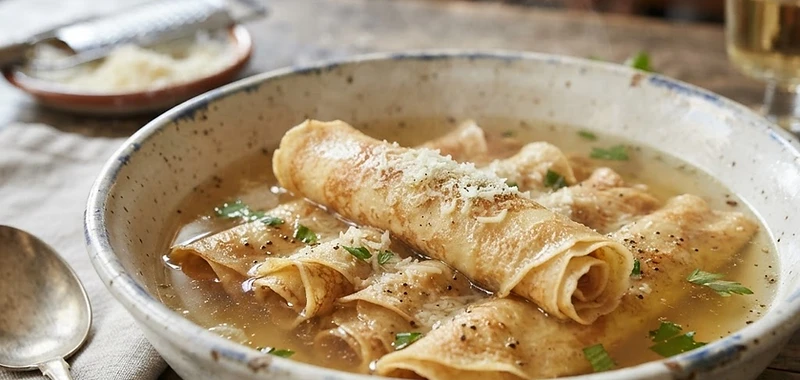
The Teramo version of 'pasta in broth' — but made of crepes. Thin crepes (scrippelle), rolled with grated cheese, dropped into a clear capon broth. The Teramo story says they were invented by a cook who forgot to put pasta in the broth and improvised with crepes. The result is silkier and more delicate than tortellini; the broth does the work. Eaten in winter, in Teramo, with a glass of Trebbiano.
Why go
To taste Abruzzo's crepe-in-broth — silkier than tortellini, and an accident.
The Field Guide take
Scrippelle 'n busso is the defining first course of the Teramo province in Abruzzo. While crepes are often associated with the culinary traditions of France, the scrippella is a foundational element of local identity, likely born from the historical cultural exchange between Southern Italy and French influence during the Bourbon era. The dish is a study in texture and restraint: thin, egg-based pancakes are dusted with pecorino, rolled into cylinders, and submerged in a clear, hot broth. It functions as the regional alternative to the stuffed pastas of the north, offering a delicate, silky experience that relies entirely on the quality of the base components.
What it is
In the Teramo dialect, 'n busso roughly translates to "in a splash" or "in a container," referring to the method of serving the crepes immersed in liquid. The dish consists of a very thin, unleavened pancake—the scrippella—that is dusted with grated Pecorino d'Abruzzo, rolled tightly, and placed in a bowl. A boiling, clarified capon broth is poured over the rolls immediately before serving. It is a light, restorative course, distinct from the heavier, sauce-laden pasta dishes found elsewhere in the region.
Origin and history
The history of the dish is frequently linked to local folklore, specifically the story of a cook named Enrico Castorani. According to tradition, Castorani allegedly ran out of traditional pasta for a formal meal and improvised by using thin, egg-based pancakes as a substitute. Whether this specific anecdote is fact or regional myth, the dish effectively supplanted stuffed pasta in the Teramo diet, becoming a ceremonial centerpiece for religious feasts and family gatherings. Its longevity in the province is a testament to the region’s ability to create a sophisticated, consistent culinary staple from humble, readily available ingredients.
How it’s made
The preparation of scrippelle begins with a simple batter of flour, eggs, and water. This is cooked on a flat, hot surface until the pancakes are thin enough to be nearly translucent yet sturdy enough to hold their shape when handled. The quality of the final dish is determined by two factors: the temperature of the broth and the texture of the crepe. A well-made version arrives with the scrippelle still retaining a slight bite; a poorly executed version results in a soggy, broken pancake floating in a cloudy, greasy liquid. A clear, well-skimmed capon broth is the standard for the canonical "in busso" preparation.
Variants and usage
While the term 'n busso refers strictly to the version served in broth, the scrippella is a versatile foundation in Abruzzese cooking. In scrippelle imbussiate, the crepes are baked, often layered with meat sauce or bechamel. Furthermore, the timballo di scrippelle replaces standard pasta sheets with these crepes, creating a much more complex, heavy, and festive dish. These baked variations are common, but they move the scrippella away from its primary role as a delicate "in-broth" course.
When and how to eat it
Scrippelle 'n busso is a seasonal dish, traditionally consumed in the cooler months. It is particularly associated with the Christmas season and other winter feast days. It is rarely served in the heat of summer, as it is intended to be a warming, restorative meal. Because of its subtle profile, it is not a heavy entrée; it is best enjoyed as a refined starter.
What to drink with it
Given the focus on broth and pecorino, the wine pairing should remain bright and acidic to cut through the richness of the capon fat. A dry, crisp Trebbiano d'Abruzzo is the standard local choice, providing the necessary acidity to balance the soup. Alternatively, a Cerasuolo d'Abruzzo—a cherry-red, savory rosé—offers enough body to complement the egg-rich crepes without overpowering the delicate broth. The dish is typically served with crusty bread on the side to complete the meal.
The Story
Where Scrippelle 'n Busso comes from
Scrippelle 'n busso is the defining first course of the Teramo province in Abruzzo. While crepes are often associated with France, the scrippella is a foundational element of local identity, likely stemming from the historical cultural exchange between Southern Italy and the French influence during the Bourbon era. The term 'n busso' roughly translates to 'in a splash' or 'in a container,' referring to the immersion of the rolled crepes in the liquid.
Local lore often credits the invention to a cook named Enrico Castorani, who allegedly ran out of traditional pasta and improvised by serving thin, egg-based pancakes rolled with cheese in broth. Whether or not this specific anecdote is the absolute truth, the dish effectively replaced stuffed pasta in the Teramo diet, becoming the ceremonial centerpiece of religious feasts and family gatherings. It stands as a testament to the region's ability to create sophisticated textures from minimal, humble ingredients.
What Defines It
Signature ingredients
Eggs
Form the base of the batter; high-quality, farm-fresh eggs are necessary to achieve the requisite elasticity and thinness of the crepe.
Pecorino d'Abruzzo
A sharp, sheep's milk cheese that provides the saltiness and savory depth needed to contrast with the mild crepe.
Capon Broth
The traditional liquid base; a long-simmered, clarified broth is essential to provide a clean, rich foundation for the delicate scrippelle.
Wheat Flour
Must be finely milled to ensure a smooth batter that produces a silky, non-rubbery crepe.
The Method
How it's made
The process begins with a thin batter of flour, eggs, and water, which is cooked into very thin pancakes on a hot flat surface. A proper scrippella must be thin enough to be translucent but sturdy enough to hold its shape when rolled. Once cooked, the crepes are dusted with a generous amount of grated pecorino, tightly rolled, and arranged in a bowl. A piping hot, crystal-clear broth is poured over them just before serving. A well-made version results in a crepe that remains slightly firm to the bite, while a careless version will result in soggy, disintegrated pancakes swimming in a greasy, cloudy broth.
Across Italy
Regional variants
Teramo
The canonical home of the dish; the standard preparation involves only broth and cheese, strictly adhering to the 'in busso' method.
Scrippelle Imbussciate
A variation where the crepes are prepared as a baked pasta dish, often layered with meat sauce or bechamel, showing the versatility of the base crepe.
Timballo di Scrippelle
The crepes are used as a substitute for pasta sheets in a layered timballo, showcasing a more complex, heavy preparation typical of festive occasions.
Timing
When to eat it
Traditionally consumed in the colder months, especially during the Christmas season and on feast days. It is rarely found in the heat of summer, as it is designed to be a warming, restorative dish.
Serve With
Classic pairings
Trebbiano d'Abruzzo
wineA crisp, structured white wine that cuts through the fat of the broth and matches the local terroir.
Cerasuolo d'Abruzzo
wineA dark, savory rosato that offers enough acidity to balance the sheep cheese.
Crusty Altamura bread
other foodUsed to finish the remaining broth in the bowl, a standard practice for ensuring no flavor is wasted.
What makes it worth going
Crepes rolled with cheese, in a clear broth — Abruzzo's answer to tortellini in brodo.
Things to do
- trattoria
A trattoria in Teramo
The home of the scrippelle 'n busso, in the Abruzzo city. The crepe, the broth, the cheese. Reserve; the trattorias are small.
2 hrs
- trattoria
An Abruzzo trattoria in L'Aquila
The other Abruzzo city, with a version of the scrippelle. The broth is the test; the crepe is the vehicle.
2 hrs
- festival
A Sagra della Scrippella
The village festivals in winter, where the scrippelle are made in the square and rolled in the broth. The broth is the season.
full day
- experience
A scrippelle-making class
The scrippelle are thin crepes (the Abruzzo answer to the French crêpe), rolled in broth and pecorino. The technique is the crepe.
Eat
- dish
Scrippelle 'n busso
The classic: thin crepes (scrippelle), rolled and immersed ('n busso) in a hot chicken broth, with grated pecorino. The Teramo dish; the broth is the dish, the crepe is the texture.
- dish
Scrippelle with broth, the Teramo way
The crepe is the pasta and the broth is the soup; the pecorino is the finish. The winter dish of Abruzzo.
- wine
A glass of Montepulciano d'Abruzzo
The Abruzzo red; the correct pairing, or a Trebbiano for the broth.
Stay
- town
Teramo center
At the source, in the Abruzzo hills. Walkable; a car is useful from Pescara.
- town
L'Aquila or the Gran Sasso
The mountain base, with good trattorias and a beautiful setting. A car is required.
Experiences Worth Booking
Scrippelle-making class
3 hrsThe crepe, the broth, the pecorino, the roll. The broth is the dish.
The scrippelle is a crepe in broth; a class shows you the thin crepe, the broth, and the roll.
Suits: Home cooks who want the Abruzzo winter dish; the crepe is the technique.
Abruzzo food day
full dayA scrippelle lunch, a maccheroni alla chitarra dinner, a Montepulciano cellar. The full Abruzzo arc.
The scrippelle, the chitarra, and the Montepulciano are the Abruzzo trinity; a day covers all.
Suits: Food travelers with a day for Abruzzo.
What's nearby & pairs with
More food from Abruzzo
Ready to plan?
Ready to turn discovery into a trip?
Italy Field Guide helps you decide where to go. When you're ready to build the actual day-by-day itinerary, take your saved places to Travel Itinerary Co — your interests go with you.
Turn your saved Italy places into a trip